

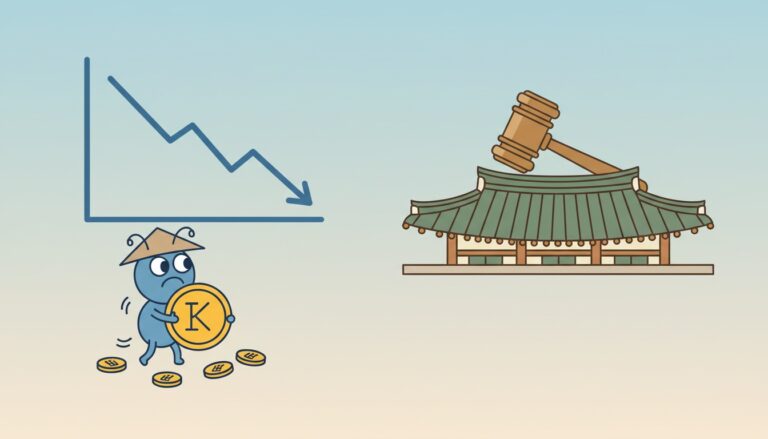
Phase 1: The Immersive Hook
Greeting: 안녕하세요! Welcome back to Daily Hangul. I’m your editor, your bridge between textbook Korean and the pulsating streets of Seoul.
K-Culture Cold Open: Picture this: You are in a bustling gogi-jip (BBQ restaurant) in Yeouido, the Wall Street of Seoul. The air is thick with smoke and the smell of samgyeopsal. But the heated conversation at the next table isn’t about K-Pop or romance. It’s about Bitcoin, Ethereum, and the National Assembly.
A young office worker slams his soju glass down and shouts, “소득 있는 곳에 세금 있다지만, 이건 너무하잖아!” (They say where there is income, there is tax, but this is too much!). His colleague sighs, “또 유예될까?” (Will it be deferred again?).
If you think Korean is just about saying “I love you” or ordering bibimbap, you’re missing the real drama. Today, we dive into the fierce debate over Virtual Asset Taxation (가상 자산 과세). This isn’t just economics; it’s a window into the generational conflict and the ‘ladder of wealth’ in modern Korea.
The ‘Why’: Understanding this topic moves you from a “foreigner” to an “intellectual peer.” You’ll be able to discuss the headlines that dominate Naver News and understand why Korean Millennials and Gen Z (the “MZ Generation”) are so passionate about crypto.
Phase 2: Deep Dive into Core Expressions
1. 조세 정의 (Jo-se jeong-ui)
- Pronunciation: [Jo-se jeong-ui] (Sounds like ‘Jo-say jung-we’)
- Meaning: Tax Justice / Tax Equity
- K-Culture Moment: You’ll hear this in serious news debates or political K-Dramas like Chief of Staff (보좌관). It’s the moral shield politicians use to justify new taxes.
- Editor’s Insight: This isn’t just a legal term. It carries a heavy emotional weight regarding fairness. In Korea, where real estate speculation has created a wealth gap, tax justice is a trigger word.
- Situation Spectrum:
[🚫 Casual Friends] ———— [⚠️ Colleagues] ———— [✅ Formal/Debate] - 🤔 Think About It: Why is “justice” emphasized in taxation? In Korea, it reflects a deep societal desire to level the playing field against chaebols and the wealthy elite.
2. 유예 (Yu-ye)
- Pronunciation: [Yu-ye] (Sounds like ‘You-yay’)
- Meaning: Deferral / Postponement / Grace Period
- K-Culture Moment: Every year before the budget season, news anchors repeat this word. “Will the tax be implemented or deferred (유예)?”
- Editor’s Insight: Yu-ye implies a temporary relief, but often suggests “we are afraid of the voters.” It’s a political football. You can also use it in legal contexts (prison sentence deferral).
- Situation Spectrum:
[🚫 Kids] ———— [⚠️ Daily Chat] ———— [✅ News/Business] - 🤔 Think About It: Korea has a history of rapid policy changes. How does the frequent use of “유예” affect trust in the government?
3. 소득 있는 곳에 세금 있다 (Sodeuk inneun gose segeum itda)
- Pronunciation: [Sodeuk inneun gose segeum itda]
- Meaning: “Where there is income, there is tax.”
- K-Culture Moment: The golden rule cited by bureaucrats. It’s the ultimate counter-argument to any investor complaining about taxes.
- Editor’s Insight: This is an idiom-like principle. Use this, and Koreans will look at you with shock. “How do you know that phrase?”
- Situation Spectrum:
[🚫 Flirting] ———— [⚠️ Drinking Complaint] ———— [✅ Academic/Serious]
Phase 3: Textbook vs. Real Life
| Situation | 📖 Textbook Korean | 🗣️ Real Korean (Insider) | 💡 Why the difference? |
|---|---|---|---|
| Discussing loss | 세금을 많이 냈어요. (I paid a lot of taxes.) | 세금 폭탄 맞았어요. (I got hit by a tax bomb.) | Koreans love dramatic metaphors. ‘Bomb’ implies sudden, devastating impact. |
| Complaining about policy | 정부가 말을 바꿨어요. (The government changed its words.) | 또 말장난하네. (They are playing with words again.) | Reflects cynicism towards political flip-flopping. |
| Losing money due to tax | 수익이 줄어들었어요. (My profit decreased.) | 남 좋은 일만 시켰네. (I only did good work for others.) | Emphasizes the futility of effort when the government takes the profit. |
Phase 4: Cultural Deep Dive — The ‘Ladder’ Desperation
4-1. The “Kimchi Premium” & Desperation
Why is the tax debate so hot? Connect this to the “Hell Joseon” discourse. For many young Koreans, crypto is the only ladder left to escape wage stagnation, as real estate prices are unreachable. Taxing crypto feels like “kicking away the ladder” (사다리 걷어차기).
4-2. Nunchi (눈치) in Politics
The “deferral” (유예) is pure political nunchi. With elections coming up, politicians are terrified of angering the “2030 generation” (investors in their 20s and 30s). If you understand this, you understand why the policy keeps changing. It’s not just economics; it’s a vote-counting game.
Phase 5: Immersive Roleplay Scenario
Setting: A sleek whiskey bar in Gangnam. You are talking to Min-su (34, a crypto enthusiast who manages a serious portfolio).
Dialogue:
Min-su: 하… 내년부터 가상 자산 과세 진짜 시행한대? 이러면 누가 한국 거래소 쓰냐?
(Ha… Are they really implementing the virtual asset tax next year? Who would use Korean exchanges then?)
YOU: 글쎄요. 여당이랑 야당이 아직 합의를 못 본 것 같던데요.
(Well, it seems the ruling and opposition parties haven’t reached an agreement yet.)
Min-su: 조세 정의도 좋지만, 투자자 보호부터 해야 하는 거 아니야? 미국은 비트코인 ETF도 승인해 주는데!
(Tax justice is good, but shouldn’t they protect investors first? The US even approved Bitcoin ETFs!)
🔀 Decision Point! How do you respond?
- A) “맞아요. 소득 있는 곳에 세금 있다지만, 시기가 좀 이른 감이 있죠.”
(Right. They say where there is income there is tax, but it feels a bit premature.) - B) “세금 내기 싫으신가 봐요? 하하.”
(Guess you don’t want to pay taxes? Haha.) - C) “유예될 가능성이 높으니까 좀 더 기다려 보시죠.”
(It’s highly likely to be deferred, so let’s wait and see.)
✅ Best Choice: A — This shows deep empathy and C2-level command of the idiom. It acknowledges both the principle and the reality.
⚠️ Choice B Analysis: Too direct. In Korean culture, discussing money loss requires empathy, not teasing.
Phase 6: 10-Second Shadowing Drill
Emotion: 😤 Frustrated but logical (Imagine debating a policymaker)
Sentence:
투자자 보호는 / 뒷전이고 / 세금만 걷겠다는 건 / 어불성설이죠!
(Tujaja boho-neun / dwitjeon-igo / segeum-man geot-get-daneun geon / eobulseongseol-ijyo!)
- Meaning: Trying to collect taxes / while putting investor protection / on the back burner / is logically absurd!
- Note: Eobulseongseol (어불성설) is a high-level idiom meaning “it doesn’t hold water” or “illogical.”
Phase 7: K-Culture Mini Glossary
| Korean | Romanization | English | Context |
|---|---|---|---|
| 개미 | Gaemi | Ant (Retail Investor) | Individual investors. We are small but mighty when we swarm! |
| 김치 프리미엄 | Kimchi Premium | Kimchi Premium | The phenomenon where crypto trades at a higher price in Korea due to high demand and capital controls. |
| 존버 | Jon-beo | HODL | Slang for “holding on for dear life” (존나 버티기). |
| 떡상 / 떡락 | Tteok-sang / Tteok-rak | Skyrocket / Crash | Essential slang for any market talk. |
| 동학개미 | Donghak Gaemi | Donghak Ants | Refers to the movement of domestic investors buying Korean stocks (historical reference to Donghak Peasant Revolution). |
Phase 8: Business Traveler’s Survival Kit
Since this is a heavy topic, let’s focus on Business/News Literacy for the advanced traveler.
📰 Survival Headlines #1
* 🇰🇷 “여야, 가상자산 과세 2년 유예 합의”
* (Ruling and opposition parties agree to defer virtual asset tax for 2 years.)
* 💡 Pro Tip: Look for words like 합의 (Agreement), 결렬 (Breakdown), 시행 (Implementation).📌 Editor’s Note
If a taxi driver starts talking about politics or the economy (which they often do!), just nod and say: “경기가 좀 풀려야 할 텐데요.” (I hope the economy gets better.) It’s the universal peace-keeping sentence.
Phase 9: Think Deeper — “Fairness” in Korea
Tax Justice vs. The Wealth Gap
Why does the younger generation resist crypto tax so fiercely? It’s not just greed. It’s about fairness relative to opportunity. The older generation built wealth through a real estate boom that is now inaccessible to the youth. To the MZ generation, crypto is their only shot. When the government tries to tax this “last hope” without providing safety nets, it’s perceived not as “justice,” but as “suppression.”
🧠 Think Deeper: In your country, is there a generational divide regarding investment assets? Do young people feel the economic system is rigged against them?
Phase 10: FAQ & Troubleshooting
- Q: Can I discuss my crypto portfolio with Korean colleagues?
- Maybe. It’s very common among peers (same rank), but avoid discussing specific amounts with superiors. It can be seen as focusing on side hustles rather than work.
- Q: Is “개미” (Ant) offensive?
- No. It’s a widely accepted term used in news and by investors themselves. It implies diligence and being the underdog.
- ❌ Common Mistake: Using simple words like “돈” (money) in formal debates.
- ✅ Upgrade: Use 자금 (funds), 자산 (assets), or 수익 (profit) to sound like a C2 learner.
Phase 11: Wrap-up & Action Items
One-Liner Summary: Today we learned how to debate Tax Justice (조세 정의) and the politics of Deferral (유예), giving you the vocabulary to understand Korea’s economic generation gap.
Your Mission:
* 🥉 Bronze: Say “소득 있는 곳에 세금 있다” out loud three times with authority.
* 🥈 Silver: Go to Naver News (Economy section) and find a headline containing “과세” (Taxation) or “코인” (Coin).
* 🥇 Gold: Ask a Korean friend: “한국에서는 비트코인 세금 문제 어떻게 됐어?” (What happened with the Bitcoin tax issue in Korea?) and listen to their rant!
K-Culture Mission: Search for the drama clip “Reborn Rich (재벌집 막내아들)” on YouTube and watch how the characters treat money and investment. It captures the essence of the Korean desire for financial ascent.
Phase 12: Interactive Quiz
- Situational Judgment: You are watching the news. The anchor says the tax law is “유예” (deferred). What does this mean for investors?
- A) They have to pay double tax immediately.
- B) The tax collection is postponed to a later date.
- C) The tax is cancelled forever.
- (Answer: B)
- Fill in the Blank: “Wait, the market is crashing! It’s a total ________!”
- A) 떡상 (Skyrocket)
- B) 떡락 (Crash)
- (Answer: B)
- True or False: In Korea, “Tax Justice” (조세 정의) is a term only used by lawyers and is never heard in daily life.
- (Answer: False. It is a common political buzzword discussed by the public.)
💬 Your Turn: Does your country tax crypto gains heavily? Share your local “Tax Justice” situation in the comments!
Frequently Asked Questions (FAQ)
Q: What does "조세 정의 (Jo-se jeong-ui)" mean in Korean and how do you pronounce it?
A: In Korean, "조세 정의 (Jo-se jeong-ui)" is pronounced [Jo-se jeong-ui] and means: Tax Justice / Tax Equity
Q: What does "유예 (Yu-ye)" mean in Korean and how do you pronounce it?
A: In Korean, "유예 (Yu-ye)" is pronounced [Yu-ye] and means: Deferral / Postponement / Grace Period
Q: What does "소득 있는 곳에 세금 있다 (Sodeuk inneun gose segeum itda)" mean in Korean and how do you pronounce it?
A: In Korean, "소득 있는 곳에 세금 있다 (Sodeuk inneun gose segeum itda)" is pronounced [Sodeuk inneun gose segeum itda] and means: "Where there is income, there is tax."







