

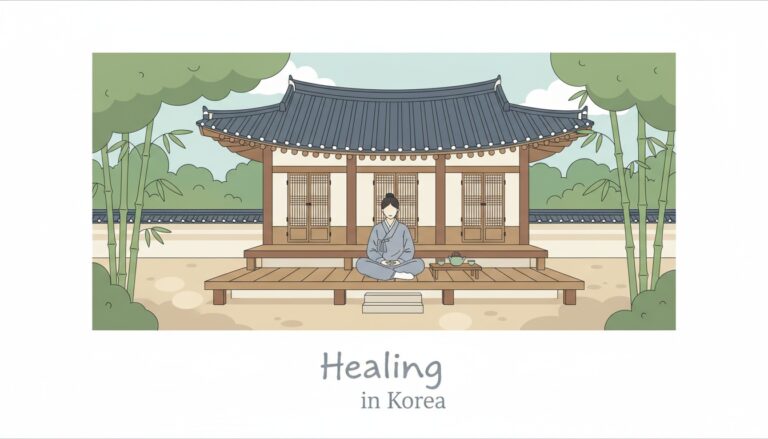
Phase 1: The ‘Healing’ Craze in a Fast-Paced Nation 🧘♀️
Hello! This is your Daily Hangul Senior Editor.
Imagine this: You’ve been watching a K-Variety show like Hyori’s Homestay (효리네 민박). Lee Hyori starts her morning with slow, deep breaths and complex yoga poses while the Jeju wind blows gently. It looks peaceful, right? But then, cut to a scene of a frantic Seoul office worker shouting, “Ah! I need healing!” (아! 힐링이 필요해!)
In Korea, the land of “Pali-Pali” (Hurry, Hurry), the concept of “Healing” (힐링) isn’t just a luxury; it’s a survival mechanism. From one-day yoga classes in Gangnam to weekend Temple Stays in the mountains, Koreans are obsessed with finding inner peace amidst the chaos.
If you walk into a yoga studio in Seoul or try a Temple Stay without knowing the language, you might feel more stressed than relaxed when the instructor says something that sounds like “Empty your mind,” and you’re just wondering where to put your shoes.
Today, let’s learn how to find your zen in Korean. Breathe in, breathe out. Let’s start.
Phase 2: Deep Dive into Core Expressions 🧠
1. 마음을 비우다 [maeum-eul biuda]
- Pronunciation: Ma-eum-eul bi-u-da (Sounds like “My-eum-eul bee-woo-da”)
- Meaning: To empty one’s mind / To let go of greed or thoughts.
- K-Culture Moment: You’ll hear this constantly in Temple Stay programs or K-Dramas where a character goes to the mountains after a breakup. A monk might hand them tea and say, “Make sure to empty your mind.”
- Editor’s Insight: Biuda (비우다) literally means to empty a container. Here, your ‘heart/mind’ is the container. It’s not just about relaxing; it’s about actively removing negative thoughts or obsession.
- Situation Spectrum:
[🚫 Formal Boss] ———— [✅ Yoga Class/Friends] ———— [✅ Self-talk] - 🤔 Think About It: Why do Koreans prioritize “emptying” the mind rather than just “relaxing” the body? It relates to the Buddhist concept of non-attachment which is deeply rooted in the culture.
2. 찌뿌둥하다 [jjippudunghada]
- Pronunciation: Jji-ppu-dung-ha-da (Imagine a heavy, grumpy sound—it sounds exactly like how your body feels!)
- Meaning: To feel heavy, stiff, or lethargic (physically).
- K-Culture Moment: The universal Monday morning phrase. Or, after a long flight to Incheon, you stretch your arms and say this. It’s the perfect cue to suggest going to a sauna (Jjimjilbang) or yoga.
- Editor’s Insight: This is a B2-level gem. Beginners say “I am tired” (피곤해요). But if you say “몸이 찌뿌둥해요,” Koreans will instantly nod and say, “Aigo, you need a massage.”
- Situation Spectrum:
[⚠️ Boss (Use caution)] ———— [✅ Colleagues] ———— [✅ Friends]
3. 동작을 유지하세요 [dongjag-eul yujihaseyo]
- Pronunciation: Dong-jag-eul yu-ji-ha-se-yo
- Meaning: Please maintain/hold the pose.
- K-Culture Moment: The moment of truth in a yoga or Pilates class. The instructor says this with a smile, but you are shaking and sweating!
- Editor’s Insight: Yuji (유지) means maintenance or keeping. You’ll see this word on skincare products (moisture maintenance) too!
- 🤔 Think About It: Korean instructions often use the polite formal ending
-(u)seyoeven when you are sweating and suffering. It shows the professional distance between instructor and student.
Phase 3: Textbook vs. Real Life 🗣️
| Situation | 📖 Textbook Korean | 🗣️ Real Korean (Insa Style) | 💡 Why the difference? |
|---|---|---|---|
| Staring into space | 아무 생각 안 하고 있어요. (I’m not thinking about anything.) | 멍 때리고 있어요. (I’m hitting ‘Mung’ / spacing out.) | “Mung” (멍) is a slang phenomenon. We even have “Fire Mung” (staring at fire) and “Water Mung” (staring at water). |
| I want to relax | 쉬고 싶어요. (I want to rest.) | 힐링이 필요해. (I need healing.) | “Resting” is passive. “Healing” implies an active pursuit of mental recovery, often through spending money or going somewhere. |
| My muscles are tight | 근육이 뭉쳤어요. (My muscles are knotted.) | 어깨에 곰 세 마리가 앉아 있어. (Three bears are sitting on my shoulders.) | A colorful idiom! It emphasizes the heaviness of stress. |
💡 Editor’s Note: “멍 때리다” (Mung-tdaerida) is super common. Seoul actually hosts an annual “Space-out Competition” (멍 때리기 대회) at the Han River!
Phase 4: Cultural Deep Dive — The ‘Healing’ Industry 🧘♂️
4-1. The Art of “No Nunchi” (눈치 보지 마세요)
In a yoga class or meditation center, the instructor might say “눈치 보지 말고 호흡하세요” (Breathe without worrying about others). Korean society is driven by Nunchi (reading the room), which is stressful. These spaces are designated “Nunchi-free zones” where you are encouraged not to care what the person on the next mat thinks of your wobble.
4-2. K-Travel Connection: Temple Stay (템플스테이)
If you want the ultimate “Mind Control” experience, booking a Temple Stay is a must.
* The 108 Bows (108배): This isn’t just exercise; it’s a moving meditation. You might hear the monk say “나를 낮추는 시간” (Time to lower myself/humble myself).
* Tea Ceremony (다도): You don’t just drink tea; you meditate on the aroma.
* Uniform: You will wear comfortable temple clothes. It’s the great equalizer—CEO or student, everyone looks the same.
Phase 5: Immersive Roleplay — Yoga Class in Seoul 🧘
Setting: A boutique Yoga studio in Seongsu-dong (the Brooklyn of Seoul). Soft indie music is playing. You are the only foreigner in a small group class.
Characters:
* YOU: An intermediate learner trying to destress after work.
* Teacher Kim: A fit, soft-spoken, but strict yoga instructor.
(Dialogue)
Teacher Kim: 자, 매트 위에 편하게 앉으세요. 척추를 곧게 펴볼까요?
(Ja, maeteu wie pyeonhage anjeuseyo. Cheokchureul gotge pyeobolkkayo?)
(Okay, sit comfortably on the mat. Shall we straighten our spines?)
YOU: (Straightening back) 이렇게요? 몸이 좀 찌뿌둥해서 잘 안 돼요.
(Ireokeyo? Momi jom jjippudunghaeseo jal an doeyo.)
(Like this? My body is a bit stiff/heavy, so it’s not working well.)
Teacher Kim: 괜찮아요. 무리하지 마세요. 숨을 깊게 들이마시고… 내쉬세요.
(Gwaenchannayo. Murihaji maseyo. Sumeul gipge deurimasigo… naeshiseyo.)
(It’s okay. Don’t overdo it. Inhale deeply… and exhale.)
YOU: (Exhaling loudly) 후…
(Hoo…)
Teacher Kim: 자, 이제 한 발로 서 볼게요. 집중하세요! 흔들려도 괜찮아요.
(Ja, ije han ballo seo bolkeyo. Jipjunghaseyo! Heundeullyeodo gwaenchannayo.)
(Now, let’s try standing on one foot. Focus! It’s okay if you wobble.)
YOU: (Wobbling) 어어… 중심 잡기가 어려워요!
(Eo-eo… jungsim japgiga eoryeowoyo!)
(Uh oh… It’s hard to find my balance/center!)
🔀 Decision Point: The teacher pushes you to hold the pose longer. What do you say?
- A) “못 하겠어요!” (I can’t do it!) – Standard refusal.
- B) “도전해 볼게요!” (I will try/challenge myself!) – Positive attitude.
- C) “살려주세요!” (Please save me!) – Funny, exaggerated distress.
✅ Best Choice: B or C. ‘B’ is great for showing determination. ‘C’ is a classic K-Drama/Variety show reaction that will make the whole class laugh and break the ice. Koreans love this kind of humor in tough physical situations.
Phase 6: 10-Second Shadowing Drill 🗣️
Let’s practice the most soothing (and useful) phrase you’ll hear and say.
Format: Korean / Pronunciation / Emotion
🧘♀️ Sentence:
복잡한 생각은 / 다 / 내려놓으세요.
(Bokjapan saenggageun / da / naeryeonoeuseyo.)
“Put down / all / your complicated thoughts.”
- Instructions:
- 복잡한 생각은 (Pause slightly – visualize your stress)
/ - 다 (Stress this word – means ‘all’)
/ - 내려놓으세요 (Say it softly, like breathing out
🌬️)
- 복잡한 생각은 (Pause slightly – visualize your stress)
- Emotion: 😌 Calm, soothing, and reassuring.
Phase 7: K-Culture Mini Glossary 📓
| Korean | Romanization | English | Context |
|---|---|---|---|
| 단전 | Danjeon | Energy Center | Often used in meditation: “Focus on your Danjeon” (lower abdomen). |
| 108배 | Baekpal-bae | 108 Bows | A traditional Buddhist practice of bowing 108 times to clear the mind. |
| 나를 찾다 | Nareul chatda | To find myself | The goal of many travelers coming to Korea for healing. |
| 일일 체험 | Iril cheheom | One-day Class | Very popular for tourists (Yoga, Pottery, Cooking). |
| 마음의 평화 | Maeum-ui pyeonghwa | Inner Peace | Often used jokingly: “I need my inner peace.” |
Phase 8: Traveler’s Survival Kit 🎒
Scenario: You want to book a Yoga or Meditation class in Seoul.
🆘 Survival Expression #1
* 🇰🇷 “초보자도 할 수 있나요?” (Chobojado hal su innayo?)
* 🗣️ Meaning: Can a beginner do this?
* 📍 Where: Yoga studios, Pottery classes, Temple Stay inquiries.🆘 Survival Expression #2
* 🇰🇷 “예약 없이 가도 돼요?” (Yeyak eopsi gado doeyo?)
* 🗣️ Meaning: Can I go without a reservation?
* 💡 Pro Tip: Most popular places require booking via Naver or Instagram DM. Walking in is risky!📌 Editor’s Travel Note
* Booking Apps: If you can’t read Korean well, look for experiences on Airbnb Experiences or Klook first. Local studios often use Naver Booking, which requires a Korean number.
* Attire: Koreans dress stylishly even for exercise (Xexymix, Andar are popular local brands). But for Temple Stays, they provide the uniform!
Phase 9: Think Deeper — “Healing” as a Commodity 💭
Why is “Healing” everywhere in Korea?
In many Western cultures, relaxing is simply doing nothing. In Korea, “Healing” is often an activity you do or buy. You go to a healing cafe, buy healing books, or take a healing trip. This reflects the intense competitive nature of modern Korean society (Hell-Joseon discourse). Ironically, people feel they must be productive even when relaxing.
🧠 Think Deeper:
Does your culture have a specific word for “active relaxing”? Is resting considered productive or lazy in your country?
Phase 10: FAQ & Troubleshooting 🛠️
Q: Can I wear leggings on the street in Korea?
* Answer: Yes, but… It’s becoming much more common (Thanks to the “Athleisure” trend), especially in areas like Gangnam or Han River parks. However, in more conservative areas or for older generations, leggings as pants can still be seen as “underwear.” If you are going to a Temple Stay, absolutely not. Loose, modest clothing is required.
Q: Is Temple Stay religious? Do I have to be Buddhist?
* Answer: No! It is a cultural experience. You don’t have to pray if you don’t want to. It’s about mindfulness.
❌ Common Mistake #1:
* Thinking “요가” (Yoga) is just stretching. In Korea, it’s often a strict discipline class.
* ✅ Fix: If you want gentle stretching, look for “힐링 요가” (Healing Yoga) or “테라피 요가” (Therapy Yoga) specifically.
Phase 11: Wrap-up & Action Mission 🎬
One-Liner Summary: Use “마음을 비우다” when meditating and “찌뿌둥하다” when your body feels heavy to sound like a native!
🔥 Your Action Missions:
* 🥉 Bronze: Sit in a chair, close your eyes, and whisper “복잡한 생각은 다 내려놓자” to yourself.
* 🥈 Silver: Go to a park or quiet space and practice “Mung-hit” (Spacing out) for 5 minutes. Post a photo with the hashtag #멍때리기 #Healing.
* 🥇 Gold: Search for “Temple Stay Korea” and find a temple you want to visit. Write down its name and location!
💬 Comments: What is your favorite way to “Empty your mind”? Tell us below!
Phase 12: Quiz — Interactive Challenge 🧩
1. Situation Judgment:
Your yoga teacher tells you to hold a difficult pose. You are shaking. What is the funniest and most natural way to express distress to make the class laugh?
* A) 선생님, 저는 이것을 할 수 없습니다. (Too robotic)
* B) 살려주세요! (Save me!)
* C) 안녕히 계세요. (Goodbye – implies you are leaving/dying)
2. True or False (K-Culture):
In a Temple Stay, you must wear your own expensive yoga clothes to show respect.
* (True / False)
3. Fill in the blank:
“My body feels so heavy and stiff today…”
= “오늘 몸이 너무 ______.”
(Answers)
1. B or C (Both are funny!), 2. False (Temples provide comfortable, modest uniforms), 3. 찌뿌둥해 (Jjippudunghae)
Frequently Asked Questions (FAQ)
Q: What does "마음을 비우다 [maeum-eul biuda]" mean in Korean and how do you pronounce it?
A: In Korean, "마음을 비우다 [maeum-eul biuda]" is pronounced [Ma-eum-eul bi-u-da (Sounds like "My-eum-eul bee-woo-da"] and means: To empty one's mind / To let go of greed or thoughts.
Q: What does "찌뿌둥하다 [jjippudunghada]" mean in Korean and how do you pronounce it?
A: In Korean, "찌뿌둥하다 [jjippudunghada]" is pronounced [Jji-ppu-dung-ha-da (Imagine a heavy, grumpy sound—it sounds exactly like how your body feels!] and means: To feel heavy, stiff, or lethargic (physically).
Q: What does "동작을 유지하세요 [dongjag-eul yujihaseyo]" mean in Korean and how do you pronounce it?
A: In Korean, "동작을 유지하세요 [dongjag-eul yujihaseyo]" is pronounced [Dong-jag-eul yu-ji-ha-se-yo] and means: Please maintain/hold the pose.







