

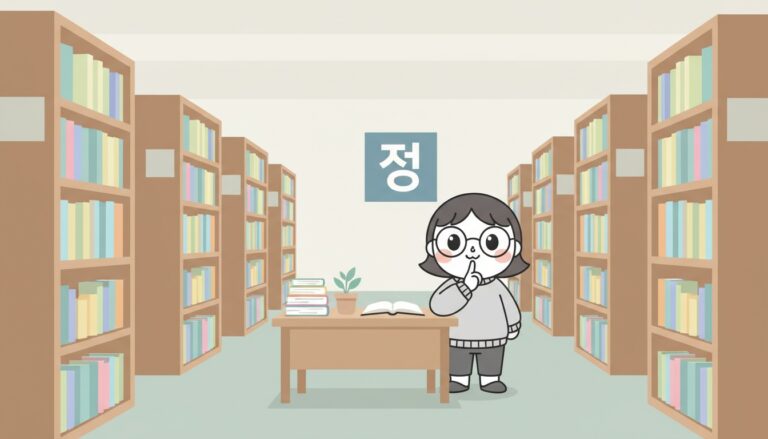
Phase 1: The Sound of Silence 🤫
Greeting: Hello, Daily Hangul family! It’s your editor here.
Picture this: You are watching a K-Drama set in high school. The main character enters a room filled with rows of desks. The atmosphere is intense. Students are hunched over books, holding iced americanos like lifelines. The silence is so heavy you can hear a pin drop. Then, the protagonist’s phone rings—RING!!!—and suddenly, twenty heads turn around with laser-like glares. 😨
Welcome to the world of Korean libraries and study cafes. In Korea, silence isn’t just a lack of noise; it’s a form of respect. If you don’t understand the rules of Jeongsuk (정숙), you might unintentionally become the villain of the library. Today, we’re going to master the art of being quiet in Korean, so you never have to face those scary glares!
Phase 2: Deep Dive into Core Expressions 🧠
Here are the B1-level expressions you need to survive in Korean quiet zones.
1. 정숙 (Jeongsuk)
- Pronunciation: [Jeongsuk] + Sounds like Jeong (affection) + Sook (like ‘look’ with an S)
- Meaning: Silence / Quietness (Formal Noun)
- K-Culture Moment: You will see this written on signs in libraries, museums, and hospital corridors. It’s rarely spoken in casual conversation but is everywhere visually.
- Editor’s Insight: This isn’t just “be quiet.” It implies a dignified, proper silence. It’s the “Classy Silence.”
- Situation Spectrum:
[🚫 Casual Talk] ———— [⚠️ Warning Signs] ———— [✅ Written Rules]- 🤔 Think About It: Why does Korean use a specific Hanja word for “silence in public” (Jeongsuk) instead of just “quiet” (Joyong)? Does your language have a “formal word” for silence?
2. 떠들면 안 돼요 (Tteodeulmyeon an dwaeyo)
- Pronunciation: [Tteodeul-myeon an dwaeyo]
- Meaning: You must not chat/make noise.
- Grammar:
-(으)면 안 되다(Grammar for prohibition: “If you do X, it is not okay”)- K-Drama Context: A strict librarian or a senior student (Sunbae) might say this to juniors who are giggling in the back.
- Editor’s Insight: The verb 떠들다 (tteodeulda) specifically means “to chat noisily” or “to make a ruckus,” not just speaking. It implies your noise is disturbing others.
- Situation Spectrum:
[🚫 To Elders] ———— [⚠️ To Juniors/Friends] ———— [✅ Stating Rules]3. 진동 모드로 해 주세요 (Jindong modeu-ro hae juseyo)
- Pronunciation: [Jindong modeu-ro hae juseyo]
- Meaning: Please put it on vibration mode.
- Real Life: This is the #1 rule in cinemas, libraries, and even quiet cafes.
- 🤔 Think About It: In some cultures, answering a phone quickly is okay. In Korea, even the ringtone is considered a violation of space. Why do you think personal space is defined by sound in Korea?
Phase 3: Textbook vs. Real Life 🗣️
| Situation | 📖 Textbook Korean | 🗣️ Real Korean | 💡 Why the difference? |
|---|---|---|---|
| Seeing a noisy person | 조용히 하십시오. (Please be quiet.) | 저기요, 좀 조용히 해 주시겠어요? (Excuse me, could you be a little quiet?) | “하십시오” is too military-style. “주시겠어요?” is softer but firm. |
| Answering a phone | 전화 받지 마세요. (Do not answer the phone.) | 나가서 받으세요. (Please go outside and answer.) | Koreans prefer offering a solution (go outside) rather than just blocking the action. |
| Seeing a warning sign | 여기서는 정숙해야 합니다. (One must be quiet here.) | 여기 ‘정숙’이래. (It says ‘Jeongsuk’ here.) | In speech, we quote the sign using -이래 (short for -이라고 해). |
💡 Bottom Note: In a real library, people rarely speak even to correct you. They might stick a Post-it note on your desk saying “조용히 좀… (Quiet please…)” instead! This is passive-aggressive but very common.
Phase 4: Cultural Deep Dive — The “Nunchi” of Silence 🤫
4-1. Non-verbal Communication: The “X” Arms
If a librarian or staff member makes an “X” with their arms or fingers over their lips, stop immediately. Also, in Korea, eye contact during a scolding is tricky. If someone scolds you for noise, look down slightly to show you are reflecting on your mistake. Staring back can look defiant.
4-2. K-Culture Connection: The Rise of “Study Cafes” (Seo-ka)
In K-Dramas like Sky Castle or Reply 1988, you see intense study rooms (Dokseo-sil). Modern Korea has upgraded this to Study Cafes (스터디 카페).
– Unlike regular Starbucks where some noise is okay, Study Cafes are strict “Jeongsuk” zones.
– You pay for time. There is free coffee, but no talking.
– K-Food/Drink Context: The fuel for this silence is usually an “Ah-Ah” (Iced Americano). If you slurp your drink too loudly, that’s also “Jeongsuk” violation!
Phase 5: Immersive Roleplay 🎭
Setting: A modern Study Cafe in Gangnam. It’s finals week. The air is tense. You (the foreigner) accidentally clicked a video on your phone, and the sound blasted out for 2 seconds.
Characters:
– YOU: A student trying to study Korean.
– Su-jin: A university student sitting next to you. She looks stressed.
(Dialogue Start)
YOU: (Internal monologue) Oops! I forgot to connect my earphones! 😱
Su-jin: (Writes a note and slides it to you) 저기요, 소리 좀 줄여 주실래요? 📝
(Romanization: Jeogiyo, sori jom julyeo jusillaeyo?)
(Translation: Excuse me, would you mind turning down the volume?)
YOU: (Whispering) 아, 죄송합니다. 깜빡했어요.
(Romanization: Ah, joesonghamnida. Kkamppakhaesseoyo.)
(Translation: Ah, I’m sorry. I forgot [it was on].)
Su-jin: 여기서는 이어폰 껴야 돼요. 다들 공부하잖아요.
(Romanization: Yeogiseoneun ieopon kkyeoya dwaeyo. Dadeul gongbuhajanayo.)
(Translation: You have to wear earphones here. Everyone is studying, you know.)
🔀 Decision Point: How do you respond?
- Option A: “알겠어요.” (Okay.) — and put earphones in.
- Option B: “네, 정말 죄송합니다. 주의할게요.” (Yes, I’m really sorry. I’ll be careful.)
- Option C: Say nothing, just nod and smile.
✅ Best Choice: B — Why? Option A is grammatically correct but feels a bit cold/defensive. Option B shows you acknowledge the mistake and respect the group atmosphere (Nunchi). Option C is okay, but a verbal apology is better here.
Phase 6: 10-Second Shadowing Drill 🗣️
Practice these sentences to get the rhythm right. Focus on the pauses!
- (Apologetic 😓) 죄송합니다 / 진동으로 / 바꿀게요.
(Joesonghamnida / jindong-euro / bakkulgeyo.)
“I’m sorry. I’ll change it to vibration mode.” -
(Firm Rule 😐) 도서관에서는 / 떠들면 / 안 돼요.
(Doseogwan-eseoneun / tteodeulmyeon / an dwaeyo.)
“You must not chat in the library.” -
(Polite Request 🙏) 좀 / 조용히 / 해 주시겠어요?
(Jom / joyonghi / hae jusigesseoyo?)
“Could you please be a little quiet?”
Phase 7: K-Culture Mini Glossary 📚
| Korean | Romanization | Meaning | Context |
|---|---|---|---|
| 독서실 | Dokseo-sil | Reading Room | The traditional, cubicle-style study room seen in older dramas. Very quiet. |
| 스터디 카페 (스카) | Seuteodi-kape (Seu-ka) | Study Cafe | The modern, premium version. Paid entry, silence mandatory. |
| 눈치 | Nunchi | Social Sense | The art of sensing the vibe. If everyone is quiet, use your nunchi! |
| 매너 모드 | Maeneo-modeu | Manner Mode | Silent/Vibration mode on a phone. |
Phase 8: Traveler’s Survival Kit 🎒
Even if you aren’t studying, you will visit museums or ride the subway. Silence is golden there too.
🆘 Survival Card: The “Quiet Zone”
– Sign to look for: 정숙 (Silence) or 통화 금지 (No Phone Calls)
– Where: Subways (specific seats), Buses, Museums, Libraries.
– Spoken Phrase: If someone is too loud near you on the bus, you can gently say: “쉿!” (Shh!) while putting a finger to your lips. It’s universal!💡 Editor’s Pro Tip: On the Korean subway (Metro), the seats at the ends of the car (often for elderly/pregnant) are strictly quiet zones. Even if you are with a friend, whispering is expected there.
Phase 9: Think Deeper — “One Step Further” 🧠
🧠 Topic: Collectivism vs. Noise
In many Western cultures, public space is seen as a place where individuals have the freedom to speak, as long as they aren’t screaming. In Korea, public space (especially enclosed ones like libraries or transits) is often viewed as a “shared collective stillness.”Breaking the silence is sometimes felt as “stealing” the peace of others. This is why the reaction to noise can seem unusually strict to foreigners. It’s not just about noise; it’s about disrespecting the group’s effort to focus.
💬 Your Turn: In your country, would someone scold a stranger for talking on the phone in a cafe? Or is that considered rude to interfere? Let me know in the comments!
Phase 10: FAQ & Troubleshooting 🛠️
Q: Can I really not talk AT ALL in a Study Cafe?
A: Yes, usually. If you need to discuss a project, you must go to a specific “Study Room” (meeting room) or the “Laptop Zone” where typing noise is allowed. In the main focus zone, even whispering is discouraged.
Q: Is it rude to blow my nose in a quiet library?
A: Surprisingly, yes! 🤧 Constant sniffing or loud blowing is considered very distracting. It’s better to step out to the restroom to blow your nose properly.
❌ Common Mistake: Answering a phone call with “I’m in the library” and continuing to talk in a whisper.
✅ Fix: Reject the call immediately and text back: “지금 도서관이야. 나중에 전화할게.” (I’m in the library now. I’ll call you later.)
Phase 11: Wrap-up & Mission 🚀
Summary: Today we learned that Jeongsuk (정숙) is the golden rule of Korean libraries, and using grammar like -(으)면 안 돼요 helps us understand rules.
🌟 Your 3-Step Mission:
– 🥉 Bronze: Practice saying “떠들면 안 돼요” five times while making a stern face in the mirror.
– 🥈 Silver: Watch a “Study with Me” video by a Korean YouTuber and see if they make any noise.
– 🥇 Gold: Go to a local library or quiet cafe. Turn your phone to Manner Mode and study Korean for 30 minutes in perfect silence!
K-Culture Mission: Next time you watch a K-Drama, look for a scene where students are studying. Are they drinking Iced Americano? Is it deadly quiet? Spot the “Jeongsuk” vibe!
See you next time! 안녕히 계세요! 👋
Frequently Asked Questions (FAQ)
Q: What does "정숙 (Jeongsuk)" mean in Korean and how do you pronounce it?
A: In Korean, "정숙 (Jeongsuk)" is pronounced [Jeongsuk] and means: Silence / Quietness (Formal Noun)
Q: What does "떠들면 안 돼요 (Tteodeulmyeon an dwaeyo)" mean in Korean and how do you pronounce it?
A: In Korean, "떠들면 안 돼요 (Tteodeulmyeon an dwaeyo)" is pronounced [Tteodeul-myeon an dwaeyo] and means: You must not chat/make noise.
Q: What does "진동 모드로 해 주세요 (Jindong modeu-ro hae juseyo)" mean in Korean and how do you pronounce it?
A: In Korean, "진동 모드로 해 주세요 (Jindong modeu-ro hae juseyo)" is pronounced [Jindong modeu-ro hae juseyo] and means: Please put it on vibration mode.







