

Phase 1: The ‘Fine Dust’ Reality Check
Hello! I’m your editor at Daily Hangul.
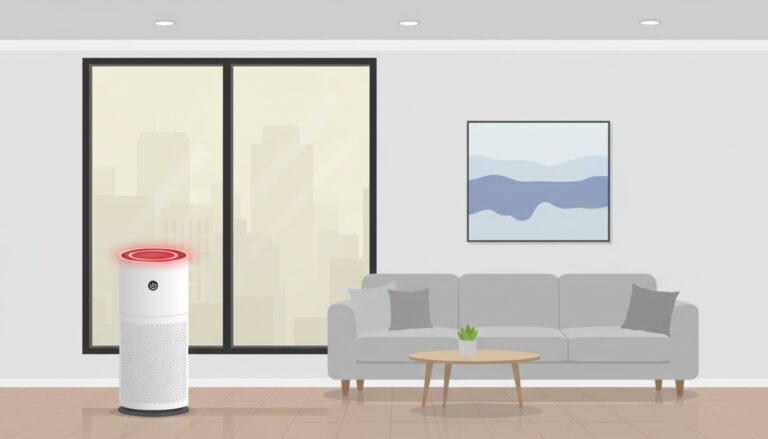
Imagine this: You wake up in Seoul, ready to start your Sunday with some fresh air and cleaning. You walk to the window, pull back the curtains, and… stop. The sky isn’t blue. It’s a hazy, yellowish-gray.
Your phone buzzes. It’s not a text from a friend. It’s an emergency alert: “Meese-munji (Fine Dust) Warning.”
In most textbooks, ‘dusting’ is just a chore. In Korea, it’s a strategic battle against the environment. If you just open the window to ‘let fresh air in’ without checking the app first, your Korean friends might look at you like you’re crazy. Today, we aren’t just learning how to say “clean the dust.” We are learning how to survive the Korean cleaning culture.
Phase 2: Deep Dive into ‘Dusting’
1. 먼지를 털다 (meonji-reul teolda)
- Pronunciation: [meon-ji-reul teol-da] (Sounds like ‘Mon-jee’ + ‘toll-da’)
- Meaning: To dust / To shake off dust
- The Vibe: The verb 털다 (teolda) is physical. You aren’t just wiping gently; you are shaking it off. Think of shaking a rug outside or shaking snow off your coat.
- K-Culture Moment: You see this in variety shows when someone falls in a mud flat (getbol). They stand up and 털어 (teoreo) — shake it off. It’s also used metaphorically: “Forget the bad memories.”
- Situation Spectrum:
[🚫 Boss] ———— [⚠️ Co-worker] ———— [✅ Friends/Roommates]
(Use polite forms for seniors!) - 🤔 Think About It: In English, we ‘dust’ furniture (wiping). In Korean, we ‘shake’ dust. Why do you think the action verb is different? Is the dust ‘heavier’ in Korea?
2. 환기하다 (hwangi-hada)
- Pronunciation: [hwan-gi-ha-da]
- Meaning: To ventilate / To air out the room
- The Vibe: This is the most critical step. You cannot clean without this. But in Korea, you must check the AQI (Air Quality Index) first.
- Editor’s Insight: If you cook Samgyeopsal (pork belly) at home, your mom will yell this word instantly. “Ya! Hwangi-hae!” (Hey! Ventilate!)
- Situation Spectrum:
[🚫 Formal Speech] ———— [⚠️ Daily Life] ———— [✅ Casual]
(This is a standard verb, safe to use with politeness levels.)
3. 공기청정기 (gong-gi-cheong-jeong-gi)
- Pronunciation: [gong-gi-cheong-jeong-gi]
- Meaning: Air purifier
- The Vibe: This is not a luxury item in Korea; it is a generic household appliance like a fridge. If you enter a Korean home, you will see a machine with a light (Blue = Good, Red = Bad).
- K-Culture Moment: In K-Dramas, when a rich CEO enters his pristine office, there is always a giant, silent machine in the corner. That’s this guy.
Phase 3: Textbook vs. Real Life
| Situation | 📖 Textbook Korean | 🗣️ Real Korean | 💡 Why the difference? |
|---|---|---|---|
| Suggesting to clean | 청소를 합시다. (Cheongso-reul hapsida.) | 청소 좀 하자. (Cheongso jom haja.) | ‘Hapsida’ sounds like a military order. ‘Jom’ makes it softer. |
| Asking to open windows | 창문을 열어주세요. (Changmun-eul yeoreo-juseyo.) | 문 좀 열까? (Mun jom yeolkka?) | ‘Changmun’ is specific, but just ‘Mun’ (door/opening) is faster. |
| Seeing dust | 먼지가 많아요. (Meonji-ga manayo.) | 먼지 장난 아니다. (Meonji jangnan anida.) | ‘Jangnan anida’ (It’s no joke) is the ultimate emphasis. |
Bottom Note: Use “jangnan anida” with friends. It instantly makes you sound like a local who’s fed up with the dirty air.
Phase 4: Cultural Deep Dive — The ‘Nunchi’ of Air
4-1. The Invisible Enemy
In Western countries, checking the weather means looking for rain. In Korea, it means checking for Misemunji (Fine Dust). Before you say “Let’s open the window to dust,” use your Nunchi. If everyone is wearing masks outside and the sky looks beige, do not suggest opening the window. You will be seen as someone who doesn’t care about health.
4-2. K-Pop Connection: “Shake it Off”
You often hear 털어 (teoreo) in Hip-hop tracks. “먼지 털어” (Shake off the dust) can mean getting rid of haters, bad vibes, or past failures. It’s an aggressive, confident reset. Next time you are cleaning your room, put on a hype track and imagine you are ‘shaking off’ your stress, not just dirt.
Phase 5: Roleplay — Sunday Morning Cleaning War
Setting: A shared apartment in Seoul. Sunday, 10:00 AM. Sunlight is streaming in, but the air looks suspicious.
Characters:
– YOU: Want to clean up the messy living room.
– Minji: Your Korean roommate, currently scrolling on her phone on the sofa.
Dialogue:
YOU: (Walking to the window) 와, 날씨 좋다! 청소 좀 할까?
(Wa, nalssi joda! Cheongso jom halkka?)
(Wow, weather is good! Should we do some cleaning?)
Minji: (Without looking up) 잠깐만! 창문 열지 마.
(Jamkkanman! Changmun yeolji ma.)
(Wait! Don’t open the window.)
YOU: 왜? 환기 좀 시켜야지. 냄새 나.
(Wae? Hwangi jom sikyeoyaji. Naemsae na.)
(Why? We need to air it out. It smells.)
Minji: 오늘 미세먼지 ‘매우 나쁨’이야. 그냥 공기청정기 틀자.
(Oneul misemunji ‘maeu nappeum’iya. Geunyang gonggicheongjeonggi teulja.)
(Fine dust is ‘very bad’ today. Let’s just turn on the air purifier.)
🔀 Decision Point: Minji is worried about the dust. What do you say?
- A) “아, 진짜? 몰랐어.” (Ah, really? I didn’t know.)
- B) “괜찮아! 나는 튼튼해.” (It’s okay! I am strong.)
- C) “그럼 걸레질만 할게.” (Then I’ll just mop/wipe.)
✅ Best Choice: C. This shows you understand the situation and offer a compromise (wiping wet cloth doesn’t require shaking dust into the air).
⚠️ Choice B Analysis: Koreans take fine dust very seriously. Saying “I’m strong” might make you look reckless, not brave.
Phase 6: 10-Second Shadowing Drill
Let’s practice the most common excuse to open a window, even on a dusty day.
😤 (Determined/Frustrated) Why don’t we / ventilate / for just 5 minutes?
우리 / 딱 5분만 / 환기할까?
(Uri / ttak o-bun-man / hwangihalkka?)
Phase 7: K-Culture Mini Dictionary
| Korean | Romanization | Meaning | Context |
|---|---|---|---|
| 미세먼지 | Misemunji | Fine Dust | The generic term for bad air quality. |
| 황사 | Hwangsa | Yellow Dust | Sand storms coming from deserts in spring. Very visible. |
| 마스크 | Maseukeu | Mask | Worn for flu, fashion, no makeup, and definitely for dust. |
| 대청소 | Dae-cheongso | Big Cleaning | Usually done in Spring (Spring cleaning). |
Phase 8: Traveler’s Survival Kit — The Air App
Even if you are staying in a hotel, you need to know this.
🆘 Survival Phrase #1
– 🇰🇷 “오늘 마스크 써야 해요?” (Oneul maseukeu sseoya haeyo?)
– 🗣️ Meaning: Do I need to wear a mask today?
– 📍 Where: Asking hotel concierge or a Korean friend.📌 Editor’s Travel Note
– Download this App: ‘MiseMise’ (미세미세). It’s the most popular air quality app. The icons change from a happy blue face to a scary black gas mask face.
– Colors: Blue (Good) -> Green (Normal) -> Yellow (Bad) -> Red (Very Bad).
Phase 9: Think Deeper — Clean Room, Clean Mind?
Food & Identity:
Have you noticed how Koreans often say “Let’s clean up” metaphorically? In Korea, cleaning is often tied to moral discipline. In schools, students historically cleaned their own classrooms (including hallways and bathrooms) rather than relying solely on janitors. This instills a sense of ‘ownership’ over the space.
🧠 Think Deeper:
Does your culture view cleaning as a paid service or a personal duty? How does that change how you treat public spaces?
Phase 10: FAQ & Troubleshooting
Q: Can I use ‘털다’ (to dust) for people?
A: Be careful! “너를 털다” (dust you?) is slang for ‘robbing someone’ or ‘emptying someone’s pockets.”
– “먼지를 털다” = Cleaning.
– “지갑을 털다” = Taking everything from a wallet.
Don’t tell your friend “I will dust you” unless you are joking about taking their money!
❌ Common Mistake: Opening windows wide when the sky is yellow.
✅ Fix: Check the app. If it’s ‘Red,’ keep windows closed and run the purifier.
Phase 11: Wrap-up & Mission
One-Liner: cleaning in Korea starts with checking the Air Quality Index, not grabbing a broom.
Action Mission:
– 🥉 Bronze: Look up the current ‘Misemunji’ level in Seoul right now on Google.
– 🥈 Silver: Tell your pet or roommate: “Meonji jangnan anida!” (The dust is no joke!) while pointing at a shelf.
– 🥇 Gold: Download a Korean air quality app (like MiseMise) and see what the cute/scary icon looks like today.
💬 Your Turn: How do you deal with dust in your country? Do you use air purifiers? Let me know in the comments!
Phase 12: Quiz — Survival Mode
- Situation: Your Korean friend looks at the sky and says “Wow, Hwangsa is bad.” What should you NOT do?
- A) Wear a mask.
- B) Open all the windows to get fresh air.
- C) Turn on the air purifier.
- Vocabulary: Which word means “It’s no joke” (used for emphasis)?
- A) Hwangi
- B) Jangnan anida
- C) Teoreo
- True or False: “털다” (Teolda) only means cleaning dust and has no other meanings.
(Answers: 1-B, 2-B, 3-False – it can mean robbing!)
Frequently Asked Questions (FAQ)
Q: What does "먼지를 털다 (meonji-reul teolda)" mean in Korean and how do you pronounce it?
A: In Korean, "먼지를 털다 (meonji-reul teolda)" is pronounced [meon-ji-reul teol-da] and means: To dust / To shake off dust
Q: What does "환기하다 (hwangi-hada)" mean in Korean and how do you pronounce it?
A: In Korean, "환기하다 (hwangi-hada)" is pronounced [hwan-gi-ha-da] and means: To ventilate / To air out the room
Q: What does "공기청정기 (gong-gi-cheong-jeong-gi)" mean in Korean and how do you pronounce it?
A: In Korean, "공기청정기 (gong-gi-cheong-jeong-gi)" is pronounced [gong-gi-cheong-jeong-gi] and means: Air purifier







