

Phase 1: The “Panic at the Door” Moment
Greeting: Hello! Your Daily Hangul editor here.
K-Culture Cold Open: Picture this. You are watching a K-Drama. The main character enters a house, and before they even say hello, they do a little dance at the door—hopping on one foot, sliding out of a sneaker, and stepping onto the wooden floor without ever letting their sock touch the stone entryway. It’s like a choreographed ballet.
Now, imagine you are in Korea. You’ve been invited to a friend’s house or a traditional restaurant. You open the door. There is a pile of shoes. You freeze. Do I take mine off? Do I leave them on? What if I have a hole in my sock?
The ‘Why’: This is the single most common panic moment for foreigners in Korea. Get this wrong, and you might get a horrified look from your host (or a sweet grandma at a restaurant will aggressively point at your feet). But get it right? You instantly look like an insider who respects the culture.
Transparency: I’ve seen countless students march into a living room with muddy sneakers. It’s painful to watch. Today, we are fixing that so you never have to feel that awkward silence.
Phase 2: The Magic Words (Deep Dive)
Here are the phrases you need when you are standing in that awkward doorway zone.
1. 실례하겠습니다 (Sillyehagessseumnida)
- Pronunciation: [Sil-lye-ha-get-sum-ni-da]
Sound analogy: Sounds like “Silly-eh? Ha! Get some knee da.”- Meaning:
- Literal: I will commit a discourtesy.
- Real Nuance: “Excuse me for entering your personal space.”
- K-Culture Moment: In dramas, when a guest enters a CEO’s office or a crush’s house, they bow slightly and say this. It creates a polite boundary.
- Editor’s Insight: It feels stiff, but it’s the safest way to enter a home. You are announcing, “I am coming in, please accept my intrusion.”
- Situation Spectrum:
[🚫 Friends] ———— [⚠️ Co-workers] ———— [✅ Elders/Strangers]
(Too formal for close friends! Just say “Annyeong!” to them.)- 🤔 Think About It: Why do Koreans apologize just for entering a room? It shows how much value is placed on personal space and the “burden” of hosting someone.
2. 신발 벗어요? (Sinbal beoseoyo?)
- Pronunciation: [Sin-bal buh-suh-yo?]
Sound analogy: “Sin” + “Bal” (like ball) + “Bus” + “Oh-yo“- Meaning: “Do I take off my shoes?”
- Editor’s Insight: This is your lifesaver. If you see a weird mix of floor and carpet and you are confused—just ask this. It is better to ask than to dirty the floor.
- Situation Spectrum:
[✅ Friends] ———— [✅ Restaurants] ———— [✅ Anywhere]
Phase 3: Textbook vs. Real Life
| Situation | 📖 Textbook Korean | 🗣️ Real Korean | 💡 Why the difference? |
|---|---|---|---|
| Entering a house | 들어오세요 (Please come in) | 어서 와! (Come quick!) | Close friends drop formalities instantly to show affection. |
| Asking about shoes | 신발을 벗어야 합니까? (Must I remove shoes?) | 여기 벗어요? (Take off here?) | Efficiency. In a busy restaurant, short is sweet. |
| Unknown zone | 실례합니다 (Excuse me) | (Just eye contact + pointing at feet) | Sometimes, a panicked look at your feet says it all. |
Bottom Note: Don’t overuse the textbook versions with friends; you’ll sound like a robot.
Phase 4: Cultural Context — The “Floor” Culture
4-1. The Invisible Line (Hyeon-gwan)
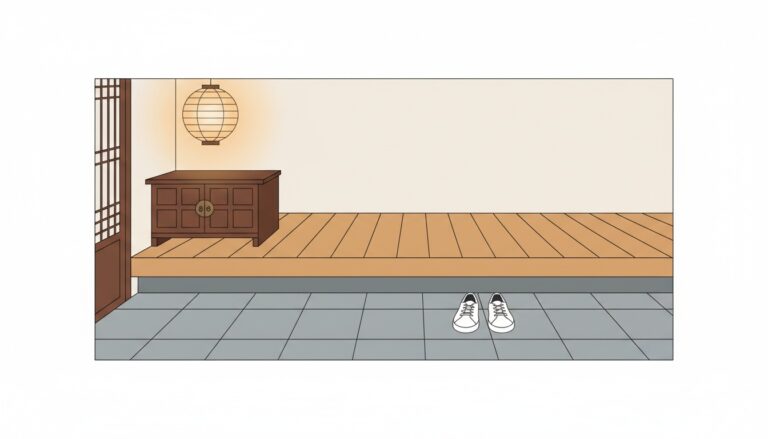
Every Korean building has a Hyeon-gwan (entryway). It is usually lower than the main floor. That step is the border.
– Dirt Zone: The tiled area where you open the door.
– Clean Zone: The wooden/heated floor.
Rule: Your bare foot/sock must never touch the Dirt Zone. Your shoe must never touch the Clean Zone. It is a game of “The Floor is Lava.”
4-2. K-Food Connection: The “Jwa-sik” Trap
Some traditional restaurants have tables where you sit on the floor (Jwa-sik).
– Warning: If you are wearing tight jeans or a short skirt, these places are a nightmare. You have to sit cross-legged for an hour.
– K-Drama Trope: You’ll often see characters banging their legs after standing up because their legs fell asleep. This is real. It hurts.
Phase 5: Interactive Roleplay
Setting: Friday night. You are visiting your Korean friend, Minji’s house for the first time. You are standing at the front door.
Characters:
– YOU: A guest holding a box of fruit (classic gift).
– Minji: Your Korean friend, excited but noticing your shoes.
Dialogue:
Minji: 오! 왔어? 빨리 들어와!
(Oh! Wasseo? Ppal-li deul-eo-wa!)
(Oh! You’re here? Come in quickly!)
YOU: (You step inside the door, standing on the tiles)
🔀 Decision Point! What do you do next?
A) Step up onto the wood floor with your shoes, then take them off.
B) Take off shoes on the tiles, step onto the wood, and leave shoes messy.
C) Take off shoes, step onto the wood, then turn around and arrange the shoes pointing towards the door.
✅ Best Choice: C.
Turning shoes around (pointing out) is pro-level etiquette. It shows you are ready to leave neatly later.
❌ Why A fails: You just brought street dirt into the clean house. Minji is screaming internally.
Phase 6: 10-Second Shadowing Drill
Let’s practice the rhythm. Don’t be flat!
- (Polite & Cautious) 😓 Excuse me (for entering)…
Sil-lye / ha-gess / seum-ni-da. -
(Confused & Curious) 😯 Do I take off my shoes?
Sin-bal / beo-seo-yo? -
(Cheerfully) 😊 Is it okay to go in?
Deu-reo-ga-do / dwae-yo?
Phase 7: K-Culture Mini Glossary
| Korean | Romanization | English | Context |
|---|---|---|---|
| 현관 | Hyeon-gwan | Entryway | The “mudroom” area. The boundary line for shoes. |
| 온돌 | Ondol | Floor Heating | The REASON we take shoes off. We sit and sleep on the warm floor. |
| 실내화 | Sil-nae-hwa | Slippers | Often provided in schools, offices, or bathrooms. |
| 신발장 | Sin-bal-jang | Shoe Cabinet | Where you store shoes if the entryway is crowded. |
Phase 8: Traveler’s Survival Kit
🆘 Survival Expression
– 🇰🇷 “슬리퍼 있어요?” (Seul-li-peo is-seo-yo?)
– 🗣️ Meaning: “Do you have slippers?”
– 📍 Use at: Guesthouses or restaurants with cold floors.📌 Editor’s Travel Note
The “Sock Check” Rule: Before you leave your hotel in Korea, check your socks. Do they have holes? Are they mismatched? You will take your shoes off at least once (temple, restaurant, dressing room). Don’t let a hole in your sock be your most embarrassing memory!
Phase 9: Think Deeper — “Why the Floor?”
Food & Identity:
Have you noticed that Korean culture is “floor-centric”? We sit, eat, and sleep on the floor. This comes from Ondol (traditional floor heating). In the West, heat comes from a fireplace or radiator (air). In Korea, heat comes from the stone beneath you.
Because the floor is the heater, it must be clean. Bringing shoes inside isn’t just “dirty”—it’s like walking on someone’s bed or dining table with boots on. That is why the “shoes off” rule is so strict. It’s about hygiene, yes, but also about respecting the living space that keeps everyone warm.
💬 Your Turn: Does your culture have a “shoes off” rule? Or is it shoes on everywhere? Tell me in the comments!
Phase 10: FAQ & Troubleshooting
Q: Can I go barefoot if I don’t have socks?
A: Technically, yes, but it is considered slightly rude in formal situations (like visiting elders or a nice restaurant). Bare feet can be seen as “unclean.”
Pro Tip: Carry a spare pair of clean socks in your bag in summer!
Q: Do I take shoes off at a clinic/hospital?
A: Usually, small clinics require you to switch to slippers at the door. Big hospitals do not. Look for the pile of slippers—that is your signal.
❌ Common Mistake:
Walking into the bathroom with your socks on.
Correction: Korean bathrooms are “wet rooms.” There are almost always rubber slippers inside the bathroom. Use them! Don’t get your socks wet.
Phase 11: Wrap-up & Missions
Summary: Look for the step (entryway). Shoes stay on the tiles; socks go on the wood. When in doubt, ask “Sinbal beoseoyo?”
Action Missions:
– 🥉 Bronze: Look at your front door. Practice saying “Sillyehagessseumnida” as you enter.
– 🥈 Silver: Watch a K-Drama episode. Count how many times people take off their shoes.
– 🥇 Gold: Go to a Korean restaurant with floor seating and arrange your shoes neatly pointing out when you enter!
K-Culture Mission: Search for “Korean entryway shoe cabinet” on Google Images. You will see how serious Koreans are about shoe storage!
Phase 12: Quick Quiz
- Situation: You enter a restaurant. Everyone is walking around in sneakers. What do you do?
- A) Take yours off anyway to be polite.
- B) Keep them on.
- C) Ask the waiter for slippers.
- Situation: You are visiting a Korean home. You are wearing sandals (no socks). What is the best etiquette?
- A) Walk in barefoot.
- B) Bring a pair of socks to put on.
- C) Ask for a wet towel to wipe your feet.
(Answers: 1-B, 2-B)
Frequently Asked Questions (FAQ)
Q: What does "실례하겠습니다 (Sillyehagessseumnida)" mean in Korean and how do you pronounce it?
A: In Korean, "실례하겠습니다 (Sillyehagessseumnida)" is pronounced [Sil-lye-ha-get-sum-ni-da] and means: Literal: I will commit a discourtesy.
Q: What does "신발 벗어요? (Sinbal beoseoyo?)" mean in Korean and how do you pronounce it?
A: In Korean, "신발 벗어요? (Sinbal beoseoyo?)" is pronounced [Sin-bal buh-suh-yo?] and means: "Do I take off my shoes?"






