

Phase 1: The “Beep-Beep-Beep” of Shame
Greeting: Hello! Your Daily Hangul Editor here.
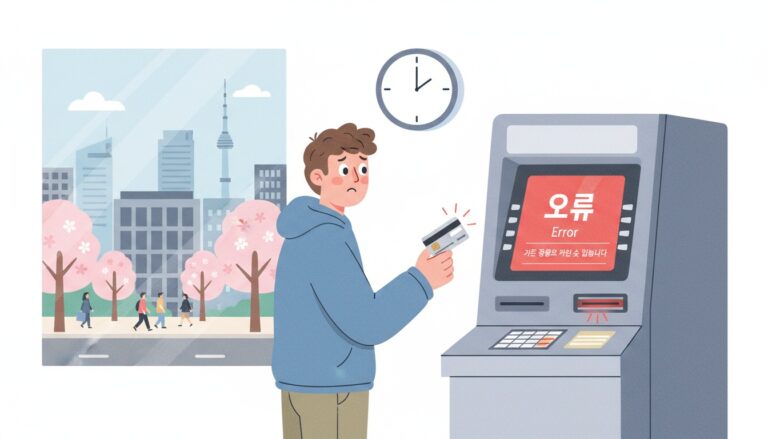
Picture this: You finally found the perfect apartment in Seoul. The landlord wants the deposit (bojeung-geum) now. You confidently walk up to the ATM to transfer the money, feeling like a responsible adult. You insert your card, type the amount, and then…
🚨 BEEP. BEEP. BEEP.
The screen flashes red: “한도 초과 (Exceeded Limit).”
There’s a line of impatient people behind you. An ajumma sighs loudly. You start sweating. This is a classic “Welcome to Korea” moment. The default daily transfer limit for new accounts (especially for foreigners) is often shockingly low—sometimes just 300,000 KRW (about $230). Buying a new laptop? Nope. Paying rent? Forget it.
Don’t panic. Today, we’re going to march into the bank and fix this. Let’s get your limits raised so you can actually use your money.
Phase 2: The Magic Words (Deep Dive)
Here are the three phrases you need to survive the bank teller interview.
1. 한도를 늘리고 싶어요
- Pronunciation: [Hando-reul neulligo sip-oy-yo]
- Sound-alike: Think of “Hand” + “Dough” (money) + “Null” + “Ego“.
- Meaning: I want to increase my limit.
- Context: This is the core sentence. You sit down, hand over your ID, and say this.
- Editor’s Insight: “Hando” (Limit) is a word you’ll hear in K-Dramas when a chaebol (rich heir) hands a credit card to someone and says, “There’s no limit.” Sadly, we are not chaebols.
- Situation Spectrum:
[🚫 Boss] ———— [⚠️ Teller] ———— [✅ Casual]
(Use the polite~yeyoending with the teller!)2. 이체 vs. 출금
- Pronunciation: [Iche] vs. [Chulgeum]
- Meaning: Transfer vs. Withdrawal
- K-Culture Moment: In spy thrillers, the villain demands an Iche (wire transfer). In a market scene, the grandma needs Chulgeum (cash withdrawal) to buy radish.
- Editor’s Insight: You need to be specific. Do you want to send money (Iche) or pull out cash (Chulgeum)? Usually, you want to raise both.
- 🤔 Think About It: Why does Korea separate these limits so strictly? It’s largely to prevent voice phishing scams targeting the elderly.
3. 증빙 서류
- Pronunciation: [Jeung-bing seo-ryu]
- Meaning: Proof documents / Supporting documents.
- Editor’s Insight: This is the boss level boss. You can’t just ask for a higher limit; you have to prove you need it.
- Usage: The teller will ask, “Jeung-bing seo-ryu isseuseyo?” (Do you have supporting docs? like a lease agreement or employment contract).
Phase 3: Textbook vs. Real Life
| Situation | 📖 Textbook Korean | 🗣️ Real Street Korean | 💡 Why the difference? |
|---|---|---|---|
| Sitting at the counter | “이체 한도를 상향 조정하고 싶습니다.” (I would like to upwardly adjust my transfer limit.) | “저 한도 좀 풀러 왔는데요.” (I came to unfreeze/release my limit.) | “상향 조정” is robot-speak. “풀다” (to untie/release) feels more like you’re solving a problem. |
| Explaining why | “월세를 지불해야 합니다.” (I must pay the monthly rent.) | “집 계약 때문에요.” (Because of the house contract.) | Koreans prefer using nouns (Contract) over full explanatory sentences for efficiency. |
Bottom Note: Stick to the “Real” column to sound less like a translation app and more like a local resident.
Phase 4: Cultural Deep Dive — The “Nunchi” of Banking
4-1. The “Number Ticket” Race
Before you even speak, you face the Beonho-pyo (Number Ticket) machine. It usually has two options:
1. 예금/업무 (Deposit/General Business)
2. 대출/외환 (Loans/Foreign Exchange)
Pro Tip: Even if you are a foreigner, if you have an ARC (Alien Registration Card) and a local account, press #1 (General Business). If you press “Foreign Exchange,” you might get sent to a teller who deals with currency exchange, not account limits. Use your nunchi (wits) and watch where the locals waiting for ATM issues go.
4-2. The “Voice Phishing” Paranoid
If the bank teller asks you 20 questions—”Why do you need this money?” “Who is it for?”—don’t get offended. Korea is currently fighting a war against Voice Phishing. Scammers trick people into transferring huge sums. The teller isn’t being rude; they are trained to suspect everyone.
K-Drama Connection: You know those scenes where a detective tracks money? That’s why your limit is 300,000 KRW. You are a suspect until proven innocent with a Pay Stub!
Phase 5: Roleplay Scenario — The Interrogation
Setting: A busy bank branch in Hongdae. 3:30 PM (Closing soon!). You are sitting in front of a teller who looks exhausted.
Characters:
* YOU: A student/worker needing to pay rent.
* Teller (Kim): Efficient, fast, typing loudly.
Kim: (Without looking up) 네, 무슨 업무 보시겠어요? (Yes, what business can I help you with?)
YOU: 아, 저 이체 한도 좀 늘리고 싶어서요. (Ah, I want to increase my transfer limit.)
Kim: 신분증 주시고요. 얼마까지 원하세요? (ID please. How much do you want?)
YOU: 하루 천만 원이요. (10 million won per day.)
Kim: (Stops typing, looks at you) 천만 원이요? 혹시 재직증명서나 계약서 가져오셨나요? (10 million? Did you bring proof of employment or a contract?)
🔀 Decision Point! How do you reply?
- A) “아니요, 없는데요. 그냥 해주세요.” (No, I don’t. Just do it please.)
- B) “네, 여기 집 계약서예요. 보증금을 보내야 해서요.” (Yes, here is the house contract. I have to send the deposit.)
- C) “저 돈 많은데요?” (I have a lot of money though?)
✅ Best Choice: B. Facts rule the bank. A lease agreement (Wolse contract) is the Golden Ticket to raising limits.
⚠️ Choice A Analysis: They will reject you immediately. No documents, no limit increase. This isn’t a negotiation; it’s a verification.
Phase 6: 10-Second Shadowing Drill
Let’s practice the sentence that saves you from embarrassment. Say it with a mix of “I’m sorry to bother you” but also “I need this done.”
🥺 Polite but clear:
혹시 / 이체 한도를 / 최대 얼마까지 / 늘릴 수 있나요?
(Hoksi / iche hando-reul / choedae eolma-kkaji / neullil su innayo?)
“By any chance / the transfer limit / up to the maximum / can I increase it?”
Phase 7: K-Culture Mini Glossary
| Korean | Romanization | English | Context |
|---|---|---|---|
| 보이스피싱 | Voice Phishing | Phone Scam | The reason banking rules are so strict. |
| 공인인증서 | Gong-in Injeung-seo | Digital Certificate | The old digital ID system. Now usually called “Naver/Kakao Cert,” but banks still love complex security. |
| OTP | OTP | One Time Password | A small device or card focused on security. You need this for high limits! |
| 대포통장 | Daepo-tongjang | Burner Account | An illegal bank account used for crimes. Banks are terrified you are opening one. |
Phase 8: Traveler’s & Expat’s Survival Kit
Banking in Korea is a different beast. Here is your cheat sheet.
🆘 Survival Card: Banking Hours
* The 4 PM Rule: Most Korean banks close at 4:00 PM. Yes, really. Some have “After Bank” centers, but don’t count on it.
* Lunch Time: 11:30 AM – 1:30 PM is chaos. Avoid visiting then.
* Global ATMs: Not all ATMs accept foreign cards. Look for the “Global” sign, but even those have “Operating Hours” (often closed late at night).📌 Editor’s Note on Apps:
Can’t you just do this on the app? Maybe. If you have a “Joint Certificate” (old Gong-in certificate) on your phone, yes. But for foreigners, the app often blocks limit increases. You usually have to visit the branch in person at least once.
Phase 9: Think Deeper — Security vs. Convenience
Korea is the land of “Bali Bali” (Hurry Hurry). You can get food delivered in 10 minutes and internet speeds are blazing fast. So why is banking so slow and bureaucratic?
It’s a clash of values. While efficiency is king in daily life, security is the emperor of finance. The legacy of restrictive ActiveX controls and the current strict limit policies are reactions to sophisticated fraud syndicates.
🧠 Think Deeper: In your country, is it easier to open a bank account? Do you prioritize fast access to your money, or are you willing to jump through hoops if it means your account is safer from hackers?
Phase 10: Troubleshooting & FAQ
Q: Can I use my University ID to increase the limit?
A: Usually, no. A student ID proves you are a student, but it doesn’t prove income. However, you can sometimes use a tuition bill (registration paper) to request a temporary limit increase to pay your school fees.
Q: Why does the ATM still say “Limit Exceeded” after I went to the bank?
A: Did you check your 1-time limit vs. 1-day limit? You might have a 5 million won daily limit, but a 1 million won per transaction limit. You might just need to split the transfer into five parts!
❌ Common Mistake: Going to a different branch.
✅ Fix: Try to go to the exact branch where you opened your account. They have your original file. Other branches can do it, but they might be stricter.
Phase 11: Wrap-up & Mission
Summary: To raise your ATM limit, go to the bank before 4 PM, bring your ARC and Proof (Contract/Job), and ask for “Hando” increase.
🚀 Action Mission:
* 🥉 Bronze: Open your Korean banking app and find where it says “이체 한도” (Transfer Limit). See what your current limit is.
* 🥈 Silver: Go to the ATM and change your language setting to Korean for one simple withdrawal.
* 🥇 Gold: Visit the bank and ask for an OTP (One Time Password) generator. It usually grants you higher transfer limits instantly!
K-Culture Mission: Watch a scene from the drama “Vincenzo” or “Little Women” involving money laundering or secret funds. Look at how many stamps and documents are involved!
💬 Your Turn: Have you ever been trapped by the “4 PM Closing Time” in Korea? Tell me your horror story in the comments!
Frequently Asked Questions (FAQ)
Q: What does "한도를 늘리고 싶어요" mean in Korean and how do you pronounce it?
A: In Korean, "한도를 늘리고 싶어요" is pronounced [Hando-reul neulligo sip-oy-yo] and means: I want to increase my limit.
Q: What does "이체 vs. 출금" mean in Korean and how do you pronounce it?
A: In Korean, "이체 vs. 출금" is pronounced [Iche] and means: Transfer vs. Withdrawal
Q: What does "증빙 서류" mean in Korean and how do you pronounce it?
A: In Korean, "증빙 서류" is pronounced [Jeung-bing seo-ryu] and means: Proof documents / Supporting documents.







