

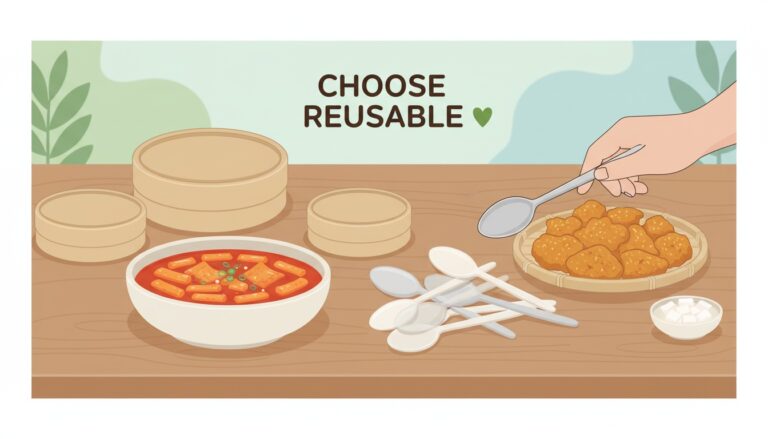
Phase 1: The Mountain in Your Entryway
Hello! This is your editor from Daily Hangul.
Let’s be honest about something. You’ve watched K-Dramas where the protagonist lives in a rooftop apartment (oktapbang), right? There’s always that scene where they are eating fried chicken or jjajangmyeon (black bean noodles) alone. It looks romantic and delicious.
But here is the reality they don’t show you: the aftermath.
I ordered delivery (baedal) last night—just a simple bossam (boiled pork) set. When I finished unpacking, my kitchen table was covered in plastic. Plastic wrap, plastic soup containers, plastic sauce cups, plastic spoons… it was a plastic mountain. In Korea, dealing with this trash—specifically recycling (bunli-sugo)—is practically a competitive sport. If you don’t do it right, the security guard (gyeongbi ahjussi) will definitely have a word with you.
Today, we are going to learn how to save the planet—and save yourself from the judgmental stare of your neighbors—by politely refusing disposable items.
Phase 2: Deep Dive into Eco-Friendly Korean
Here are the three phrases that will make you look like a sophisticated local, not just a tourist.
1. 일회용품은 빼 주세요
- Pronunciation: [Il-hoe-yong-pum-eun ppae ju-se-yo] + (Sounds like you are gently declining a flyer on the street)
- Meaning: Please leave out disposable items. (Literal: Disposable items, please subtract/remove.)
- K-Culture Moment: You will see this mostly on delivery apps like Baedal Minjok or Coupang Eats. It used to be a request you had to type, but now it’s often a default checkbox.
- Editor’s Insight: The verb 빼다 (ppae-da) is incredibly versatile. You use it to remove ingredients (“No cucumber, please” = Oi-neun ppae juseyo) and here, to remove waste.
- Situation Spectrum:
[🚫 Formal] ———— [✅ Semi-formal/Casual] ———— [✅ Apps]- 🤔 Think About It: Korea has a “Pali-pali” (Hurry, hurry) culture. Disposable items are faster to clean up. Why do you think the government is pushing so hard against this convenience now?
2. 수저는 안 주셔도 돼요
- Pronunciation: [Su-jeo-neun an ju-syeo-do dwae-yo]
- Meaning: You don’t need to give me spoons and chopsticks.
- Editor’s Insight: Sujeo (수저) is a combination of spoon (Sutgarak) and chopsticks (Jeotgarak). It’s a convenient word. Also, notice the grammar ~do dwaeyo (it is okay to…). You aren’t commanding them; you are giving them permission to do less work. It sounds much softer.
- Situation Spectrum:
[⚠️ Formal] ———— [✅ Semi-formal] ———— [✅ Casual]3. 용기에 담아 주세요 (The “Yonggi-nae” Challenge)
- Pronunciation: [Yong-gi-e da-ma ju-se-yo]
- Meaning: Please put it in (my) container.
- K-Culture Moment: There is a famous pun here. 용기 (Yonggi) means “Container,” but it also means “Courage.” So the #Yonggi-nae campaign means both “Bring a container” and “Show some courage.”
- Editor’s Insight: This is for when you physically go to the store to pick up food (pojang). You hand them your Lock & Lock box. The owner might look surprised at first, but usually, they give you extra food (service) for being eco-friendly.
Phase 3: Textbook vs. Real Life
| Context | 📖 Textbook Korean | 🗣️ Real Korean (Street/App) | 💡 Why the difference? |
|---|---|---|---|
| Delivery App Request | 일회용 수저와 포크를 주지 마십시오. (Do not give disposable spoons and forks.) | 수저 X / 일회용품 X | Koreans value speed. In the “Request to Boss” box, short is sweet. |
| At a Cafe | 머그컵에 커피를 마시고 싶습니다. (I want to drink coffee in a mug.) | 먹고 갈게요. (I’ll eat/drink and go.) | If you stay, they must give you a mug by law. No need to specify the cup. |
Bottom Note: B2 learners often try to be too specific. In a cafe, just saying “I am staying” (Meokgo galkkeyo) automatically triggers the “Mug Cup” protocol because of strict environmental laws.
Phase 4: Cultural Context — The “Han River” Paradox
Let’s talk about a specific trap for travelers: The Han River Park.
Delivery to the Han River is a quintessential K-Culture experience. You sit on a mat, order chicken, and it arrives at a “Delivery Zone.”
Here is the catch: If you habitually check the “No disposables” box because you want to be a good person, you will be eating sticky Yangnyeom Chicken (seasoned chicken) with your bare hands in the dark.
Korean culture relies heavily on context. “No disposables” usually assumes you are at home (where you have metal chopsticks). If you are outside (picnic, hotel), you need those plastics. Don’t let your eco-guilt ruin your picnic. Be eco-friendly at home; be practical at the river.
Phase 5: Roleplay Scenario — The Tteokbokki Stand
Setting: A popular Tteokbokki stall near a subway station. It’s 6 PM, people are lining up. You have brought your own thermal pot to take the food home.
Characters:
* YOU: An eco-conscious exchange student.
* Auntie (Imo): The busy stall owner, flipping fried squid with one hand.
The Dialogue:
Imo: (Loudly) 뭐 드릴까? 포장?
(Mwo deurilkka? Pojang?)
Translation: What can I get you? To go?
YOU: 네, 떡볶이 1인분만 주세요. 아, 그리고…
(Ne, tteokbokki il-inbun-man juseyo. Ah, geurigo…)
Translation: Yes, one serving of spicy rice cakes, please. Ah, and…
🔀 Decision Point: How do you present your container?
A) Say nothing and shove the container in her face.
B) “여기 담아주세요.” (Please put it in here.)
C) “일회용품 사용을 규제해야 합니다.” (We must regulate the use of disposables.)
✅ Best Choice: B
Say “Yeogi dama juseyo” while holding out your container with two hands. It’s polite and clear.
⚠️ Choice C Analysis: You sound like a news anchor or a politician. The Auntie will just stare at you.
(Dialogue Continues with Choice B)
Imo: (Pauses, looks at your pot) 아이구, 예쁜 통 가져왔네.
(Aigu, yeppeun tong gajyeo-wanne.)
Translation: Oh my, you brought a pretty container.
(🎭 Stage Direction: She smiles and scoops an extra ladle of soup into your pot.)
Imo: 많이 줬어!
(Mani jwosseo!)
Translation: I gave you extra!
Phase 6: 10-Second Shadowing Drill
Practice saying this naturally. Don’t be robotic!
Context: The delivery guy is handing you the bag, but you realize he forgot the chopsticks, and you are at a hotel. (Wait, actually, this drill is for refusing them!)
Context: Ordering on the phone.
😊 Polite but Firm:
저희 / 집이라서 / 수저는 / 안 주셔도 / 돼요.
(Jeo-hui / jip-i-ra-seo / su-jeo-neun / an ju-syeo-do / dwae-yo.)
Since we are home, you don’t need to give us spoons.
Phase 7: K-Culture Mini Glossary
| Word | Romanization | Meaning | Context |
|---|---|---|---|
| 분리수거 | Bunli-sugo | Recycling | The act of separating trash. A major source of stress and community in Korea. |
| 반찬 | Banchan | Side dishes | The main reason you get so many tiny plastic cups in delivery. |
| 용기내 | Yonggi-nae | Courage/Container | The catchphrase for the zero-waste movement in Korea. |
| 텀블러 할인 | Tumbler hal-in | Tumbler Discount | Discounts cafes give (usually 300-500 won) for bringing your own cup. |
Phase 8: Traveler’s Survival Kit
Even if you aren’t living in Korea, you will deal with trash.
🆘 Survival Expression: “Where is the trash can?”
– 🇰🇷 “쓰레기통 어디 있어요?” (Sseuregitong eodi isseoyo?)
– 💡 Pro Tip: You will struggle to find public trash cans on the street in Korea. This is not because the city is lazy; it’s a policy to reduce household waste dumping.
– Solution: Give your trash to the staff at the place you bought it, or carry it back to your hotel/Airbnb. Do NOT leave your coffee cup on a random bus stop bench. That is a major faux pas.
Phase 9: Think Deeper — Media vs. Reality
The Clean Streets Paradox
If you watch K-Dramas, the streets of Seoul look pristine. Characters walk along the Cheonggyecheon stream or trendy Hongdae streets, and everything sparkles. But the reality of Delivery Korea is a constant battle with waste. Korea has one of the world’s highest recycling rates, not because people naturally love sorting trash, but because the system forces it.
This “Plastic Fatigue” is why phrases like “Please leave out disposables” have become essential survival Korean. It’s not just about saving the earth; it’s about saving yourself from spending 20 minutes washing and peeling labels off plastic containers on Sunday morning.
💬 Your Turn: In your country, does ordering delivery create a lot of guilt? How do you handle it?
Phase 10: FAQ & Troubleshooting
- Q: Can I ask them to take away the leftover food containers later?
- A: NO. Historically (in the 90s/00s), Chinese restaurants would collect their reusable plates later. You would leave them outside your door. Today, 99% of delivery comes in disposable plastic. You must dispose of it yourself. Do not leave dirty plastic outside your door!
- Q: I saw a “Service” sticker on a random side dish. What is this?
- A: This is Service (freebie). It’s a gift from the owner. You don’t need to return it or pay for it. Just enjoy it!
Phase 11: Wrap-up & Mission
Summary: Today we learned how to reject plastic spoons politely (~an jusyeodo dwaeyo) and use the “Courage” pun (Yonggi-nae) to get extra food.
🚀 Action Mission:
- 🥉 Bronze: Open a Korean delivery app (or look at a screenshot online) and find the checkbox that says “일회용 수저, 포크 X”.
- 🥈 Silver: Go to a cafe and say “Meokgo galkkeyo” (I’ll eat here) and drink from a real mug.
- 🥇 Gold: Go to a street food stall with your own container and try the line: “Yeogi dama juseyo!”
Phase 12: Interactive Quiz
Situation: You are at a convenience store buying a “Dosirak” (Lunch box) to eat at the Han River park. The clerk asks: “Jeotgarak deuryeoyo?” (Should I give you chopsticks?)
Which answer ends in disaster?
- “Ne, juseyo.” (Yes, please.)
- “Aniyo, gwaenchana-yo.” (No, I’m fine.)
- “Du gae juseyo.” (Please give me two.)
⬇️ Toggle to see Answer
Disaster Choice: 2.
Why? If you are at the Han River, you likely don’t have chopsticks in your pocket. If you say “No,” you will be eating rice with your fingers. Always check your location context!
Frequently Asked Questions (FAQ)
Q: What does "일회용품은 빼 주세요" mean in Korean and how do you pronounce it?
A: In Korean, "일회용품은 빼 주세요" is pronounced [Il-hoe-yong-pum-eun ppae ju-se-yo] and means: Please leave out disposable items. (Literal: Disposable items, please subtract/remove.)
Q: What does "수저는 안 주셔도 돼요" mean in Korean and how do you pronounce it?
A: In Korean, "수저는 안 주셔도 돼요" is pronounced [Su-jeo-neun an ju-syeo-do dwae-yo] and means: You don't need to give me spoons and chopsticks.
Q: What does "용기에 담아 주세요 (The "Yonggi-nae" Challenge)" mean in Korean and how do you pronounce it?
A: In Korean, "용기에 담아 주세요 (The "Yonggi-nae" Challenge)" is pronounced [Yong-gi-e da-ma ju-se-yo] and means: Please put it in (my) container.







