

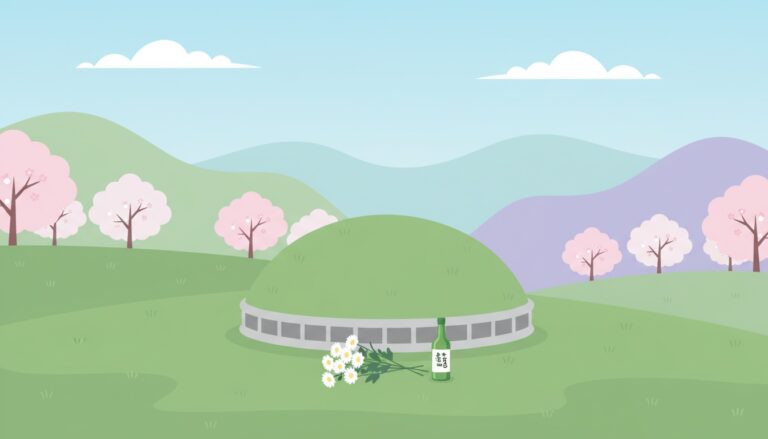
Phase 1: The Scene — More Than Just a “Cemetery Visit”
Hello! This is your Daily Hangul editor.
You’ve seen this scene a hundred times in K-Dramas. The hero, usually wearing a sleek black coat, hikes up a quiet, grassy hill. He stands in front of a round mound of earth, places a bouquet of white chrysanthemums, pours a cup of Soju, and sprinkles it onto the grass. Then, he starts talking to the air.
“Father, I finally destroyed the company that betrayed you.”
Or maybe, “Mom, I met someone.”
To a Western eye, this looks like a cemetery visit. But in Korea, this is Seongmyo (성묘). It’s not just about remembering the dead; it’s about maintaining an active relationship with them. And one of the biggest days for this isn’t just Chuseok—it’s Hansik (한식).
If you don’t understand the weight of this specific day, you miss the emotional depth of that scene. It’s not just sadness; it’s duty, guilt, and affection wrapped into one spring afternoon. Today, we’re going to look at the language of “filial piety” that doesn’t sound like a Confucian textbook, but like something a real Korean would say while stuck in traffic on their way to the family burial ground.
Phase 2: Deep Dive — Three Expressions You Won’t Find in Survival Guides
1. 성묘 가다 (Seongmyo gada)
- Pronunciation: [Seong-myo ga-da] (The ‘ng’ flows into the ‘m’, sounding a bit like Seong-myo)
- Meaning: Literally “to go examine the grave.” In reality, it means “going to pay respects to ancestors.”
- K-Culture Moment: In the drama My Liberation Notes, characters often discuss visiting the mountains. It’s never just a hike; it’s Seongmyo. It implies cleaning the grave, cutting weeds, and checking if the winter snow damaged the mound.
- Editor’s Insight: You don’t say “I’m going to the cemetery.” That sounds sterile. You say “Seongmyo gada.” It implies you are going to perform a duty. It’s active.
- Situation Spectrum:
[🚫 Casual Friend] ———— [⚠️ Colleague] ———— [✅ Family/Elders]
(Actually, you can tell anyone you are doing this, but the act itself is deeply familial.) - 🤔 Think About It: Why do we say “examine” (살필 성) the grave? It suggests the grave is a living entity that needs care, not just a stone marker.
2. 한 잔 올리다 (Han jan ollida)
- Pronunciation: [Han jan ol-li-da]
- Meaning: “To raise up a glass.” Real nuance: “To offer a drink to the deceased.”
- K-Culture Moment: Every time a character pours alcohol on the grave in a movie. They pour it three times, or in a circle. They never drink it first. They offer it (올리다) to the spirit.
- Editor’s Insight: The verb 올리다 (to raise/offer) is crucial here. You don’t “give” (주다) alcohol to your late grandfather. You raise it. It elevates the recipient.
- Situation Spectrum:
[🚫 To a Junior] ———— [⚠️ To a Senior] ———— [✅ To Ancestors/Elders]
3. 인사드리고 오다 (Insa-deurigo oda)
- Pronunciation: [In-sa-deu-ri-go o-da]
- Meaning: “To come back after greeting.” Real nuance: “I just got back from visiting the grave.”
- K-Culture Moment: A character returns to the office with muddy shoes. “Where were you?” implies a scolding. The answer, “Father’s anniversary, so I went to say hello (인사드리고 왔어요),” immediately softens the boss’s face.
- Editor’s Insight: This is the ultimate euphemism. Koreans treat the dead as if they are merely away. We don’t say “I saw the grave.” We say “I greeted them.”
Phase 3: Textbook vs. Real Life
| Situation | 📖 Textbook Korean | 🗣️ Real Korean | 💡 Why the difference? |
|---|---|---|---|
| Explaining the visit | 묘소에 방문했습니다. (I visited the grave site.) | 산소에 좀 다녀왔어. (I went to the ‘mountain’ for a bit.) | Sanso (Mountain) is the common word for a grave, confusing foreigners who think you went hiking. |
| Offering food | 음식을 차렸습니다. (I set the food.) | 간단하게 절만 하고 오자. (Let’s just bow simply and come back.) | Modern families value efficiency. The full ritual is exhausting, so we often minimize it verbally. |
| Traffic complaints | 교통 체증이 심각합니다. (Traffic congestion is severe.) | 와, 차 대박 막혀. (Wow, cars are blocked ‘daebak’.) | On Hansik, highways are parking lots. You need emotional emphasis! |
Bottom Note: Use “Sanso” (산소) instead of “Myoji” (묘지). “Myoji” sounds like a spooky graveyard in a horror movie; “Sanso” sounds peaceful and respectful.
Phase 4: Cultural Context — The “Why”
4-1. The “Cold Food” Irony
“Hansik” literally means “Cold Food.” Legend has it we shouldn’t use fire on this day to honor a loyal Chinese servant who died in a fire. But here is the reality check: Nobody actually eats cold food anymore.
If you ask a Gen Z Korean, “Are you eating cold rice today?” they will look at you like you’re an alien. Today, Hansik is synonymous with maintenance. It’s the “Spring Cleaning” day for ancestors. The frost has melted, the ground is soft, and weeds are sprouting. If you don’t clean the grave now, you’re considered an unfilial child.
4-2. The K-Drama “Grave Confession”
Why do drama leads always reveal secrets at graves? Because in Korean culture, ancestors are the only ones who can’t judge you, but can still hear you. It’s a safe space. When you see that scene, notice the body language. The character usually touches the gravestone. That touch is a substitute for a hug they can no longer give.
Phase 5: Immersive Roleplay — The Hillside Picnic
Setting: A sunny hillside in Gyeonggi-do province. You are with your Korean friend, Min-jun, visiting his grandmother’s grave. He lays out a mat and some fruits.
Min-jun: (Sighs while wiping the tombstone)
할머니, 저 왔어요. 이번엔 친구랑 같이 왔네요.
(Halmeoni, jeo wasseoyo. Ibeonen chingurang gachi wanneyo.)
(Grandma, I’m here. This time I brought a friend.)
YOU: (Awkwardly standing) …
Min-jun: 야, 너도 인사드려. 그냥 편하게 서서 묵념해도 돼.
(Ya, neodo insa-deuryeo. Geunyang pyeonhage seoseo mungnyeomhaedo dwae.)
(Hey, say hello. You can just stand comfortably and do a silent tribute.)
🔀 Decision Point: How do you respond?
- Option A: Perform a full “Keun-jeol” (Deep bow, forehead to ground).
- Option B: Stand straight, lower your head, and close your eyes (Silent tribute).
- Option C: Say “Nice to meet you!” loudly and wave.
✅ Best Choice: Option B. As a foreigner/friend, a silent tribute (Mungnyeom) is perfectly respectful and expected. A full bow (A) is impressive but usually reserved for family members unless you were very close.
🚫 Why not C? Waving is too casual. You are greeting an elder, even if they are deceased.
Min-jun: (Pouring Soju into a paper cup and circling it over the grave)
한 잔 받으세요.
(Han jan badeuseyo.)
(Please accept a drink.)
(Min-jun sprinkles the drink on the earth)
YOU:
그 술은 왜 땅에 뿌리는 거야?
(Geu sureun wae ttange ppurineun geoya?)
(Why are you sprinkling that alcohol on the ground?)
Min-jun:
음… 나눠 마시는 거지. 할머니 한 잔, 그리고 땅의 신에게도 한 잔.
(Eum… nanwo masineun geoji. Halmeoni han jan, geurigo ttang-ui sin-egedo han jan.)
(Hmm… it’s sharing. One for grandma, and one for the god of the earth.)
Phase 6: 10-Second Shadowing Drill
Let’s practice the sentence you can use when you need to visit your own family or explain a friend’s absence.
“It’s Hansik next week, so I have to go visit my grandfather’s grave.”
🇰🇷 다음 주가 / 한식이라 / 할아버지 산소에 / 다녀와야 해요.
(da-eum ju-ga / han-si-gi-ra / ha-ra-beo-ji san-so-e / da-nyeo-wa-ya hae-yo)
- Emotion: 😌 Respectful and slightly dutiful.
- Intonation: Rise slightly on ‘la’ (한식이라), drop firmly on ‘yo’ (해요).
Phase 7: K-Culture Mini Glossary
| Korean | Romanization | Meaning | Context |
|---|---|---|---|
| 벌초 | Beolcho | Cutting weeds | Doing the landscaping for the grave. A physically demanding duty often done before Chuseok or on Hansik. |
| 절 | Jeol | Formal Bow | Not just a nod. Kneeling and lowering your head to the floor. |
| 쑥떡 | Ssuk-tteok | Mugwort Rice Cake | A traditional food eaten around Hansik (spring season). Mugwort is ubiquitous in Korean spring. |
| 음복 | Eumbok | Sharing sacrificial food | Eating the food/alcohol after offering it to ancestors. It signifies receiving blessings. |
Phase 8: Traveler’s Survival Kit
Even if you aren’t visiting a grave, Hansik affects you as a traveler.
🆘 Survival Info
* Traffic Alert: On Hansik (early April), highways leaving Seoul are jammed. Avoid bus travel out of the city in the morning.
* Fire Watch: You will see “Forest Fire Caution” banners everywhere. It’s dry season + strong winds. Do not smoke on hiking trails. The fine is huge.🗣️ Useful Expression for Traffic
* 🇰🇷 “차가 너무 막혀요.” (Cha-ga neo-mu ma-kyeo-yo.)
* meaning: “The traffic is blocked bad.”
Phase 9: Think Deeper — Death as a Picnic?
In many Western cultures, graveyards are somber, quiet places often visited alone. In Korea, Seongmyo often feels like a family picnic. We bring fruits, dried fish, and alcohol. We sit on mats next to the burial mound and eat the “leftovers” (Eumbok). We chat, laugh, and sometimes argue right next to the grave.
Why? Because in the Korean worldview, death doesn’t sever the family bond. Sharing a meal with the ancestor (even if they are under the grass) reaffirms that they are still part of the family unit. It’s less about “memorializing” a memory and more about “spending time” with a member who has moved to a different room.
💬 Your Turn: How does your culture treat grave visits? Is it a solitary act or a family gathering? Is food involved?
Phase 10: FAQ & Troubleshooting
- Q: Can I visit a friend’s grave if I’m not family?
- A: Yes, absolutely. Just stand respectfully while the family performs the bowing rituals. You can bow (silent tribute) afterwards. It is seen as a gesture of great loyalty (義uri).
- Q: Why is the grave a mound and not a flat stone?
- A: Traditional Korean graves (bongbun) are rounded mounds. It represents returning to the womb or the earth. However, flat stones and urn burials are becoming common now due to lack of space.
- Q: Do I really have to wear a black suit?
- A: For a funeral? Yes. For Seongmyo (grave visit)? No. Neat casual clothes are fine. Just avoid neon colors or flip-flops. Hiking gear is surprisingly acceptable because… well, graves are often on mountains.
Phase 11: Wrap-up & Mission
One-Liner Summary:
Hansik isn’t just about cold food; it’s the spring duty of cleaning ancestors’ graves to maintain the eternal family bond.
🚀 Action Mission:
* 🥉 Bronze: Say “성묘 가다” (Seongmyo gada) out loud three times, focusing on the smooth nasal sound.
* 🥈 Silver: Search for “Korean grave visit scene” on YouTube and observe the pouring of the alcohol. Look for the circular motion.
* 🥇 Gold: If you are in Korea during spring, hike a mountain. If you see a maintained mound, notice it (from a distance) and recognize it as someone’s cherished ancestor, not just a hill.
Phase 12: Quiz — Interactive Challenge
1. Situation: Your Korean boss says, “I’m going to ‘Sanso’ (산소) this weekend.”
What should you say?
* A) “Have a nice hike! Take pictures!”
* B) “Oh, are you going for Seongmyo (paying respects)? Safe travels.”
* C) “Is the oxygen level low there?” (Pun on Sanso meaning Oxygen)
2. True or False?
On Hansik, it is mandatory to eat only cold leftovers from the fridge.
3. K-Drama Context:
A character pours Soju on the grave. Why?
* A) To disinfect the grass.
* B) To kill the weeds.
* C) To offer a drink to the spirit of the ancestor.
Answers:
1. B. (A is rude because it’s a solemn duty, C is a dad joke for C2 level only!)
2. False. Historically yes, but modern Koreans just focus on the grave visit.
3. C. It’s a gesture of sharing and respect.
Frequently Asked Questions (FAQ)
Q: What does "성묘 가다 (Seongmyo gada)" mean in Korean and how do you pronounce it?
A: In Korean, "성묘 가다 (Seongmyo gada)" is pronounced [Seong-myo ga-da] and means: Literally "to go examine the grave." In reality, it means "going to pay respects to ancestors."
Q: What does "한 잔 올리다 (Han jan ollida)" mean in Korean and how do you pronounce it?
A: In Korean, "한 잔 올리다 (Han jan ollida)" is pronounced [Han jan ol-li-da] and means: "To raise up a glass." Real nuance: "To offer a drink to the deceased."
Q: What does "인사드리고 오다 (Insa-deurigo oda)" mean in Korean and how do you pronounce it?
A: In Korean, "인사드리고 오다 (Insa-deurigo oda)" is pronounced [In-sa-deu-ri-go o-da] and means: "To come back after greeting." Real nuance: "I just got back from visiting the grave."







