

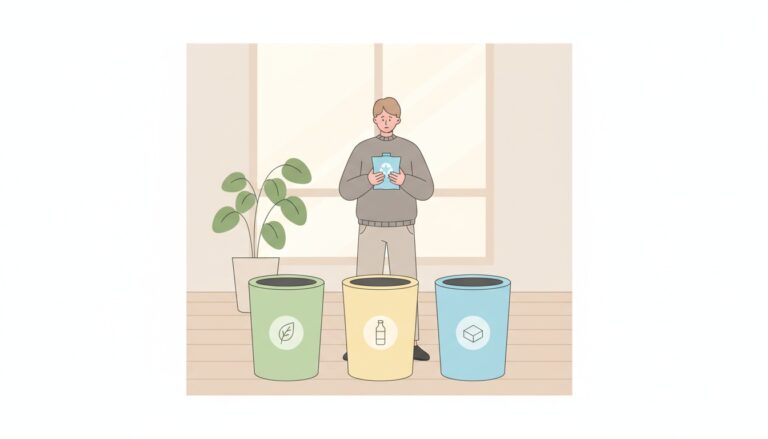
Phase 1: The “Freezer Tetris” Struggle
Hello there! It’s your Daily Hangul editor.
Let’s be real for a second. If you’ve lived in Korea for more than a week, you’ve ordered delivery. Maybe it was Saebyeok Baesong (Dawn Delivery) for fresh groceries, or perhaps a late-night craving satisfied by Coupang Fresh.
And with that convenience comes the inevitable aftermath: The Ice Pack Invasion.
Open your freezer. How many of them are in there? Stacked like a game of Tetris gone wrong? You keep them thinking, “I might need this for a picnic,” but that picnic never happens. Now you want to throw them away, but you pause.
“Do I cut this open? Do I throw it in the general trash? Is there a special bin?”
In Korea, doing recycling wrong isn’t just a mistake; it’s a social faux pas. You can practically feel the laser beams from the Gyeongbi-ajeossi (security guard) watching your every move. Today, we are going to navigate the advanced nuances of Eco Action: Dealing with Ice Packs, so you can recycle with the confidence of a local.
Phase 2: Deep Dive into Core Expressions
Since we are at a C2 level, we aren’t just looking for “trash can.” We are looking for precision.
1. 처치 곤란 (Cheochi gollan)
- Pronunciation: [cheo-chi gol-lan] (Sounds like church + ee + goal + lan)
- Meaning: Difficult to deal with / A nuisance to get rid of
- K-Culture Moment: You’ll hear this on news segments about environmental issues or from a mom looking at a pile of clutter in her living room. It implies a burden.
- Editor’s Insight: This is high-level vocabulary. Using this shows you understand the emotional weight of the clutter, not just the physical presence.
- Situation Spectrum:
[🚫 Formal Report] ———— [⚠️ Semi-formal] ———— [✅ Daily Chat]
(Actually, this is ✅ across the board. Even news anchors use it.)- 🤔 Think About It: Why does Korean have a specific four-syllable idiom for “difficult to dispose of”? It reflects a society where space is limited and waste management is a collective burden.
2. 전용 수거함 (Jeonyong sugeoham)
- Pronunciation: [jeon-yong su-geo-ham]
- Meaning: Dedicated collection bin / Exclusive receptacle
- K-Culture Moment: Walking into a Community Center (Dong-samsu-so) and seeing a specific bin just for batteries or ice packs.
- Editor’s Insight: Jeonyong means “exclusive use.” If you park in a “resident jeonyong” spot, you will get towed. If you put trash in an “ice pack jeonyong” bin, you will get judged.
- Situation Spectrum:
[🚫 Intimate] ———— [⚠️ Casual] ———— [✅ Information Seeking]3. 종량제 봉투 (Jongnyangje bongtu)
- Pronunciation: [jong-nyang-je bong-tu]
- Meaning: Volume-rate garbage disposal bag (Standard trash bag)
- Context: This is the legal, paid plastic bag you must use for general waste.
- Editor’s Insight: This is the ultimate “Is it or isn’t it?” question. If an ice pack is “Gel Type,” it often goes here if no collection bin is available. If it’s “Water Type,” you drain and recycle the plastic.
Phase 3: Textbook vs. Real Life
| Situation | 📖 Textbook Korean | 🗣️ Real Korean (Street/Casual) | 💡 Why the difference? |
|---|---|---|---|
| Asking where to throw away | 이것을 어디에 버립니까? (Where do I throw this?) | 이거 수거함 어디 있어요? (Where is the collection bin for this?) | ‘버리다’ (throw) implies waste. ‘수거함’ implies you know the system exists. |
| Unsure about the method | 어떻게 배출합니까? (How do I discharge this?) | 이거 그냥 종량제에 넣어요? (Do I just put this in the standard bag?) | Practicality. Most people want to know if they can take the easy route (the bag). |
| Declining extra ice packs | 아이스팩은 필요 없습니다. (I do not need ice packs.) | 아이스팩은 빼주세요. (Please leave out the ice packs.) | ‘빼다’ (remove/exclude) is more active and common in service requests. |
Bottom Note: At C2 level, avoid asking “What is this?” Instead, ask for verification of the rule (“Is this the standard bag situation?”). It makes you sound like an insider double-checking, rather than an outsider who is lost.
Phase 4: Cultural Deep Dive — The “Nunchi” of Recycling
4-1. The Vigilante Security Guard
In Korean apartment complexes (Apartul), the recycling area is a sacred space governed by the Security Guard (Gyeongbi-ajeossi). On recycling day, he isn’t just watching; he is inspecting.
If you hold a gel ice pack and hover over the plastic bin, he might click his tongue (tsk tsk). That sound is your cue to stop. The proper nunchi (sensing the mood) here is to make eye contact, hold up the item, and look confused before you attempt to throw it. It shows respect for his authority over the bins.
4-2. The “Eco-Guilt” & Delivery Culture
Korea has the world’s most convenient delivery culture, but it comes with a side dish of guilt. K-Dramas often show the pristine, high-tech side of city life, but they rarely show the mountain of packaging waste. Recently, “Eco-Action” has become a trend. Reusing ice packs isn’t just about saving the planet; it’s a way to participate in the community virtuous cycle.
Phase 5: Immersive Roleplay
Setting: It is Tuesday morning in your officetel building. You are holding three heavy gel ice packs. You walk down to the recycling station. The stern Security Guard is organizing boxes.
Characters:
* YOU: A foreign resident who wants to be a “Good Neighbor.”
* Security Guard (Kim): 60s, meticulous, takes recycling very seriously.
Dialogue:
YOU: (Approaching cautiously) 아저씨, 안녕하세요! 혹시 여기 아이스팩 전용 수거함 있나요?
(Ajeossi, annyeonghaseyo! Hoksi yeogi aiseupaek jeonyong sugeoham innayo?)
(Sir, hello! By any chance, is there a dedicated ice pack collection bin here?)
Guard Kim: (Looks at your hands) 젤 타입이야, 물이야?
(Jel taib-iya, mul-iya?)
(Is it gel type or water?)
YOU: 젤이에요. 그냥 버리기 아까워서요.
(Jerieyo. Geunyang beorigi akkawoseoyo.)
(It’s gel. It feels wasteful to just throw it away.)
Guard Kim: (Nods approvingly) 저기 주민센터 앞에 가면 있어. 우리는 따로 없어.
(Jeogi jumin-senteo ape gamyeon isseo. Urineun ttaro eopseo.)
(Go to the Community Center over there. We don’t have one separately.)
🔀 Decision Point! How do you respond?
- A) “아, 너무 머네요. 그냥 종량제 봉투에 버릴게요.” (Ah, too far. I’ll just trash it in the standard bag.)
- B) “아, 주민센터요? 운동 삼아 다녀올게요. 감사합니다!” (Ah, the Community Center? I’ll go as a workout. Thanks!)
- C) “왜 우리는 없어요?” (Why don’t we have one?)
✅ Best Choice: B — This wins you massive points. You are showing effort (Seong-ui). He might even smile.
⚠️ Choice A Analysis: Technically legal (if you put it in the standard bag), but kills the “eco-friendly vibe” you just established.
Phase 6: 10-Second Shadowing Drill
Let’s practice the sentence that saves you from getting yelled at.
- Emotion: Slightly apologetic but proactive. You are asking for guidance.
- Sentence: “Since it’s a gel type / I shouldn’t put it / in the plastic recycling, right?”
🇰🇷 젤 타입이라서 / 플라스틱에 / 버리면 안 되죠?
(Jel taib-iraseo / peullaseutige / beorimyeon an dwejo?)
Phase 7: K-Culture Mini Glossary
| Korean | Rom. | Meaning | Context |
|---|---|---|---|
| 새벽 배송 | Saebyeok Baesong | Dawn Delivery | The main culprit of your ice pack accumulation. Delivery arrives before 7 AM. |
| 분리수거 | Bunli-sugeo | Separate Collection | The act of recycling. “Bunli-sugeo day” is a weekly ritual. |
| 동사무소 | Dong-samsu-so | Community Center | Older term for Haengjeong-bokji-senteo. The place to find specialized bins. |
| 당근 | Danggeun | Carrot (Market) | Korea’s Craigslist. People often give away clean ice packs here for free. |
Phase 8: Traveler’s Survival Kit
Even if you are in an Airbnb, you will order food. Dealing with the trash is your responsibility.
🆘 Survival Expression #1
* 🇰🇷 “이거 재활용 되나요?” (Igeo jaehwalyong dwenayo?)
* 🗣️ Pronunciation: [ee-geo jae-hwal-yong dway-na-yo?]
* 📍 Where: Convenience stores, Airbnb hosts, hotel lobby.
* 💡 Pro Tip: If the ice pack says “100% Water” (물 100%), cut it open, pour the water in the sink, and recycle the plastic vinyl. Easy!📌 Editor’s Note on Trash Bags
You cannot just use a random black plastic bag for trash. You MUST buy the Standard Garbage Bag (Jongnyangje Bongtu) at a convenience store. It varies by district (Mapo-gu bags cannot be used in Gangnam-gu!).
Phase 9: Think Deeper — Convenience vs. Conscience
The Paradox of “Ppalli-ppalli” (Hurry-hurry)
Korea’s obsession with speed created the “Dawn Delivery” culture, which revolutionized convenience but created an environmental crisis of packaging waste. It’s fascinating to watch how society corrects itself. The government didn’t just ban delivery; instead, companies invented “Water Ice Packs” and communities set up “Reuse Bins.”
🧠 Think Deeper:
Does your country prioritize speed of delivery over packaging waste? Korea tries to balance both by putting the burden of sophisticated recycling on the consumer. Is this fair, or should the companies bear more responsibility?
Phase 10: FAQ & Troubleshooting
- Q: Can I put the gel ice packs down the toilet/sink?
- A: NO! ABSOLUTELY NOT! 🚫 The gel contains microplastics (superabsorbent polymers). It will clog your pipes and pollute the ocean. Put it in the Standard Garbage Bag (Burnable) if you can’t find a collection bin.
- Q: My Airbnb host didn’t tell me where the bins are.
- A: Look for a cluster of bins in the parking lot or near the back entrance. If you see a bin marked 일반쓰레기 (General Waste), that is for the standard bags.
- Q: Common Mistake?
- ❌ Mistake: Throwing dirty packaging (with food stains) into recycling.
- ✅ Fix: In Korea, if it’s stained red with kimchi or sauce, it is trash, not recycling. Wash it perfectly, or throw it in the general bag.
Phase 11: Wrap-up & Action Items
Today we tackled the freezing cold reality of Korean delivery culture.
- One-Liner: “Gel goes in the bin (or standard bag), water goes in the sink, and asking shows class.”
-
Action Missions:
- 🥉 Bronze: Check the ice packs in your freezer. Are they water or gel? Read the Hangul label.
- 🥈 Silver: Locate the nearest “Community Center” (Haengjeong-bokji-senteo) on Naver Maps. That’s likely where the bin is.
- 🥇 Gold: Ask a Korean friend or security guard, “Is there an ice pack collection bin nearby?” using the phrase we learned.
- K-Culture Mission: Next time you watch a K-Drama and see a pristine apartment, wonder to yourself: “Where do they hide their trash bags?”
💬 Your Turn: How strictly do you have to recycle in your home country? Tell me in the comments below!
Frequently Asked Questions (FAQ)
Q: What does "처치 곤란 (Cheochi gollan)" mean in Korean and how do you pronounce it?
A: In Korean, "처치 곤란 (Cheochi gollan)" is pronounced [cheo-chi gol-lan] and means: Difficult to deal with / A nuisance to get rid of
Q: What does "전용 수거함 (Jeonyong sugeoham)" mean in Korean and how do you pronounce it?
A: In Korean, "전용 수거함 (Jeonyong sugeoham)" is pronounced [jeon-yong su-geo-ham] and means: Dedicated collection bin / Exclusive receptacle
Q: What does "종량제 봉투 (Jongnyangje bongtu)" mean in Korean and how do you pronounce it?
A: In Korean, "종량제 봉투 (Jongnyangje bongtu)" is pronounced [jong-nyang-je bong-tu] and means: Volume-rate garbage disposal bag (Standard trash bag)






