

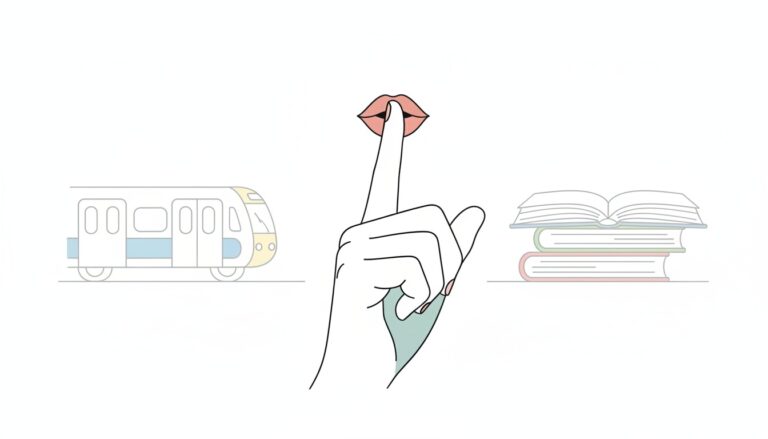
Don’t Be That Loud Tourist! The Art of ‘Quiet’ in Korea 🤫
Phase 1: The ‘Sound of Silence’ in Seoul
Hello! Your Daily Hangul editor here. 👋
Picture this: You step onto a subway in Seoul during rush hour. It is packed. Shoulder to shoulder. Yet, it is… silent. Eerily silent. You can hear the AC humming. Suddenly, your phone rings at full volume. Every head turns. You feel 50 pairs of eyes burning into your soul.
Welcome to Korea’s silence culture.
In K-Dramas, you might see the male lead grab the female lead’s wrist and run out of a library to talk. Why? Because making noise in public shared spaces (subways, libraries, elevators) is a big no-no. But conversely, slurping noodles loudly? Totally fine. Confusing, right?
Today, we’re going to learn how to ask someone to be quiet politely, and how to excuse yourself when you need to make noise.
Phase 2: The Core Expressions
Here are the only three phrases you need to survive without getting “the glare.”
1. 조용히 해 주세요 (Please be quiet)
- Pronunciation: [Jo-yong-hi hae ju-se-yo]
- Sound Analogy: Jo (like ‘Joe’) + Yong (like ‘Young’) + hi (he) + hae (hair without ‘r’) + ju-se-yo.
- Meaning: “Please do it quietly.”
- K-Culture Moment: You’ll hear this in variety shows like Running Man when the members are trying to hide from the seeker.
- Editor’s Insight: This is polite but direct. Use it if someone is really bothering you in a movie theater or library. Don’t use it on an older person unless you want a fight.
- Situation Spectrum:
[🚫 Elders/Boss] ———— [⚠️ Strangers] ———— [✅ Friends/Juniors]- 🤔 Think About It: Why does adding “Juseyo” (Please give) make a command sound polite? It turns a demand into a request for a favor.
2. 쉿! (Shh!)
- Pronunciation: [Shwit!]
- Sound Analogy: Exactly like the English “Shh” but shorter and sharper. Stop the sound abruptly.
- Meaning: Shh!
- K-Culture Moment: Every K-Pop fan knows this. When the ballad starts at a concert, the leader might put a finger to their lips. The crowd goes dead silent instantly.
- Editor’s Insight: It’s universal. If you don’t remember the Korean words, just the gesture (finger on lips) works 100% of the time.
- Situation Spectrum:
[🚫 Elders] ———— [⚠️ Strangers] ———— [✅ Everyone else]3. 죄송합니다 (I am sorry)
- Pronunciation: [Joe-song-ham-ni-da]
- Meaning: I apologize.
- Editor’s Insight: Wait, why is “Sorry” here? Because if you accidentally make noise (phone rings, you sneeze loudly), you must apologize immediately. It restores the peace.
Phase 3: Textbook vs. Real Life
| Situation | 📖 Textbook Korean | 🗣️ Real Korean | 💡 Why different? |
|---|---|---|---|
| Library | 정숙해 주십시오 (Please maintain silence) | 좀 조용히요… (Quiet, please…) | ‘정숙’ is too formal words written on signs, not spoken. |
| Phone rings | 전화를 받으러 나가겠습니다 (I will go out to answer) | 잠시만요! (Just a moment!) | Koreans value speed (Palli-Palli). Just say “Wait” and run out. |
Bottom Note: In real life, people often don’t say anything. They just give you a “sharp look” (nun-chi). If you catch someone staring at you on the bus, you’re probably too loud.
Phase 4: Cultural Deep Dive — The ‘Nunchi’ of Noise
4-1. Non-verbal Communication: The ‘X’ Arms
If you are being too loud, a staff member might not say a word. They might catch your eye and cross their arms in an ‘X’ shape. This doesn’t mean “You are banned.” It just means “Stop that” or “Not allowed.”
4-2. K-Culture Connection: The ‘Study Cafe’
In Korea, “Cafes” are for chatting, but “Study Cafes” (스터디카페) are like tombs. You can hear a pin drop. If you talk in a Study Cafe, you will receive notes on your desk asking you to leave. K-Drama students are often seen here stressing out. It shows the intense pressure of Korean education culture.
Phase 5: Interactive Roleplay
Setting: A quiet ‘Study Cafe’ in Hongdae. You are studying Korean. The person next to you is clicking their pen repeatedly. Click. Click. Click. It’s driving you crazy.
Characters:
– YOU: A foreign student trying to focus.
– Student: A stressed Korean university student.
Dialogue:
(Sound of pen clicking: Tak. Tak. Tak.)
YOU: (Whispering) 저기요…
(Jeo-gi-yo…)
(English) Excuse me…
Student: (Takes off headphones) 네?
(Ne?)
(English) Yes?
🔀 Your Turn! How do you stop the noise?
– A) “조용히 해 주세요.” (Polite standard)
– B) “쉿!” (Gesturing finger to lips)
– C) “시끄러워요!” (It’s noisy!)✅ Best Choice: A. “Jeo-gi-yo… joyonghi hae juseyo” is the safest, most polite way to ask a stranger to stop.
⚠️ Choice C Analysis: “Sikkeureowoyo” is grammatically correct but sounds like you are picking a fight. Use only if you are very angry.
Phase 6: 10-Second Shadowing Drill
Let’s practice the rhythm. Don’t be robotic! Feel the emotion.
- (Polite Request) 😊
여기서 / 조용히 / 해 주세요.
(Yeo-gi-seo / jo-yong-hi / hae ju-se-yo)
Please be quiet here. -
(Apologizing for noise) 🙇
아! / 죄송합니다.
(Ah! / joe-song-ham-ni-da)
Ah! I am sorry.
Phase 7: K-Culture Glossary
| Korean | Romanization | English | Context |
|---|---|---|---|
| 눈치 | Nunchi | Social Awareness | The art of sensing the vibe. If the room is quiet, you be quiet. That is “having Nunchi.” |
| 독서실 | Dok-seo-sil | Reading Room | Older version of a study cafe. Extremely quiet cubicled rooms seen in drama Reply 1988. |
| 매너모드 | Manner Mode | Silent Mode | Putting your phone on vibrate. Essential on public transport. |
Phase 8: Traveler’s Survival Kit
Situation: You are on the KTX (High-speed train).
🆘 Survival Expressions
– 🇰🇷 “잠시만요!” (Jamsimanyo!)
– Use this when your phone rings and you need to squeeze past people to go to the vestibule/corridor to talk.
– 💡 Pro Tip: Never talk on the phone in your seat on the KTX or Subway. Walk to the space between train cars.📌 Editor’s Travel Note
– Bus vs. Subway: Buses are slightly more forgiving with noise than subways, but loud talking is still frowned upon.
– Earphones: If your music leaks out of your earphones, someone might tap your shoulder. Keep it low!
Phase 9: Think Deeper — “One Body, One Sound”
🧠 Think Deeper:
Korea is a collectivist society. The comfort of the group usually outweighs the freedom of the individual. On the subway, your right to talk loudly on the phone is less important than the group’s right to a peaceful commute. This is why “public silence” is heavily enforced by staring (Nunchi) rather than police or rules. In your country, is it okay to talk on the phone on the bus? Why or why not?💬 Your Turn: Have you ever been shushed in a foreign country? Tell me your story in the comments!
Phase 10: FAQ & Troubleshooting
Q: Can I talk to my friend on the subway if we whisper?
A: Yes! Whispering is fine. Just don’t use your “outside voice.”
Q: Is it rude to blow my nose in public?
A: Actually, yes. Sniffling is tolerated, but blowing your nose loudly at the dinner table or a quiet room is considered gross/rude by many older Koreans. Go to the bathroom if possible.
❌ Common Mistake: Yelling “Excuse me!” (Excuse me!) across a restaurant.
✅ Correction: In a loud BBQ place, yelling “Sajangnim!” (Boss!) is good. But in a quiet cafe, walk up to the counter instead of yelling.
Phase 11: Wrap-up & Mission
One-Liner: Silence in Korea isn’t just about no noise; it’s about respecting the shared space.
🚀 Action Mission:
– 🥉 Bronze: Whisper “Jo-yong-hi hae ju-se-yo” to yourself three times.
– 🥈 Silver: Watch a scene in a K-Drama set in a library or office. Notice how quiet they are!
– 🥇 Gold: Next time you are in a public space (even in your country), try to be completely silent for 10 minutes. Feel the ‘Nunchi’!
Phase 12: Quiz — Interactive Challenge
- Situation: You are in a movie theater in Seoul. The guy in front is talking on the phone. What is the BEST thing to say?
- A) 야! (Ya!)
- B) 조용히 해 주세요. (Joyonghi hae juseyo)
- C) 사랑해요. (Saranghaeyo)
- True or False: It is polite to answer a phone call while sitting in your seat on the subway.
- (True / False)
- Culture Check: If someone crosses their arms in an ‘X’ at you, what does it mean?
- A) They love you.
- B) Stop what you are doing.
- C) Wait a moment.
(Answers: 1-B, 2-False, 3-B)
Frequently Asked Questions (FAQ)
Q: What does "조용히 해 주세요 (Please be quiet)" mean in Korean and how do you pronounce it?
A: In Korean, "조용히 해 주세요 (Please be quiet)" is pronounced [Jo-yong-hi hae ju-se-yo] and means: "Please do it quietly."
Q: What does "쉿! (Shh!)" mean in Korean and how do you pronounce it?
A: In Korean, "쉿! (Shh!)" is pronounced [Shwit!] and means: Shh!
Q: What does "죄송합니다 (I am sorry)" mean in Korean and how do you pronounce it?
A: In Korean, "죄송합니다 (I am sorry)" is pronounced [Joe-song-ham-ni-da] and means: I apologize.






