

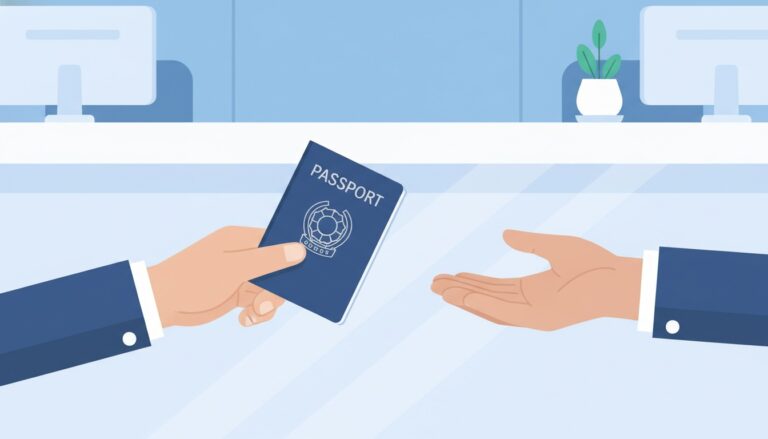
Phase 1: The “Panic Moment” at the Counter
Hello! I’m your editor at Daily Hangul. 👋
Picture this: You’ve finally worked up the courage to walk into a Korean bank (or maybe a telecom store to get that SIM card). You’ve rehearsed your greeting. You pull a ticket from the machine. Ding-dong! It’s your turn.
The teller smiles, says something rapid-fire, and holds out a hand. You freeze. Was it a greeting? A question?
In 90% of these administrative situations—whether you’re opening a bank account in Gangnam or trying to buy a beer at a loud Hongdae pocha (tent bar)—they are asking for one thing: Your ID.
Today, we aren’t just learning the word for “ID card.” We’re learning how to hand it over with the grace of a K-Drama lead, not a confused tourist. Let’s get your identity verified, Korean style.
Phase 2: Deep Dive (The Big Three)
1. 신분증 (Sinbunjeung)
- Pronunciation:
Shin-bun-jeung[Shin as in shin bone + bun as in bundle + jeung as in jungle] - Meaning: ID Card / Identification
- K-Culture Moment: You know that scene in a crime thriller where the detective flashes a badge? Or when a bouncer stops the baby-faced K-Pop idol at a club? They are asking for this.
- Editor’s Insight: This is the umbrella term. It covers your passport, your residence card, or a driver’s license. If you hear “Shin…” and see a hand extended, just reach for your wallet.
- Situation Spectrum:
[🚫 Formal Only] ———— [✅ Everywhere] ———— [🚫 Slang]- It is the standard, neutral word used by everyone from police officers to convenience store clerks.
- 🤔 Think About It: In English, we just say “ID.” In Korean, Sinbun means “status/identity” and Jeung means “certificate.” It’s literally a “Status Certificate.” Sounds serious, right?
2. 여권 (Yeogwon)
- Pronunciation:
Yeo-gwon[Yeo like yuh + gwon like Gwen Stefani] - Meaning: Passport
- Editor’s Insight: If you are a traveler or don’t have a Korean Residence Card yet, this is your only lifeline. A foreign driver’s license usually won’t cut it at a Korean bank.
3. 여기 있습니다 (Yeogi isseumnida)
- Pronunciation:
Yeo-gi is-sum-ni-da - Meaning: Here it is.
- Real Nuance: “I am presenting this to you respectfully.”
- Editor’s Insight: You can shorten this to “여기요” (Yeogiyo) in a convenience store, but at a bank? Stick to the long version. It makes you sound educated and serious about your money.
Phase 3: Textbook vs. Real Life
Wait, didn’t the textbook say I have to use a full sentence?
| Situation | 📖 Textbook Korean | 🗣️ Real Korean | 💡 Why different? |
|---|---|---|---|
| The Ask | 신분증을 보여 주시겠습니까? (Could you please show me your ID?) | 신분증 좀… (ID, please…) | Koreans value efficiency. They often trail off (…yo) to soften the command without wasting time. |
| The Handover | 여기 제 신분증이 있습니다. (Here is my ID card.) | 네, 여기요. (Yes, here.) | Context is everything. You’re holding a card; they know it’s an ID. No need to narrate your life! |
Phase 4: Cultural Deep Dive — The Art of “Handing Over”
Language is only 50% of the conversation. The rest is body language.
4-1. The “Two-Hand” Rule (Non-verbal)
In Western banking, you might slide your ID across the counter with one hand. In Korea? Don’t do that.
When handing over something important like an ID or credit card:
1. Hold the card with your right hand.
2. Lightly support your right wrist or forearm with your left hand.
3. Or, simply hold the card with both hands.
Why? It shows respect. Giving something with one hand (especially the left) can look dismissive or arrogant to an older generation bank teller.
4-2. K-Drama Connection: The “Soju Check”
Even if you aren’t at a bank, you’ll need this skill.
* Scene: A convenience store (CU or GS25).
* Action: Buying Soju or beer.
* Dialogue: The clerk looks at you. Even if you have a beard and look 40, they might ask: “Shinbunjeung…”
* Reality Check: Take it as a compliment! They are legally required to check if you look young. Just smile and hand it over with two hands. You are now the polite foreigner everyone loves.
Phase 5: Immersive Roleplay
Setting: A quiet branch of KB Bank in Seoul. You need to exchange currency. The air conditioning is cold. The teller looks tired but professional.
Characters:
* YOU: A prepared traveler.
* Teller (Min-ji): Efficient, polite, wearing a uniform.
(Dialogue Start)
Min-ji: 번호표 주시겠어요? (May I have your number ticket?)
YOU: 아, 네. 여기요. (Ah, yes. Here.)
Min-ji: 환전 하러 오셨나요? (Did you come to exchange money?)
YOU: 네, 맞아요. (Yes, that’s right.)
Min-ji: 알겠습니다. 신분증 좀 부탁드립니다. 💳
(Romanization: Al-get-sum-ni-da. Shin-bun-jeung jom bu-tak-deu-rim-ni-da.)
(Translation: Understood. Please give me your ID.)
🔀 DECISION POINT: How do you react?
- A) Freeze and say “What?”
- B) Hand over your Passport with one hand and say “Yeo-gwon.”
- C) Hand over your Passport with two hands and say “Yeogi isseumnida.”
🛑 Analysis:
* Choice A: Natural, but slows things down.
* Choice B: Acceptable, but a bit blunt.
* ✅ Choice C (Best): Perfect! You used the polite phrase and the “manner hands.” The teller will instantly respect you.
(Dialogue Continue)
Min-ji: (Takes passport) 감사합니다. 잠시만 기다려 주세요. (Thank you. Please wait a moment.)
Phase 6: 10-Second Shadowing Drill
Don’t just read it. Feel it. Imagine you are confident.
Context: Handing your ID to the teller.
😊 Bright & Polite:
네 / 여기 / 있습니다!
(Ne / yeo-gi / is-sum-ni-da!)
Yes, here it is!
Context: You need a moment to find it in your bag.
🥺 Apologetic:
아, 잠시만요 / 찾고 / 있어요.
(Ah, jam-si-man-yo / chat-go / i-sseo-yo.)
Ah, just a moment, I’m looking for it.
Phase 7: K-Culture Mini Glossary
| Korean | Romanization | Meaning | Context |
|---|---|---|---|
| 민증 | Min-jeung | Civil ID (Slang) | Short for Jumin-deungnok-jeung. Used by friends/at bars. NOT at a bank. |
| 외국인등록증 | Oegukin-deungnok-jeung | Residence Card | The “Green Card” of Korea. Essential for long-term stay. |
| 서명 | Seo-myeong | Signature | You’ll hear this after showing ID. “Yeogie seomyeong haejuseyo.” |
Phase 8: Traveler’s Survival Kit (Banking Edition)
Heading to a bank in Korea? Don’t leave the hotel without these.
🆘 Survival Essentials
1. YOUR PASSPORT: Not a photocopy. The original. Banks are strict.
2. Phrase: “환전해 주세요” (Hwan-jeon-hae ju-se-yo) – Please exchange money.
3. Pro Tip: Most Korean ATMs close their doors around 11:00 PM or midnight. They are not all 24/7! Also, look for the “Global ATM” sign if using a foreign card.
Phase 9: Think Deeper — Why the Obsession with Age?
Language & Power:
Have you noticed that “Show me your ID” is often the first step in many Korean interactions, specifically at bars or social settings? In Korea, age determines the hierarchy of language. Knowing your birth year tells the other person whether they should use honorifics (Jondaemal) or casual speech (Banmal). It’s not just about legality; it’s about establishing the “social grammar” between two people.
💬 Your Turn: In your culture, is asking for age rude? In Korea, it’s almost necessary to start a friendship. How does that make you feel?
Phase 10: FAQ & Troubleshooting
- Q: Can I use my country’s driver’s license as ID?
- A: At a bank? No. At a bar? Maybe, but don’t count on it. Always carry your passport if you don’t have a Korean Residence Card.
- Q: The teller isn’t saying “Sinbunjeung.” What else could it be?
- A: They might say “Sinn-bunn-hwag-in” (Identity verification). Same result: Hand over the card!
- ❌ Common Mistake:
- Handing over your credit card when they ask for ID. (I’ve done this. It’s awkward.)
- Fix: Listen for the “Jeung” (Certificate) sound at the end of the word.
Phase 11: Wrap-up
One-Liner: When you hear “Shin-bun-jeung,” smile and use two hands to give your passport.
🚀 Action Missions:
* 🥉 Bronze: Say “Yeogi isseumnida” out loud 3 times while handing a pen to yourself in the mirror.
* 🥈 Silver: Watch a K-Drama scene where someone enters a club or buys alcohol. Did they check ID? (Bonus points if you spot the ‘Min-jeung’ slang).
* 🥇 Gold: Go to a convenience store in Korea, buy a beer (if of age), and present your ID with perfect two-hand manners before they even ask.
See you next time at Daily Hangul! Don’t forget your wallet!
Frequently Asked Questions (FAQ)
Q: What does "신분증 (Sinbunjeung)" mean in Korean and how do you pronounce it?
A: In Korean, "신분증 (Sinbunjeung)" is pronounced [Shin-bun-jeung [Shin as in shin bone + bun as in bundle + jeung as in jungle] and means: ID Card / Identification
Q: What does "여권 (Yeogwon)" mean in Korean and how do you pronounce it?
A: In Korean, "여권 (Yeogwon)" is pronounced [Yeo-gwon [Yeo like yuh + gwon like Gwen Stefani] and means: Passport
Q: What does "여기 있습니다 (Yeogi isseumnida)" mean in Korean and how do you pronounce it?
A: In Korean, "여기 있습니다 (Yeogi isseumnida)" is pronounced [Yeo-gi is-sum-ni-da] and means: Here it is.






