

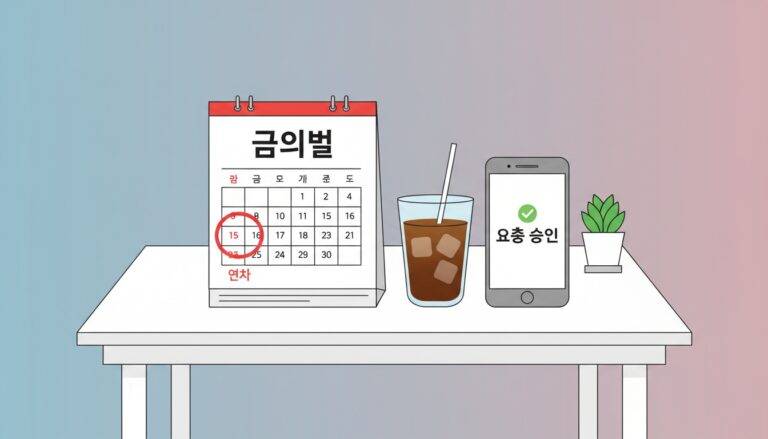
How to Ask for Vacation in Korea Without the Guilt Trip
Phase 1: The ‘Eye Contact’ Moment
Hello! Your Daily Hangul editor here.
Picture this scene from a K-Drama: The office is silent, just the furious sound of keyboards clacking. The protagonist, a nervous new employee, slowly stands up from their cubicle. They walk toward the team leader’s desk, holding a piece of paper. The dramatic music swells. They take a deep breath and say…
“Team Leader… do you have a minute?”
If you’ve worked in Korea, or plan to, you know that asking for Yeoncha (Annual Leave) isn’t just an administrative task—it’s a psychological thriller. In many Western cultures, you just block the calendar. In Korea? It’s often a negotiation of Nunchi (reading the room).
Today, I’m going to teach you how to claim your freedom (legally!) without making the office air turn awkward. Let’s get you that day off.
Phase 2: The Core Expressions
Here are the three phrases you need to navigate this social minefield.
1. 연차를 쓰고 싶습니다 (Yeoncha-reul sseugo sipseumnida)
- Pronunciation: [Yeon-cha-reul sseu-go sip-seum-ni-da]
Sound analogy: ‘Yawn’ (like you’re tired) + ‘Cha’ (cha-cha-cha) + ‘rule’ (with a soft r).- Meaning: I want to use my annual leave. (Direct & Formal)
- K-Culture Moment: You won’t hear this often in casual conversation. This is the sentence you say after you’ve successfully checked the boss’s mood. It’s the official declaration.
- Editor’s Insight: While grammatically correct, starting a conversation with this is too blunt. It feels like throwing a resignation letter on the desk. You need a “buffer” phrase first.
- Situation Spectrum:
[🚫 Friends] ———— [⚠️ Close Colleagues] ———— [✅ Boss/HR]🤔 Think About It: Why does Korean have a specific word for “Annual Leave” (Yeoncha) distinct from just “Vacation” (Hyuga)? It reflects the corporate structure where days off are calculated and earned assets, not just leisure time.
2. 혹시 그날 일정 괜찮으실까요? (Hoksi geunal iljeong gwaenchaneusilkkayo?)
- Pronunciation: [Hok-si geu-nal il-jeong gwaen-cha-neu-sil-kka-yo?]
- Meaning: Would the schedule be okay on that day? (Checking availability)
- K-Culture Moment: This is the real question. You aren’t asking if you can go; you are asking if the team will survive without you. This shows you are a “team player” (a crucial concept in Korean corporate life).
- Editor’s Insight: Use the magic word “Hoksi” (By any chance). It softens any request by 200%. It says, “I am not demanding this, I am gently suggesting it.”
- Situation Spectrum:
[🚫 Friends] ———— [✅ Close Colleagues] ———— [✅ Boss]3. 개인적인 사정이 있어서요 (Gaein-jeogin sajeong-i isseoseoyo)
- Pronunciation: [Gae-in-jeog-in sa-jeong-i i-sseo-seo-yo]
- Meaning: I have a personal matter.
- K-Culture Moment: In K-Dramas, when someone has a secret or just doesn’t want to explain, they use this card. It is the ultimate shield.
- Editor’s Insight: Korean bosses can be inquisitive (“Going on a trip? Who with? Where?”). If you don’t want to share, use this phrase. It politely shuts down the interrogation.
- Situation Spectrum:
[🚫 Friends] ———— [✅ Close Colleagues] ———— [✅ Boss]
Phase 3: Textbook vs. Real Life
| Situation | 📖 Textbook Korean | 🗣️ Real Korean (Survival Mode) | 💡 Why the difference? |
|---|---|---|---|
| Starting the talk | 휴가 신청하고 싶습니다. (I want to apply for vacation.) |
팀장님, 잠깐 시간 괜찮으세요? (Team leader, do you have a sec?) |
You must ‘test the waters’ (Nunchi) before dropping the bomb. |
| Giving a reason | 여행을 갈 계획입니다. (I plan to go on a trip.) |
집에 일이 좀 있어서요… (Something came up at home…) |
vague reasons are often preferred to avoid jealousy or judgment. |
| Asking for approval | 결재해 주십시오. (Please approve this.) |
결재 올렸는데, 확인 부탁드립니다! (I submitted the request, please check it!) |
‘Approve’ sounds demanding. ‘Check’ sounds polite. |
Bottom Note: If you are really close with your boss, you can just say “저 그날 좀 쉴게요!” (I’m gonna rest that day!), but don’t try this until you’ve had at least 10 team dinners together.
Phase 4: Cultural Deep Dive — The Art of ‘Nunchi’ (눈치)
4-1. Non-verbal Communication
When asking for leave, do not smile too broadly. It might look like you hate work and are celebrating your escape. Maintain a neutral, slightly apologetic face (even if you are legally entitled to this leave!).
4-2. K-Drama Connection: The “Electronic Approval” Anxiety
In dramas like Misaeng (Incomplete Life), you see employees nervously watching their computer screens, waiting for the “Approved” (결재 완료) notification. In modern Korean companies, you usually submit the request online first, then go tell your boss verbally. This double-step process is respect. You don’t want your boss to be surprised by an automated email from HR.
Phase 5: Immersive Roleplay
Setting: Tuesday, 2:00 PM. Post-lunch food coma time. The office vibe is relatively calm. You approach Manager Kim (strict but fair).
Characters:
* YOU: An expat employee who wants next Friday off to go to Busan.
* Manager Kim: 40s, slightly tired, typing furiously.
Dialogue:
YOU: (Knocking on the partition lightly) 팀장님, 지금 바쁘세요?
(Timjangnim, jigeum bappeuseyo?)
(Team leader, are you busy right now?)
Manager Kim: (Without looking up) 어, 잠깐만. 이거만 보내고. … 그래, 무슨 일이야?
(Uh, wait a sec. Just sending this. … Okay, what’s up?)
YOU: 다름이 아니라, 다음 주 금요일에 연차를 좀 쓰고 싶어서요.
(Dareumi anira, da-eum ju geumyoire yeonchareul jom sseugo sipeoseoyo.)
(It’s nothing else but… I’d like to use my annual leave next Friday.)
Manager Kim: 금요일? 흠… 그때 마감일 없나?
(Friday? Hmm… Don’t we have a deadline then?)
🔀 Your Turn! How do you respond?
- A) “제 업무는 목요일까지 다 끝내놓겠습니다.” (I will finish all my work by Thursday.)
- B) “법적으로 제 권리입니다.” (It is my legal right.)
- C) “아, 안 될까요? 그럼 취소할게요.” (Ah, is it not allowed? I’ll cancel then.)
✅ Best Choice: A — This is the perfect answer. It relieves the boss’s anxiety about your absence.
⚠️ Choice B Analysis: True, but you might lose your “social credit” in the office. In Korea, relationships often outweigh rules.
Manager Kim: 그래? 미리 다 해놓으면 상관없지. 결재 올려.
(Really? If you finish it beforehand, it doesn’t matter. Submit the request.)
Phase 6: 10-Second Shadowing Drill
Let’s practice the most useful phrase. Say it with a “polite but firm” attitude.
😊 (Polite/Soft) 혹시 / 다음 주 금요일에 / 연차 써도 될까요?
(Hok-si / da-eum ju geum-yo-il-e / yeon-cha sseo-do doel-kka-yo?)
- Emphasis: Stretch the “Hok-si” slightly to sound softer.
- Pause: Slight pause after “Friday” to gauge reaction.
Phase 7: K-Culture Mini Glossary
| Korean | Rom. | Meaning | Context |
|---|---|---|---|
| 연차 | Yeoncha | Annual Leave | The standard term for paid leave in companies. |
| 반차 | Bancha | Half-day off | Very popular in Korea. Use 0.5 days to leave at 2 PM! |
| 징검다리 휴일 | Jing-geom-dari | Bridge Holiday | Taking a day off between a holiday and weekend (e.g., Thu is holiday, Fri is work -> take Fri off). |
| 눈치 | Nunchi | Social Sense | The ability to know when to ask for leave. |
Phase 8: Traveler’s Survival Kit (Business Trip Edition)
Even if you aren’t working in a Korean office, you might need to extend a business trip for leisure.
🆘 Survival Expression #1
* 🇰🇷 “하루 더 묵고 싶어요.” (Haru deo mukgo sipeoyo)
* 🗣️ Pronunciation: [Ha-ru deo muk-go si-peo-yo]
* 📍 Where: Hotel reception
* 💡 Meaning: I want to stay one more day.📌 Editor’s Travel Note
* Check-out times: Usually 11:00 AM strictly. Late check-out often incurs a fee.
* Extending stays: Weekends in Seoul are often fully booked. Ask on Thursday if possible.
Phase 9: Think Deeper — “Rest is a Crime?”
Collectivism vs. Individualism:
In many Western cultures, an employment contract is strictly transactional: “I give you work, you give me money and vacation.” In Korea, a company is traditionally viewed as a pseudo-family (or a military unit). Taking a day off when the team is busy can be seen as “abandoning your comrades” in the trenches.
This is changing rapidly with the younger generation (MZ Generation), who value work-life balance (Wor-ra-bal). But the legacy of “sorry for resting” still lingers in the language we use—like starting sentences with “I’m sorry, but…” before asking for rights.
💬 Your Turn: Does your culture view vacation as a “right” or a “favor”? How do you ask for it?
Phase 10: FAQ & Troubleshooting
Q: Can I ask for leave on a Monday or Friday?
A: Yes, but be careful. Taking leave attached to a weekend is called “sticking it on” (붙여서 쓰다). Older bosses might jokingly say, “Wow, taking a long weekend?” Just smile and say, “Ne! (Yes!)” confidentially. It’s becoming much more common now.
Q: Do I have to tell them exactly where I am going?
A: No. You can say “Just resting at home” (집에서 좀 쉬려고요) even if you are flying to Jeju Island. It’s often better to be vague so they don’t ask you to bring back gifts!
❌ Common Mistake: Saying “I want to play” (놀고 싶어서요).
✅ Fix: Say “I need to recharge” (충전이 좀 필요해서요) or “I have personal matters” (개인 사정).
Phase 11: Wrap-up & Mission
One-Liner: Asking for leave in Korea is 20% paperwork and 80% reading the room (Nunchi).
Action Missions:
* 🥉 Bronze: Look in the mirror and practice the “Sorry but I need this” face while saying “Yeon-cha.”
* 🥈 Silver: Watch a K-Drama office scene and spot when someone gets scolded for bad timing. Post the timestamp in the comments!
* 🥇 Gold: If you have a Korean friend, ask them: “Hoksi… naeil bappa?” (By chance… are you busy tomorrow?) using the soft tone we practiced.
K-Culture Mission: Search for “Jing-geom-dari holiday” (Sandwich holiday) on a Korean calendar for this year. When is the best time to use your Yeoncha?
Phase 12: Quiz — The “Nunchi” Challenge
Situation: Your boss just got yelled at by the CEO. He is sighing deeply and rubbing his temples. You have a flight booked for tomorrow evening.
What should you do?
- Run up to him and shout: “Sign my vacation form!”
- Wait until he goes for a smoke/coffee break, then send a polite message or email first.
- Just don’t show up tomorrow.
Correct Answer: 2. Timing is everything. Approaching an angry boss with a request is suicide. Sending a written request first allows him to process it calmly.
Frequently Asked Questions (FAQ)
Q: What does "연차를 쓰고 싶습니다 (Yeoncha-reul sseugo sipseumnida)" mean in Korean and how do you pronounce it?
A: In Korean, "연차를 쓰고 싶습니다 (Yeoncha-reul sseugo sipseumnida)" is pronounced [Yeon-cha-reul sseu-go sip-seum-ni-da] and means: I want to use my annual leave. (Direct & Formal)
Q: What does "혹시 그날 일정 괜찮으실까요? (Hoksi geunal iljeong gwaenchaneusilkkayo?)" mean in Korean and how do you pronounce it?
A: In Korean, "혹시 그날 일정 괜찮으실까요? (Hoksi geunal iljeong gwaenchaneusilkkayo?)" is pronounced [Hok-si geu-nal il-jeong gwaen-cha-neu-sil-kka-yo?] and means: Would the schedule be okay on that day? (Checking availability)
Q: What does "개인적인 사정이 있어서요 (Gaein-jeogin sajeong-i isseoseoyo)" mean in Korean and how do you pronounce it?
A: In Korean, "개인적인 사정이 있어서요 (Gaein-jeogin sajeong-i isseoseoyo)" is pronounced [Gae-in-jeog-in sa-jeong-i i-sseo-seo-yo] and means: I have a personal matter.







