

Phase 1: The ‘Running Late’ Scene
Hello! This is your editor from Daily Hangul.
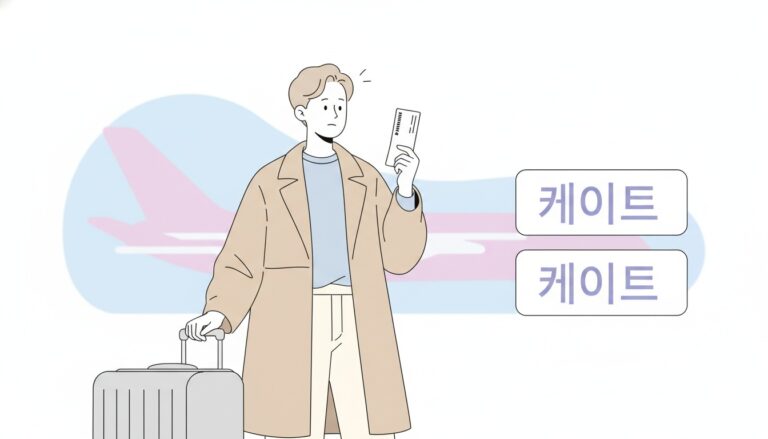
We’ve all seen that scene in a K-Drama. The main character realizes—usually 20 minutes too late—that the love of their life is leaving for America. They sprint through Incheon Airport, dodging luggage carts, sweat dripping down their face, desperate to find the right gate before the plane takes off.
Now, you probably aren’t chasing a long-lost lover (or maybe you are, I don’t judge), but the panic of being lost in Incheon Airport is very real. It is massive. It’s not just an airport; it’s a small city with robots, luxury stores, and a never-ending flow of people.
Your flight leaves in 40 minutes. You passed security, but the signs are confusing. You need to ask someone where to go. If you just shove your ticket in someone’s face, it works, but it’s not exactly polite. Let’s learn the one sentence that turns you from a “confused tourist” into a “savvy traveler.”
Phase 2: Deep Dive into the “Where?”
Here are the three tools you need in your linguistic pocket.
1. 게이트 어디예요? (Where is the gate?)
- Pronunciation: [Ge-i-teu eo-di-ye-yo?]
- Sound-alike: Ge (like ‘get’) + i (like letter ‘E’) + teu (like ‘two’ but soft) + Au-dee-yeah-yo?
- Meaning: Where is the gate? (Literal: Gate where is it?)
- Editor’s Insight: Korean adopts the English word “Gate,” so you don’t need to memorize a difficult native word like tap-seung-gu. The ending “-yeyo” is the polite sticker. Without it, you sound like a boss talking to an employee. Don’t drop it!
- Situation Spectrum:
[🚫 Boss/Elder] ———— [⚠️ Stranger] ———— [✅ Friendly/Standard]
(Note: This is the safe, standard politeness level for strangers.)🤔 Think About It: Notice the word order? “Gate where is?” unlike English “Where is the gate?” Korean puts the most important subject first. Why do you think that is?
2. 혹시… (By any chance…)
- Pronunciation: [Hok-si]
- Sound-alike: Hoke (rhymes with poke) + she
- Meaning: By any chance / Excuse me
- K-Culture Moment: You hear this constantly in dramas when someone approaches a stranger on the street. It’s the “softener.” It signals, “I am about to bother you, and I am sorry about it.”
- Editor’s Insight: If you just walk up to a Korean person and say “Where is the gate?”, it can feel a bit sudden. Starting with “Hoksi…” gives them time to prepare to listen.
3. 저기요 (Excuse me / Over there)
- Pronunciation: [Jeo-gi-yo]
- Sound-alike: Jug (like a water jug) + ee + yo
- Meaning: Excuse me (to get attention)
- Situation Spectrum:
[🚫 Elders] ———— [⚠️ Strangers] ———— [✅ Staff/Servers]
(Use this to call staff or stop someone walking by. If they are older than you, “Sillye-hamnida” is safer, but “Jeogiyo” works for airport staff.)
Phase 3: Textbook vs. Real Life
| Situation | 📖 Textbook Korean | 🗣️ Real Street Korean | 💡 Why the difference? |
|---|---|---|---|
| Asking for the gate | 탑승구가 어디입니까? (Tapseung-guga eodi-imnikka?) | 게이트 어디예요? (Ge-i-teu eodi-yeyo?) | “Tapseung-gu” is too formal and old-fashioned. Everyone uses “Gate” now. |
| Showing your ticket | 이것은 어디입니까? (Igeos-eun eodi-imnikka?) | 여기 어디예요? (Yeogi eodi-yeyo?) | Pointing at the ticket and asking “Where is here?” is faster and clearer. |
Bottom Note: Don’t worry about perfect grammar sentences like “Could you please tell me…” Just pointing at the destination on your ticket and asking “Eodi-yeyo?” (Where is it?) is perfectly natural.
Phase 4: Cultural Context — The “Bali Bali” Airport
4-1. Non-verbal: The Open Hand
In Western cultures, pointing with an index finger is fine. In Korea, pointing with a finger at a person or even a direction can sometimes feel aggressive. When airport staff show you the way, notice they use an open hand, like they are presenting a prize on a game show. Try to do the same when pointing at your ticket.
4-2. K-Travel Connection: The Robot Guides
Incheon Airport is famous for its “Airstar” robots. They wander around looking cute. If you are too shy to speak to a human, look for the robot with the LCD face. But speaking to humans is better practice! Also, Koreans have a “Bali Bali” (Hurry Hurry) culture. People walk fast. If you stop in the middle of the hallway to look at your phone, you become a traffic jam. Move to the side!
Phase 5: Roleplay Scenario
Setting: Incheon Airport, Terminal 1. It is crowded. You are holding your boarding pass, looking confused near the duty-free cosmetics shop.
Characters:
– YOU: A traveler running slightly late.
– Min-ji: An airport information desk staff member.
The Scene:
YOU: (Approaching the desk) 저기요… 혹시…
(Jeogiyo… hoksi…)
(Excuse me… by any chance…)
Min-ji: 네, 도와드릴까요?
(Ne, dowa-deurilkkayo?)
(Yes, can I help you?)
YOU: 게이트… 10번… 어디예요?
(Ge-i-teu… sip-beon… eodi-yeyo?)
(Where is… Gate 10?)
Min-ji: (Pointing right) 저쪽이에요. 오른쪽으로 가세요.
(Jeojjok-ieyo. Oreunjjok-euro gaseyo.)
(It’s that way. Go right.)
🔀 Your Turn! How do you reply?
– A) “Okay, bye.” (Leaving immediately)
– B) “감사합니다!” (Gamsahamnida!)
– C) “사랑해요!” (Saranghaeyo!)✅ Best Choice: B. “Gamsahamnida” (Thank you) is the standard, polite response. Even a slight bow of the head is perfect.
⚠️ Choice C Analysis: Do not tell the airport staff you love them. This only happens in K-Dramas if the staff member is actually your ex-boyfriend.
Phase 6: 10-Second Shadowing Drill
Repeat after me. Focus on the intonation—it goes up at the end like a question.
- 😟 With a worried face:
혹시 / 게이트 / 어디예요?
(Hoksi / ge-i-teu / eo-di-ye-yo?) -
👉 Pointing at your ticket:
여기 / 어디예요?
(Yeo-gi / eo-di-ye-yo?)
Phase 7: K-Culture Mini Glossary
| Korean | Romanization | English | Context |
|---|---|---|---|
| 면세점 | Myeon-se-jeom | Duty-Free Shop | The place you spend all your money before flying. |
| 여권 | Yeo-gwon | Passport | The one thing you must not lose. |
| 화장실 | Hwa-jang-sil | Restroom | Useful to ask “Hwajangsil eodi-yeyo?” |
Phase 8: Traveler’s Survival Kit
🆘 Survival Expression #1
– 🇰🇷 “한국말 잘 못해요.” (Hanguk-mal jal mot-haeyo.)
– 🗣️ Pronunciation: [Han-guk-mal jal mot-te-yo]
– 📍 Use: When someone starts speaking Korean too fast.
– 💡 Pro Tip: Incheon Airport has excellent English signage, but small shops inside might not. This phrase lowers expectations instantly.📌 Editor’s Travel Note
– WiFi: Incheon Airport has the fastest free WiFi in the world. You don’t need a password.
– Water: You can drink the water from fountains, unlike in some countries. It’s safe!
Phase 9: Think Deeper — Language & Politeness
Notice how we add “-yo” (요) to everything? Eodi-yeyo? Jeogi-yo?
In Korean culture, language isn’t just about information; it’s about social distance. When you add “-yo,” you are creating a respectful buffer zone between you and the stranger. It acknowledges, “I don’t know you, so I will respect your space.”
🧠 Think Deeper: In English, we use “Please” or “Could you…” to be polite. Korean changes the entire verb ending. Does your native language have different words for talking to strangers vs. friends?
Phase 10: FAQ & Troubleshooting
Q: Can I use “Gate eodi-ya?” (leaving off the ‘yo’)?
A: NO. Keep the ‘yo’. Removing it makes it “Banmal” (casual speech). If you say this to a stranger, they might think you are picking a fight or being incredibly rude. Save Banmal for close friends or people younger than you (after you know them well).
Q: What if I don’t know the Korean number for the gate?
A: Just say the number in English! “Gate Ten eodi-yeyo?” 99% of airport staff understand English numbers. Don’t stress about learning Sino-Korean numbers just to catch a flight.
❌ Common Mistake: shouting “EXCUSE ME!” in English loudly.
✅ Better Way: Softly saying “Jeogiyo…” or “Excuse me” in a calm voice.
Phase 11: Wrap-up
One-Liner: To find your way, remember to point at your ticket and ask “Yeogi eodi-yeyo?” with a polite “yo” at the end.
Action Mission:
– 🥉 Bronze: Look at a map of your local airport online and say “Gate [Number] eodi-yeyo?” three times.
– 🥈 Silver: Watch a K-Drama airport scene (there is always one) and listen for “Eodi-yeyo.”
– 🥇 Gold: Next time you are at any Korean restaurant or shop, ask where the restroom is: “Hwajangsil eodi-yeyo?”
Phase 12: Quiz
1. You see a security guard and want to ask for directions. How do you start?
A. Ya! (Hey!)
B. Jeogiyo… (Excuse me…)
C. Saranghaeyo. (I love you.)
2. True or False?
It is polite to point with just your index finger at the staff’s face when asking a question.
3. Which sentence is safer for a beginner?
A. Gate eodi-ya?
B. Gate eodi-yeyo?
Answers:
1. B (A is rude, C is weird.)
2. False (Use an open hand or point at the object/ticket, not the person.)
3. B (Always keep the ‘yo’!)
Frequently Asked Questions (FAQ)
Q: What does "게이트 어디예요? (Where is the gate?)" mean in Korean and how do you pronounce it?
A: In Korean, "게이트 어디예요? (Where is the gate?)" is pronounced [Ge-i-teu eo-di-ye-yo?] and means: Where is the gate? (Literal: Gate where is it?)
Q: What does "혹시... (By any chance...)" mean in Korean and how do you pronounce it?
A: In Korean, "혹시... (By any chance...)" is pronounced [Hok-si] and means: By any chance / Excuse me
Q: What does "저기요 (Excuse me / Over there)" mean in Korean and how do you pronounce it?
A: In Korean, "저기요 (Excuse me / Over there)" is pronounced [Jeo-gi-yo] and means: Excuse me (to get attention)







