

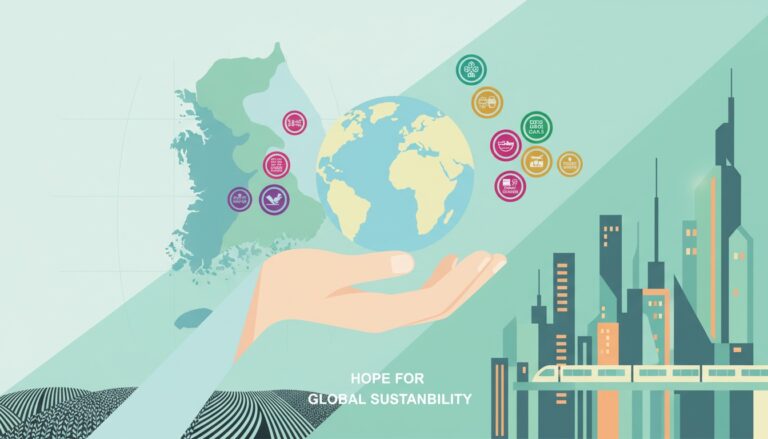
Phase 1: The Hook — More Than Just K-Pop at the UN
Hello! Daily Hangul editor here.
Remember when BTS danced through the UN General Assembly hall? Or when BLACKPINK spoke about climate change? It wasn’t just a win for the fandoms. For Koreans watching the news, those moments hit a very specific emotional chord that foreigners often miss.
In less than a lifetime, South Korea went from being one of the poorest countries relying on foreign aid to a major donor country. This transition defines the modern Korean identity. When you talk about ODA (Official Development Assistance) or SDGs (Sustainable Development Goals) in Korean, you aren’t just discussing policy. You are tapping into a narrative of national pride, the “Miracle on the Han River,” and a lingering pressure to prove that Korea belongs at the “developed nations” table.
If you are at a C2 level, you need to move beyond simple translations of “environment” or “poverty.” You need to express how Korea views its responsibility to the world. Let’s look at the language of rapid development and global responsibility.
Phase 2: Deep Dive — Words That Carry History
1. 격세지감 (Gyeok-se-ji-gam)
- Pronunciation: [Gyeok-se-ji-gam] (Sounds like ‘Gyeok’ as in ‘yuck’ but with a G, ‘se’, ‘ji’, ‘gam’)
- Meaning: Literally “feeling separated by a generation.” It refers to a change so drastic it feels like a different world.
- K-Culture Moment: You hear this in documentaries or when older CEOs talk about ODA projects. They look at a developing nation’s struggle and say, “It feels like yesterday we were here. It’s truly gyeok-se-ji-gam.”
- Editor’s Insight: This is the perfect C2 idiom to validate Korea’s history. It shows you understand where they came from. It’s not just “things changed.”
- Situation Spectrum:
[🚫 Casual Friends] ———— [✅ Business/Formal] ———— [✅ Interviews] - 🤔 Think About It: Why does a single idiom exist specifically for “drastic change over a short time”? Perhaps because Korean history has been nothing but drastic changes since 1950.
2. 발 벗고 나서다 (Bal beot-go na-seo-da)
- Pronunciation: [Bal beot-go na-seo-da] (Imagine stepping out ‘barefoot’)
- Meaning: Literally “to step forward with bare feet.” It means to participate actively and enthusiastically, not just passively helping.
- K-Culture Moment: News anchors love this. “Government steps forward barefoot to achieve carbon neutrality.” It implies urgency and sincerity.
- Editor’s Insight: If you say you will “support” a project, it’s weak. If you say you will “step forward barefoot,” you are telling your Korean partners you are all-in.
- Situation Spectrum:
[✅ Casual] ———— [✅ Business] ———— [✅ Formal]
3. 보여주기식 (Bo-yeo-ju-gi-sik)
- Pronunciation: [Bo-yeo-ju-gi-sik]
- Meaning: “Show-off style” or performative. Doing something just for optics.
- K-Culture Moment: This is the cynical side. In office dramas like Misaeng, when a company does a CSR (Corporate Social Responsibility) event just for photos, employees whisper, “Ah, it’s just bo-yeo-ju-gi-sik.”
- Editor’s Insight: Use this to critique ineffective SDG policies. It shows you have a sharp, critical eye and aren’t just a foreigner nodding along.
- Situation Spectrum:
[✅ Private/Honest Talk] ———— [⚠️ Formal Meetings] ———— [🚫 To the Boss]
Phase 3: Textbook vs. Real Life
| Situation | 📖 Textbook Korean | 🗣️ Real Korean (C2 Level) | 💡 The Context |
|---|---|---|---|
| Discussing Progress | 목표 달성이 잘 되고 있습니다. (Goal achievement is going well.) |
가시적인 성과가 나오고 있습니다. (Tangible results are coming out.) |
In ODA/Business, “doing well” is too vague. We need “visible” (tangible) proof. |
| Offering Help | 저희가 도와드리겠습니다. (We will help you.) |
노하우를 전수해 드리겠습니다. (We will pass down our know-how.) |
Korea prefers sharing “experience/know-how” over just giving money/help. It sounds less arrogant. |
| Criticizing a Plan | 그 계획은 현실성이 없습니다. (That plan has no reality.) |
현지 사정을 고려하지 않은 탁상행정입니다. (It’s ‘desk administration’ ignoring local conditions.) |
탁상행정 (Table-top admin) is the ultimate insult for bureaucrats who don’t visit the field. |
Bottom Note: Tak-sang-haeng-jeong (Desk administration) is a killer vocabulary word. Use it when a policy makes no sense in the real world. Everyone will respect you (or fear you).
Phase 4: Cultural Deep Dive — The “Recycling” Obsession
Let’s talk about SDG 12 (Responsible Consumption and Production). In Korea, this isn’t abstract; it’s a daily source of stress and pride.
The Non-Verbal Pressure:
Have you ever stood in front of a Korean trash can area? It looks like a spaceship control panel. General waste, food waste (which you pay for by weight in many places), plastic, vinyl, cans, paper… If you throw a plastic bottle with the label still on it into the plastic bin, a grandmother or a security guard will appear from nowhere to scold you. This intense “nunchi” (social sensing) drives high recycling rates.
The K-Drama Connection:
You often see scenes where a rich chaebol character is humbled by being forced to sort trash by a poor protagonist. It’s a equalizer. No matter how rich you are, in Korea, you must separate your food waste.
Critical Angle:
Why is Korea so strict? It’s a small landmass with few natural resources. “Sustainability” here is about survival, not just being eco-friendly. When discussing SDGs in Korea, acknowledge this scarcity mindset.
Phase 5: Immersive Roleplay — The ODA Strategy Meeting
Setting: A conference room in Seoul, overlooking the city. You are an international consultant discussing a development project in Southeast Asia with Director Kim (50s, proud of Korea’s development model) and Manager Lee (30s, practical and cynical).
Dialogue:
Director Kim: 이번 프로젝트는 한국의 경제 성장 모델을 그대로 이식하는 것이 핵심입니다.
(Ibeon peurojekteu-neun hangug-ui gyeongje seongjang model-eul geudaero isik-haneun geosi haeksim-imnida.)
[The core of this project is transplanting Korea’s economic growth model exactly as it is.]
YOU: (Politely pushing back) 물론 훌륭한 모델입니다만, 현지 상황에 맞게 수정이 필요하지 않을까요?
(Mullon hullyunghan model-imnidaman, hyeonji sanghwang-e matge sujeong-i piryohaji aneulkkayo?)
[Of course, it’s an excellent model, but shouldn’t we modify it to fit the local situation?]
Manager Lee: 맞아요. 무조건적인 적용은 자칫하면 보여주기식 사업으로 끝날 수 있습니다.
(Majayo. Mujogeonjeogin jeogyong-eun jachithamyeon bo-yeo-ju-gi-sik saeob-euro kkeunnal su itseumnida.)
[Right. Unconditional application could end up just being a performative project.]
Director Kim: (Frowning) 그래도 우리가 겪은 시행착오를 줄여주는 게 진정한 노하우 전수 아닐까요?
(Geuraedo uriga gyeok-eun sihaengchago-reul juryeojuneun ge jinjeonghan nohau jeonsu anilkkayo?)
[Still, isn’t reducing the trial and error we went through the true transfer of know-how?]
🔀 Your Turn! How do you mediate?
– A) “Director Kim is right. We should follow the Korean way.” (Safe, but you lose respect as an expert.)
– B) “Times have changed. That old method is tak-sang-haeng-jeong.” (Too aggressive. Do not insult the Director’s era.)
– C) “Director Kim’s intention is right, but to avoid trial and error (sihaengchago), we need local customization.”✅ Best Choice: C. You validate his intent (giving know-how) while siding with the Manager’s practicality. You use the Director’s own logic against him gently.
Phase 6: 10-Second Shadowing Drill
Let’s practice a sentence that perfectly summarizes Korea’s stance on SDGs/ODA. Speak with a tone of humble pride.
🇰🇷 “우리가 / 도움을 받던 나라에서 / 도움을 주는 나라가 된 만큼 / 책임감도 큽니다.”
(Uriga / doumeul batdeon nara-eseo / doumeul juneun nara-ga doen mankeum / chaegimgam-do keumnida.)Meaning: “Since we have turned from a recipient country into a donor country, our responsibility is also great.”
Emotion: 😊 Proud but solemn (Serious face, slight nod).
Phase 7: K-Culture Mini Glossary (Development Edition)
| Word | Romanization | Meaning & Context |
|---|---|---|
| 선진국 | Seonjinguk | Advanced/Developed Nation. Koreans are obsessed with this status. “Are we a seonjinguk yet?” is a common debate. |
| 수원국 | Suwonguk | Recipient Country. The formal term for countries receiving aid. Antonym: 공여국 (Gongyeoguk – Donor Country). |
| 빨리빨리 | Pali-pali | Hurry Hurry. Korea’s speed culture. In development contexts, this is both a strength (fast infrastructure) and a weakness (safety issues). |
| 국격 | Gukgyeok | National Prestige/Dignity. ODA is often discussed as a way to raise “Gukgyeok.” |
Phase 8: Traveler’s Survival Kit (Business Trip Edition)
If you are visiting Korea for a conference, NGO meeting, or business related to SDGs:
🆘 Survival Expression #1: The Business Card Ritual
– 🇰🇷 “명함 하나 주시겠습니까?” (Myeongham hana jusigesseumnika?)
– Meaning: “Could you give me a business card?”
– Why: In Korea, you don’t exist until you exchange cards. Receive it with two hands, study it for 5 seconds (do NOT put it away immediately), and place it on the table in front of you.📌 Editor’s Note:
If you are discussing SDGs, bring a digital business card (QR code) as an option. Introduce it as: “종이 사용을 줄이려고 합니다” (I’m trying to reduce paper use). It’s a great icebreaker that proves your commitment to the topic!
Phase 9: Think Deeper — “The Han River Miracle” Narrative
Topic: Is the “Korean Model” always right?
Korea often markets its development history as the ultimate roadmap for developing nations. But there’s a critical angle here. The rapid growth came at a cost: military dictatorship, labor suppression, and environmental neglect—things modern SDGs explicitly try to avoid.
When speaking Korean at a high level (C2), you can acknowledge this nuance. Instead of just praising the “Miracle,” ask: “How can we achieve the speed of Korea’s growth without the social side effects Korea suffered?” (한국의 고속 성장은 배우되, 부작용은 어떻게 피할 수 있을까요?). This question shows you respect their achievement but also understand the complexity of sustainable development.
Phase 10: FAQ & Troubleshooting
Q: Can I use informal language (Banmal) with local NGO workers if I am the donor/funder?
A: Absolutely NO. Even if you are bringing the money, using Banmal implies hierarchy and disrespect. In the world of international cooperation, “partnership” (동반자 관계) is key. Always use honorifics (Jondaemal) to show you view them as equals, not subordinates.
Q: Is it okay to critique Korea’s plastic use?
A: Yes, but frame it as a “shared global problem.” Koreans are already hyper-aware of their plastic consumption (cafes banned plastic cups for dine-in). If you say, “Korea uses too much plastic,” it sounds like an attack. If you say, “We all struggle with plastic, but I was impressed by Korea’s strict recycling system,” you win friends.
Phase 11: Wrap-up & Mission
Summary: Today we learned how to discuss Korea’s transformation from aid recipient to donor using high-level vocabulary like 격세지감 and 보여주기식.
🚀 Action Missions:
– 🥉 Bronze: Say “Gyeok-se-ji-gam” when looking at an old photo of Seoul vs. now.
– 🥈 Silver: Read a Korean news headline about ODA or ESG and find the word “지속가능” (Sustainable).
– 🥇 Gold: Use the phrase “시행착오를 줄이다” (Reduce trial and error) in your next business meeting or serious conversation.
K-Culture Mission: Watch a clip of a K-Pop idol’s speech at the UN (e.g., BTS). Notice when they switch from personal stories to formal “global citizen” language. Can you hear the shift in tone?
Phase 12: Quiz — Are You a Diplomat?
- Situation: Your partner proposes a project that looks good on paper but won’t work in the humid local climate. What word describes this plan?
- A) 격세지감
- B) 탁상행정
- C) 발 벗고 나서다
- True or False: In a business meeting regarding aid, it is polite to emphasize that you are “giving help” repeatedly.
- (True / False)
- Culture: Which behavior might get you scolded by a security guard in an apartment complex?
- A) Bowing too low.
- B) throwing a soda can into the ‘General Waste’ bin.
- C) Walking fast.
Answers:
1. B (Tak-sang-haeng-jeong). Desk administration.
2. False. Emphasize “sharing experience” or “partnership.” Focusing on “giving help” creates a vertical hierarchy.
3. B. Recycling is taken very seriously.
Frequently Asked Questions (FAQ)
Q: What does "격세지감 (Gyeok-se-ji-gam)" mean in Korean and how do you pronounce it?
A: In Korean, "격세지감 (Gyeok-se-ji-gam)" is pronounced [Gyeok-se-ji-gam] and means: Literally "feeling separated by a generation." It refers to a change so drastic it feels like a different world.
Q: What does "발 벗고 나서다 (Bal beot-go na-seo-da)" mean in Korean and how do you pronounce it?
A: In Korean, "발 벗고 나서다 (Bal beot-go na-seo-da)" is pronounced [Bal beot-go na-seo-da] and means: Literally "to step forward with bare feet." It means to participate actively and enthusiastically, not just passively helping.
Q: What does "보여주기식 (Bo-yeo-ju-gi-sik)" mean in Korean and how do you pronounce it?
A: In Korean, "보여주기식 (Bo-yeo-ju-gi-sik)" is pronounced [Bo-yeo-ju-gi-sik] and means: "Show-off style" or performative. Doing something just for optics.







