

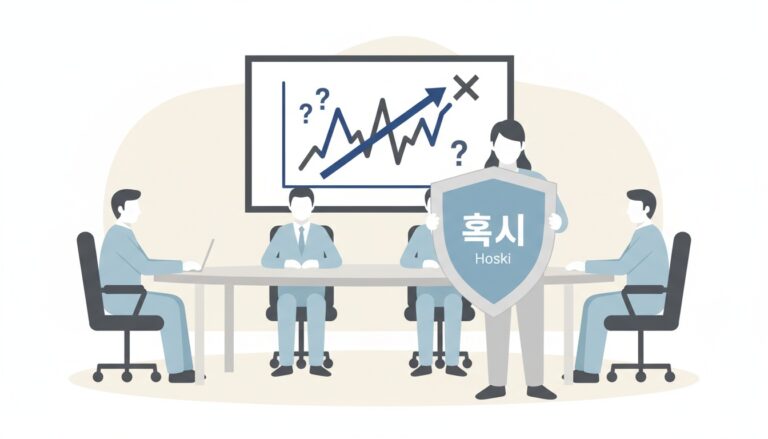
Phase 1: The Art of “Maybe” — Reading the Room
Hello! This is your Daily Hangul editor. 👋
Let’s be honest. In data analysis, we calculate probability with p-values and confidence intervals. But in Korean society, we calculate probability with Nunchi (눈치).
Imagine a typical K-Drama scene: The protagonist is a new employee. The team is deciding on a lunch menu. The intimidating boss says, “I’m fine with anything,” but his eyes are fixed on the spicy Kimchi Stew poster. The statistical probability that he actually wants pasta is 0.01%, even though he said “anything.”
If you take his words literally (Textbook Korean), you might suggest pasta and face a “social risk.” If you use probabilistic thinking (Real Korean), you’ll suggest, “How about spicy soup today?”
Today, we aren’t just learning words for “chance” or “risk.” We are learning how to navigate uncertainty in Korea—how to hedge your bets, soften your assertions, and prepare for the unexpected without sounding wishy-washy. This is C1 level: it’s about subtlety.
Phase 2: Deep Dive into Core Expressions
1. 혹시 모르니까 (Hoksi moreunikka)
- Pronunciation: [Hok-shi mo-reu-ni-kka] (Sounds like: “Hoke-she” + “more” + “nick” + “ah”)
- Meaning: “Just in case” / “Because you never know”
- K-Culture Moment: You see this in variety shows like 2 Days & 1 Night. Even for a short trip, someone packs ramyun, medicine, and three jackets. Why? Hoksi moreunikka.
- Editor’s Insight: This is the ultimate risk management phrase. It justifies over-preparation. It’s not about being paranoid; it’s about being thorough. Koreans love preparedness.
- Situation Spectrum:
[🚫 Formal Speech/Presentations] ———— [⚠️ Colleagues] ———— [✅ Friends/Daily Life]
(Note: In a very formal presentation, use ‘만약의 사태를 대비하여’ instead.) - 🤔 Think About It: Why does this phrase often precede an act of care (like bringing an extra umbrella for a friend)? Is risk management a form of affection in Korea?
2. 간(을) 하다 / 간(을) 보다 (Gan-eul boda)
- Pronunciation: [Gan-eul bo-da] (Sounds like: “Gone” + “eul” + “bow-da”)
- Meaning: Literally “to taste the seasoning” → Figuratively “to test the waters” or “to weigh the odds.”
- K-Culture Moment: In corporate K-Dramas, before a big merger, companies will “gan-eul boda”—sending vague signals to see how the other side reacts without committing. It’s a strategic dance.
- Editor’s Insight: This is a high-level idiom. If you say someone is “Gans seeing” (간 보고 있다), it implies they are calculating their benefit/risk ratio before making a move. It can have a slightly negative nuance of being too calculating.
- Situation Spectrum:
[🚫 To your boss about yourself] ———— [⚠️ About a third party] ———— [✅ Close Peers] - 🤔 Think About It: Salt (
gan) is the most crucial part of Korean cooking. Why is “social calibration” compared to cooking?
3. 설마 그럴 리가요 (Seolma geureol ligayo)
- Pronunciation: [Seol-ma geu-reol li-ga-yo]
- Meaning: “Surely that can’t be possible” / “No way” (Probability ≈ 0%)
- Editor’s Insight: Use this when you want to deny a high-risk possibility, but deep down, you fear it might be true. It’s often the famous “famous last words” in movies before the zombie outbreak starts.
Phase 3: Textbook vs. Real Life
| Situation | 📖 Textbook Korean | 🗣️ Real Korean | 💡 Why different? |
|---|---|---|---|
| Predicting an outcome | 아마도 그럴 것입니다. (It will probably be so.) |
케바케죠. (It’s case-by-case.) |
Koreans love abbreviations. Ke-ba-ke acknowledges variable data points instantly. |
| Risky Choice | 운에 맡기겠습니다. (I will leave it to luck.) |
복불복이죠! (Bok-bul-bok!) |
Bokbulbok is a cultural institution (Blessing vs. No Blessing). It makes risk fun rather than scary. |
| Uncertain Plan | 갈 수 있을지 모르겠습니다. (I don’t know if I can go.) |
상황 봐서요. (I’ll look at the situation.) |
This is the polite Korean way to delay confirmation (risk avoidance) without saying “No.” |
💡 Bottom Note: “Ke-ba-ke” (Case-by-case) is universally understood, even in semi-formal office chats (but not in reports!).
Phase 4: Cultural Deep Dive — The Probability of “Nunchi”
4-1. Non-verbal: The “Eum…” (음…)
In Western culture, silence during a risky conversation might mean “I’m thinking.” In Korea, a prolonged “Eum…” accompanied by avoiding eye contact usually increases the probability of rejection to 90%.
- Risk Management Tip: If you hear “Eum…” after asking a favor, give them an out immediately. “If it’s too difficult, don’t worry!” (곤란하시면 괜찮아요!). You save their face, and you save the relationship.
4-2. K-Culture Connection: The “Bokbulbok” (복불복) Game
In the legendary variety show 1 Night 2 Days, members play games to decide who sleeps indoors (comfy) or outdoors in a tent (freezing). This is Bokbulbok.
- Critical View: Why is Korea obsessed with luck-based games? Perhaps in a highly competitive, high-pressure society, surrendering to “pure luck” provides a momentary psychological relief from the burden of constant effort and calculation.
Phase 5: Immersive Roleplay — The Project Launch
Setting: A meeting room in Pangyo (Korea’s Silicon Valley). Tuesday, 3 PM. You are the Team Lead discussing a product launch with Minji, a bright but cautious manager.
Characters:
* YOU (Team Lead): Wanting to push forward but checking risks.
* Minji: Has analyzed the data and is worried.
Dialogue:
Minji: 팀장님, 이번 서버 증설 말인데요… 예산이 좀 빠듯할 것 같아요. 📉
(Timjangnim, ibeon seobeo jeungseol mal-indeyo… yesan-i jom ppadeut-hal geot gat-ayo.)
(Lead, about the server expansion… the budget looks a bit tight.)
YOU:
🔀 Your Turn! How do you handle the risk?
* A) “설마 문제가 생기겠어? 그냥 진행해.” (Dismissive Risk Taker)
* B) “혹시 모르니까 예비비를 좀 챙겨둡시다.” (Prudent Manager)
* C) “간 보지 말고 확실하게 말해봐요.” (Aggressive/Direct)
✅ Best Choice: B
* Translation: “Just in case (Hoksi moreunikka), let’s set aside some contingency funds.”
* Why: Option A is reckless (typical “kkondae” boss). Option C is too aggressive for a simple budget concern. B shows leadership and risk management.
Minji: 네, 알겠습니다! 만약을 대비해서 플랜 B도 짜올게요. 🫡
(Ne! Manyag-eul daebi-haeseo plan B-do jja-ol-geyo.)
(Got it! I’ll draft a Plan B just in case.)
Phase 6: 10 Second Shadowing Drill
Let’s practice the “Prudent Manager” vibe. Sound professional yet cautious.
- Context: Suggesting a backup plan.
- Emotion: 👔 Professional / 🧠 Thoughtful
혹시 모르니까 / 비상 연락망도 / 확인해 두세요.
(Hok-shi mo-reu-ni-kka / bi-sang yeon-rak-mang-do / hwa-gin-hae du-se-yo.)
Just in case / the emergency contact list too / please double-check it.
Phase 7: K-Culture Mini Glossary
| Korean | Rom | Meaning | Context |
|---|---|---|---|
| 복불복 | Bokbulbok | Luck of the draw | Used when the outcome is purely random (like eating a wasabi cookie). |
| 눈치게임 | Nunchi Game | Strategic waiting | When everyone is waiting for someone else to move first (e.g., trying to leave work). |
| 줄타기 | Jultagi | Tightrope walking | Managing risks in office politics or relationships. |
Phase 8: Traveler’s Survival Kit — The “Sold Out” Risk
Traveling involves the risk of things going wrong: missed trains, sold-out tickets, or closed restaurants.
🆘 Survival Expression: “Checking Availability”
* 🇰🇷 “혹시 자리 남은 거 있어요?” (Hoksi jari nameun geo isseoyo?)
* 🗣️ Sound-alike: [Hoke-she jah-ree nah-moon go isso-yo?]
* Meaning: “By any chance, are there any seats left?”
* Use: KTX station, popular cafes, restaurants.📌 Editor’s Travel Note:
Korean booking apps (like KORAIL Talk or CatchTable) are excellent for risk management. They show real-time probability of getting a seat. If a cafe is famous, don’t just go—check the “waiting” status on an app first!
Phase 9: Think Deeper — Uncertainty Avoidance in Korea
🧠 Uncertainty Avoidance:
According to Hofstede’s cultural dimensions, South Korea scores very high (85) on Uncertainty Avoidance. This explains a lot about the language.
Why do Koreans use “~인 것 같다” (It seems like…) even when stating facts? It’s a linguistic insurance policy. By not stating things definitively, you protect yourself from the social risk of being wrong or sounding arrogant. In your culture, does being “vague” sound polite or incompetent? In Korea, vagueness is often a safety buffer.
Phase 10: FAQ & Troubleshooting
- Q: Can I use “Hoksi” (혹시) in a business email?
- Yes! It’s actually very polite. “혹시 파일 확인하셨나요?” (Did you by chance check the file?) sounds much softer than “Did you check the file?”
- Q: Is “Gambling” (도박) a bad word?
- Literal gambling is illegal in most cases for Koreans. Metaphorically, saying “This is a gamble” (이건 도박이야) implies a reckless risk. Use “Modeom” (모험 – adventure) for a more positive spin on risk-taking.
- ❌ Common Mistake: Saying “I promise” (약속해요) regarding a business outcome.
- Correction: Unlike English where “I promise to try” is okay, Korean Yaksok is heavy. If you aren’t 100% sure based on data, use “노력하겠습니다” (I will make an effort) or “최선을 다하겠습니다” (I will do my best).
Phase 11: Wrap-up & Mission
One-Liner: Manage risks with “Hoksi moreunikka” and navigate social odds with “Nunchi.”
🔥 Action Mission:
* 🥉 Bronze: Stand before a mirror and practice the “Eum…” (thinking face) before answering a question.
* 🥈 Silver: Go to a Korean restaurant. When ordering, ask the server: “혹시 추천 메뉴 있어요?” (By chance, is there a recommended menu?).
* 🥇 Gold: Look at the weather forecast. Even if it’s 10% rain, grab an umbrella and say to yourself: “혹시 모르니까!”
💬 Your Turn: Have you ever experienced a “Bokbulbok” moment (bad luck) during your travels? Tell us in the comments!
Phase 12: Quiz — Risk Manager Edition
- Situation: Your boss suggests a project that is mathematically impossible to finish by Friday. How do you respond politely?
- A) 절대 안 됩니다. (Absolutely not.)
- B) 한번 해보겠습니다. (I’ll give it a try.) – Warning: High risk!
- C) 최선을 다하겠지만, 만약을 대비해 일정을 조정할 수 있을까요?
- True or False: Saying “Maybe” (아마도) is considered rude in Korea.
- (Answer: False, but it can sound irresponsible in business. Use “Check haebogesseumnida” – I will check – instead.)
🔑 Answer Key:
1. C (Polite negotiation + Risk management)
2. False
Frequently Asked Questions (FAQ)
Q: What does "혹시 모르니까 (Hoksi moreunikka)" mean in Korean and how do you pronounce it?
A: In Korean, "혹시 모르니까 (Hoksi moreunikka)" is pronounced [Hok-shi mo-reu-ni-kka] and means: "Just in case" / "Because you never know"
Q: What does "간(을) 하다 / 간(을) 보다 (Gan-eul boda)" mean in Korean and how do you pronounce it?
A: In Korean, "간(을) 하다 / 간(을) 보다 (Gan-eul boda)" is pronounced [Gan-eul bo-da] and means: Literally "to taste the seasoning" → Figuratively "to test the waters" or "to weigh the odds."
Q: What does "설마 그럴 리가요 (Seolma geureol ligayo)" mean in Korean and how do you pronounce it?
A: In Korean, "설마 그럴 리가요 (Seolma geureol ligayo)" is pronounced [Seol-ma geu-reol li-ga-yo] and means: "Surely that can't be possible" / "No way" (Probability ≈ 0%)







