

Don’t Be That Customer: How to Ask “When Do You Close?” in Korean Cafes
Phase 1: The ‘Cinderella’ Moment
Hello! This is your Daily Hangul editor.
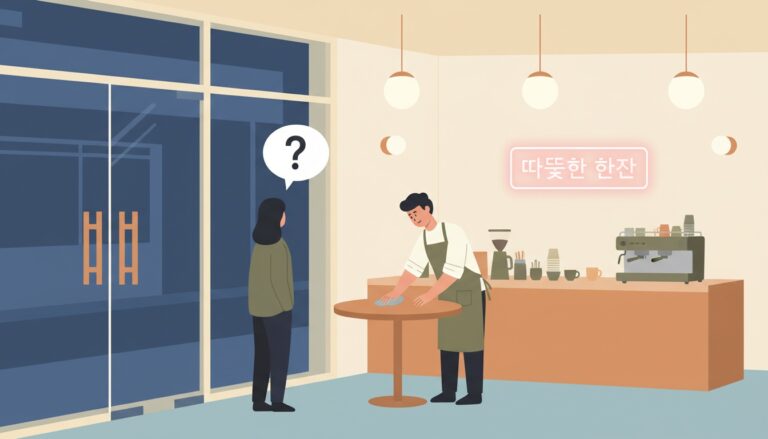
Picture this: You are in a beautiful cafe in Hongdae. The vibe is perfect. You are feeling like the main character in a K-Drama. You are writing in your journal, or maybe deep in conversation with a new friend. Suddenly, the K-Pop background music stops. The bright lights dim, or worse—they turn on the super bright cleaning lights.
The barista starts aggressively wiping the table next to you. In a K-Drama, this is usually where the lead actor grabs the heroine’s hand and runs out. In real life? It means you have overstayed your welcome, and you didn’t catch the signal.
To avoid the awkwardness of being the last person sitting in a dark cafe while the staff stares at you, you need one simple question. Today, we aren’t just learning numbers; we are learning cafe survival.
Phase 2: The Core Expressions
Here are the only three phrases you really need. Forget the complex grammar for a second.
1. 몇 시까지 해요? (Myeot si-kkaji haeyo?)
- Pronunciation: [Myeot-si-kka-ji hae-yo?]
- Tip: “Myeot” sounds like “mutt” (dog). “Kkaji” sounds a bit like “gadget” without the ‘t’.
- Meaning:
- Literal: Until what time do you do?
- Real: What time are you open until?
- K-Culture Moment: You will hear this constantly. Not just in cafes, but at pojangmacha (street food tents) and PC bangs. It is the universal question for “When does the fun end?”
- Editor’s Insight: This is soft and conversational. It is much better than asking “When do you close?” which can sound a bit like “When are you leaving?”
- Situation Spectrum:
[🚫 Boss/Formal Meeting] ———— [⚠️ Elders] ———— [✅ Friendly/Staff]
(Perfect for cafe staff, taxi drivers, and shop owners.) - 🤔 Think About It: Notice we use “Until” (kkaji) instead of “Close.” Koreans focus on the duration of the service, not just the ending action.
2. 마감 시간 언제예요? (Magam sigan eonjeyeyo?)
- Pronunciation: [Ma-gam si-gan eon-je-ye-yo?]
- Meaning: When is closing time?
- Editor’s Insight: ‘마감 (Magam)’ is a magic word. It means “closing” or “deadline.” You will see staff shouting “Magam!” to each other when they lock the doors. Using this word makes you sound like a local who understands how businesses run.
3. 라스트 오더 끝났나요? (Lasteu-odeo kkeut-nannayo?)
- Pronunciation: [La-su-teu o-deo kkeut-nan-na-yo?]
- Meaning: Is the ‘Last Order’ finished?
- K-Culture Moment: Korea loves Konglish (Korean + English). “Last Order” is a standard term here. Many cafes stop taking orders 30-60 minutes before they actually close.
- Situation Spectrum:
[✅ Essential for late-night cafe visits]
Phase 3: Textbook vs. Real Life
| Situation | 📖 Textbook Korean | 🗣️ Real Korean | 💡 Why? |
|---|---|---|---|
| Asking closing time | 영업 종료 시간이 언제입니까? (Yeong-eop jong-ryo…) | 몇 시까지 해요? (Myeot si-kkaji haeyo?) | The textbook version sounds like a police interrogation. “Haeyo” is softer. |
| Asking if they are open | 문 열었습니까? (Mun yeol-eoss-seumnikka?) | 아직 해요? (Ajik haeyo?) | “Are you still doing (business)?” is quicker and more natural. |
| Late arrival | 주문 가능합니까? (Jumun ganeung hamnikka?) | 지금 주문 돼요? (Jigeum jumun dwaeyo?) | “Dwaeyo?” (Does it work/Is it okay?) is the MVP of Korean verbs. |
Bottom Note: If you memorize “Dwaeyo?” (Is it okay?), you can survive 80% of situations in Korea.
Phase 4: Cultural Context — The Art of ‘Nunchi’
4-1. The “Broom Sweep” Signal
Korean service workers are generally very polite. They rarely say, “Get out, we are closed.” Instead, they use non-verbal cues. If the music stops, the air conditioner turns off, or they start putting chairs on tables around you, that is your signal. This is where Nunchi (the ability to read the room) comes in. If you ask “Myeot si-kkaji haeyo?” after the music stops, you have zero Nunchi!
4-2. The “Last Order” Culture
In many Western countries, if the door is open, you can order. In Korea, the Last Order is a strict deadline. If a cafe closes at 10 PM, the Last Order is often at 9:30 PM. Why? Because the staff wants to go home exactly at 10 PM. Korean “Palli Palli” (Hurry Hurry) culture applies to going home, too!
Phase 5: Roleplay — The Late Night Caffeination
Setting: A trendy, dimly lit cafe in Seongsu-dong. It is 9:20 PM. You really need coffee.
Characters:
* YOU: A tired traveler needing a caffeine fix.
* Barista: A chic staff member with glasses, looking ready to clean up.
Dialogue:
YOU: (Approaching the counter hesitantly) 저기요… 혹시 마감했어요?
(Jeogiyo… hoksi magam haesseoyo?)
(Excuse me… did you close?)
Barista: 아, 아직 아니에요. 그런데 10시까지 해요.
(Ah, ajik aniyeyo. Geureonde yeol-si-kkaji haeyo.)
(Ah, not yet. But we are open until 10 o’clock.)
YOU: 아, 괜찮아요! [ YOUR CHOICE ]
(Ah, that’s okay! …)
🔀 Your Turn! Pick your ending:
- A) “라스트 오더 언제예요?” (When is the last order?)
- B) “아이스 아메리카노 하나 주세요.” (One Iced Americano, please.)
- C) “그럼 앉아도 돼요?” (Then, is it okay to sit?)
✅ Best Choice: A — Checking the “Last Order” first shows respect. It confirms you won’t keep them waiting.
⚠️ Choice B Analysis: Acceptable, but if it’s 9:29 PM, they might panic. Asking first is smoother.
Phase 6: 10-Second Shadowing Drill
Don’t just read it. Say it with the emotion of someone who desperately wants coffee but doesn’t want to be rude.
🥺 The “Please say yes” vibe:
저기요 / 혹시 / 몇 시까지 / 해요?
(Jeo-gi-yo / hok-si / myeot si-kka-ji / hae-yo?)
Key: Stretch the “Jeo-gi-yo” slightly to sound polite.
Phase 7: K-Culture Mini Glossary
| Korean | Romanization | Meaning | Context |
|---|---|---|---|
| 마감 | Magam | Closing/Deadline | Used for business hours, project deadlines, and even newspaper editing. |
| 라스트 오더 | Lasteu-odeo | Last Order | The real closing time for ordering food/drinks. |
| 칼퇴 | Kal-toe | Leaving work on time | Literally “Knife Leave.” Leaving exactly when the shift ends. Staff love this. |
Phase 8: Traveler’s Survival Kit
Stuck in a cafe/restaurant situation? Use these cards.
🆘 Survival Card #1: The Magic Permission
* 🇰🇷 “여기 앉아도 돼요?” (Yeogi an-ja-do dwae-yo?)
* 🗣️ Meaning: Can I sit here?
* 📍 Use: When you are unsure if a seat is reserved or if the area is closed for cleaning.🆘 Survival Card #2: Take-out Safety
* 🇰🇷 “테이크아웃 할게요.” (Te-i-keu-a-ut hal-ge-yo.)
* 🗣️ Meaning: I’ll do take-out.
* 📍 Use: If they say they are closing soon (Magam), say this immediately. They will likely serve you.📌 Editor’s Note: In Korea, if you order in a disposable cup, you sometimes cannot sit inside due to environmental regulations. If you say “Take-out,” be prepared to leave!
Phase 9: Think Deeper — Cafe as a Shelter
Korean Cafes: More than Coffee
Have you noticed how late cafes stay open in Seoul? Some are 24 hours. In many cultures, cafes are just for morning coffee. In Korea, due to small apartments and living with parents until marriage, cafes act as a “second living room.” It is a private space in a public area. Asking “How long are you open?” is often asking, “How long can I own this rented space?”
💬 Your Turn: In your country, do people study or date in cafes until midnight? Or do cafes close at 5 PM? Tell me in the comments!
Phase 10: FAQ & Troubleshooting
Q: Can I stay 10 minutes past closing time if I haven’t finished my drink?
A: No. In Korea, closing time means lights out. Staff often have to catch the last bus/train. It is considered rude to stay even 5 minutes past the stated time.
Q: What if I don’t know the Korean numbers for the time?
A: Don’t panic. Just ask “Myeot si?” (What time?) and hold up your fingers, or let them show you on a phone screen. Or, listen for the English numbers—many young Koreans will switch to English numbers for you.
❌ Common Mistake: Asking “Open?” (Yeoreosseoyo?) when you mean “Are you still open?”
✅ Fix: Use “Ajik haeyo?” (Do you still do business?)
Phase 11: Wrap-up & Mission
Summary: Use “Myeot si-kkaji haeyo?” for hours, and respect the “Last Order.” Read the room (Nunchi)!
🏆 Action Mission:
* 🥉 Bronze: Look at your clock right now. Say “Myeot si-kkaji haeyo?” out loud three times.
* 🥈 Silver: Next time you watch a K-Drama scene in a cafe/restaurant, look for the “Magam” (cleaning up) signals.
* 🥇 Gold: Go to a Korean cafe (or any cafe) and ask the staff when they close using the Korean phrase (or explain the Korean phrase to them!).
Phase 12: Quiz — Do You Have Nunchi?
Situation: You walk into a cafe at 9:50 PM. The sign says Open until 10:00 PM. The staff is mopping the floor. What do you do?
- Sit down and order a warm latte. It’s not 10 PM yet!
- Ask “Myeot si-kkaji haeyo?” just to be sure.
- Ask “Take-out dwaeyo?” (Is take-out okay?)
- Leave quietly.
Answer: 3 or 4.
* Option 1 is legally okay but socially rude (zero Nunchi!).
* Option 2 is pointless; you can see they are closing.
* Option 3 is the polite compromise.
* Option 4 is the most considerate move.
Frequently Asked Questions (FAQ)
Q: What does "몇 시까지 해요? (Myeot si-kkaji haeyo?)" mean in Korean and how do you pronounce it?
A: In Korean, "몇 시까지 해요? (Myeot si-kkaji haeyo?)" is pronounced [Myeot-si-kka-ji hae-yo?] and means: a key conversational Korean expression covered in this lesson.
Q: What does "마감 시간 언제예요? (Magam sigan eonjeyeyo?)" mean in Korean and how do you pronounce it?
A: In Korean, "마감 시간 언제예요? (Magam sigan eonjeyeyo?)" is pronounced [Ma-gam si-gan eon-je-ye-yo?] and means: When is closing time?
Q: What does "라스트 오더 끝났나요? (Lasteu-odeo kkeut-nannayo?)" mean in Korean and how do you pronounce it?
A: In Korean, "라스트 오더 끝났나요? (Lasteu-odeo kkeut-nannayo?)" is pronounced [La-su-teu o-deo kkeut-nan-na-yo?] and means: Is the 'Last Order' finished?







