

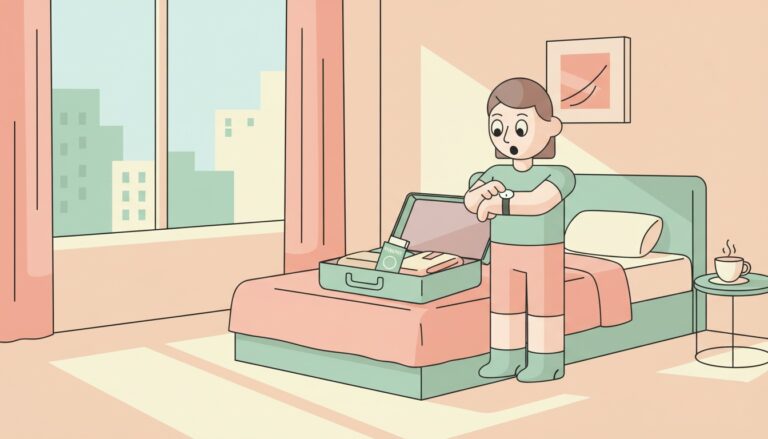
Overslept in Seoul? How to Handle Hotel Checkout Like a K-Drama Star
Phase 1: The Morning After (Immersive Hook)
Greeting: Hello! Your Daily Hangul editor here.
Picture this: You’re in Seoul. Last night, you got swept away by the neon lights of Hongdae. Maybe you tried Soju for the first time, or maybe you stayed up until 3 AM analyzing the latest music video with new friends at a pocha (street food tent).
Now, sunlight is hitting your face. Your head is pounding. You look at your phone… 10:55 AM.
Panic sets in. Is checkout at 11:00 or 12:00?
In K-Dramas, the protagonist usually runs out in perfectly messy hair, leaving the key on the bed. But in real life? You get charged extra fees if you’re late.
Don’t worry. I’ve seen my students freeze at the front desk dozens of times. Today, I’ll teach you exactly how to ask about time, request a late checkout (because we all need it), and store your bags so you can grab one last ice americano before the airport.
Phase 2: Deep Dive (Core Expressions)
Here are the only three phrases you really need to survive the checkout counter.
1. 체크아웃 몇 시예요? (Chekeu-aut myeot-si-yeyo?)
- Pronunciation: [Che-keu-out] + [myut-she-yey-yo?]
- Sound Analogy: “Check-out” sounds almost English. “Myeot” sounds like “Mutt” (dog). “Si” is like “She”.
- Meaning: What time is checkout?
- K-Culture Moment: Think of those reality travel shows like Earth Arcade. The cast always asks this first thing when they arrive, terrified of waking up early.
- Editor’s Insight: Korean hotels are strict about time. 11:00 AM means 11:00 AM. This isn’t just a question; it’s a safety measure for your wallet.
- Situation Spectrum:
[🚫 Formal Boss] ———— [⚠️ Front Desk] ———— [✅ Casual]
(Ideally, use the respectful ending “-yeyo” with staff. Never drop it to just “Myeot-si?” unless you want rude service.)- 🤔 Think About It: Notice how “Check-out” is just English? Modern Korean uses a ton of “Loanwords” in hospitality. Why do you think that is?
2. 레이트 체크아웃 돼요? (Reiteu chekeu-aut doeyo?)
- Pronunciation: [Lay-teu] + [Che-keu-out] + [Dwe-yo?]
- Sound Analogy: “Dwe-yo” sounds like a confused bird chirping “Dwe? Dwe?”.
- Meaning: Is late checkout possible?
- K-Culture Moment: Essential for K-Pop fans who attended a concert the night before and are physically unable to move until noon.
- Editor’s Insight: This is “Konglish” (Korean-English) at its finest. You can say “yeon-jang” (extension), but “Late Check-out” is understood everywhere from motels to 5-star hotels.
- Situation Spectrum: ✅ Safe to use everywhere.
3. 짐 맡겨도 돼요? (Jim mat-gyeo-do doeyo?)
- Pronunciation: [Jim] + [mat-gyeo-do] + [dwe-yo?]
- Sound Analogy: “Jim” like the name Jim. “Mat” sounds like a floor mat.
- Meaning: Can I leave my bags (luggage) with you?
- Real Nuance: “I want to explore more without dragging this 20kg suitcase.”
- Editor’s Insight: Korean hotels are incredibly safe. I once left a bag at a lobby, came back 8 hours later, and it hadn’t moved an inch.
Phase 3: Textbook vs. Real Life
Let’s be honest. Textbooks sound like robots.
| Situation | 📖 Textbook Korean | 🗣️ Real Korean | 💡 Why the difference? |
|---|---|---|---|
| Asking time | 체크아웃 시간은 언제입니까? (Chekeu-aut siganeun eonje-imnikka?) | 체크아웃 몇 시예요? (Chekeu-aut myeot-si-yeyo?) | “-Imnikka” is military-level formal. You aren’t in the army; you’re on vacation! |
| Leaving bags | 짐을 보관해 주실 수 있습니까? (Jimeul bogwan-hae jusil su isseumnikka?) | 짐 좀 맡겨주세요. (Jim jom matgyeo-juseyo.) | Adding “Jom” (a little/please) softens the request instantly. |
Bottom Note: Stick to the “Real Korean” column. The staff will appreciate that you sound natural, not like a translation app.
Phase 4: Cultural Context — The “Eye Contact” Game
4-1. Non-verbal Communication
In Western cultures, direct eye contact shows confidence. In Korea? It can be intense. When asking these questions at the desk:
– Look at the person, but maybe aim for their nose or mouth occasionally.
– Give a slight head bow when you say “Thank you” (Gamsahamnida). It’s like a magical pass that makes staff want to help you more.
4-2. K-Travel Connection: The “Ppalli Ppalli” (Hurry Hurry) Culture
Korean cleaning crews are fast. If checkout is 11:00 AM, they might knock at 11:05 AM.
– Why? Efficiency is a national sport.
– Survival Tip: If you need 10 more minutes, don’t ignore the knock. Yell “Jam-si-man-yo!” (Just a moment!).
Phase 5: Immersive Roleplay
Setting: Hotel Lobby in Myeongdong. 10:30 AM. It’s busy. You have huge bags and want to shop for cosmetics before your flight.
Characters:
– YOU: Tired but excited traveler.
– Clerk: Polite, wearing a uniform, typing fast.
Dialogue:
YOU: (Approaching the desk) 안녕하세요. 체크아웃 할게요.
(Annyeonghaseyo. Chekeu-aut hal-ge-yo.)
(Hello. I’ll check out now.)
Clerk: 네, 여기 키 주세요. … 결제는 다 되셨습니다.
(Ne, yeogi ki juseyo… Gyeol-je-neun da doe-syeot-seum-nida.)
(Yes, give me the key here… Payment is all done.)
YOU: 저기요… 짐 맡겨도 돼요? 🧳
(Jeogiyo… Jim mat-gyeo-do doeyo?)
(Excuse me… Can I leave my bags?)
Clerk: 네, 가능합니다. 언제 찾으러 오세요?
(Ne, ganeung-hamnida. Eonje chajeureo oseyo?)
(Yes, possible. When will you come to pick them up?)
🔀 Decision Point! How do you answer?
- A) “Six o’clock.” (Saying it in English)
- B) “Yeoseot-si-yo.” (6 PM in Korean)
- C) (Show 6 fingers and smile)
✅ Best Choice: B is best, but C works perfectly too! Koreans differeniate numbers for time (Native Korean numbers), so showing fingers avoids confusion between 6 (Yeoseot) and other numbers.
Phase 6: 10-Second Shadowing Drill
Don’t just read it. Feel it.
- Checking the time (Curious 😊):
체크아웃 / 몇 시예요?
(Chekeu-aut / myeot-si-yeyo?) -
Asking for a favor (Polite/Desperate 🥺):
레이트 체크아웃 / 돼요?
(Reiteu chekeu-aut / doeyo?) -
Leaving bags (Relieved 😌):
짐 / 맡겨도 / 돼요?
(Jim / mat-gyeo-do / doeyo?)
Phase 7: K-Culture Mini Glossary
| Korean | Romanization | Meaning | Context |
|---|---|---|---|
| 프런트 | Peureonteu | Front Desk | Just “Front”. Where you solve all problems. |
| 키 | Ki | Key | Usually a card key (Kadeu-ki). |
| 추가 요금 | Chuga Yogeum | Extra Charge | The scary words you hear if you oversleep. |
| 조식 | Josik | Breakfast | “Josik poham?” (Is breakfast included?) |
Phase 8: Traveler’s Survival Kit
Hotel Edition
🆘 Survival Phrase #1
– 🇰🇷 “택시 불러주세요.” (Taeksi bulleojuseyo)
– 🗣️ Sounds like: “Taxi bull-uh ju-se-yo”
– 📍 Use when: You have heavy bags and can’t walk to the subway.
– 💡 Pro Tip: If the hotel is busy, they might point you to the door. Download Kakao T (Uber of Korea) to hail one yourself. No Korean number needed usually!📌 Editor’s Travel Note
– Toothbrushes: Many Korean hotels do not provide free toothbrushes due to environmental laws. You might have to buy one at the “Convenience Store” (Pyeonuijeom) in the lobby.
– Wifi: It’s almost always free and fast. Usually no password or just the room number.
Phase 9: Think Deeper — “Why so much English?”
Global Korean or Konglish?
Did you notice? Check-out, Lobby, Service, Room Service… they are all English words used in Korean.
🧠 Think Deeper:
Since the modernization of Korea happened rapidly, many hospitality terms were imported directly from the West. However, notice how the pronunciation changes to fit the Korean “flat” rhythm (no strong stress). It’s not “CHECK-out”, it’s “Che-keu-a-ut”.
💬 Your Turn: Does your language use English words for hotels, or do you have your own native words? Tell me in the comments!
Phase 10: FAQ & Troubleshooting
Q: Can I just leave the key in the room and go?
A: Usually, yes! This is called “Express Checkout”. But if you have extra charges (minibar?), stop by the desk.
Q: I don’t speak Korean. Can I just speak English?
A: At major hotels? Yes. At small motels or guesthouses outside Seoul? Maybe not. That’s why knowing “Chekeu-aut myeot-si-yeyo?” saves you.
❌ Common Mistake:
Don’t say “Goodbye” (Annyeong-hi gyeseyo) to the cleaning staff in the hallway.
✅ Better: Say “Sugo-haseyo” (Thank you for your hard work). It acknowledges their labor and makes you sound like a local insider.
Phase 11: Wrap-up
Summary: To checkout smoothly, remember: Myeot-si-yeyo? (What time?), Doeyo? (Is it possible?), and Mat-gyeo-do doeyo? (Can I store bags?).
🎯 Action Mission:
– 🥉 Bronze: Say “Chekeu-aut myeot-si-yeyo?” three times while looking at your watch.
– 🥈 Silver: Search for a Seoul hotel on YouTube and see if you can spot the “Front Desk”.
– 🥇 Gold: Next time you are at any hotel (even in your country), pretend you are in Seoul and whisper these phrases to yourself at the counter.
K-Culture Mission: Watch a scene from the drama King the Land (a hotel drama). Count how many times they bow to guests!
See you next time!
Phase 12: Quiz — Interactive Challenge
1. You overslept! It’s 11:30 AM. What do you ask?
A) Chekeu-aut myeot-si-yeyo?
B) Reiteu chekeu-aut doeyo?
C) Annyeong-hi gyeseyo.
2. True or False?
In Korea, you should stare intensely at the hotel clerk to show dominance.
(True / False)
3. Fill in the blank:
“Can I leave my ___ (bags)?” -> ___ mat-gyeo-do doeyo?
Answers:
1. B (You need an extension/late checkout!)
2. False (Soft eye contact is polite. Too intense is rude.)
3. Jim (짐)
Frequently Asked Questions (FAQ)
Q: What does "체크아웃 몇 시예요? (Chekeu-aut myeot-si-yeyo?)" mean in Korean and how do you pronounce it?
A: In Korean, "체크아웃 몇 시예요? (Chekeu-aut myeot-si-yeyo?)" is pronounced [Che-keu-out] and means: What time is checkout?
Q: What does "레이트 체크아웃 돼요? (Reiteu chekeu-aut doeyo?)" mean in Korean and how do you pronounce it?
A: In Korean, "레이트 체크아웃 돼요? (Reiteu chekeu-aut doeyo?)" is pronounced [Lay-teu] and means: Is late checkout possible?
Q: What does "짐 맡겨도 돼요? (Jim mat-gyeo-do doeyo?)" mean in Korean and how do you pronounce it?
A: In Korean, "짐 맡겨도 돼요? (Jim mat-gyeo-do doeyo?)" is pronounced [Jim] and means: Can I leave my bags (luggage) with you?






