

Phase 1: The Immersive Hook
Hello, Daily Hangul readers.
Let’s talk about a side of Seoul that K-Dramas usually gloss over. In the dramas, the CEO walks effortlessly into a glass skyscraper, or the lovers run up a romantic, winding staircase in a hillside village (daldongne).
But if you’ve actually walked through Seoul, you know the reality is a bit grittier. It’s a city of hills, endless stairs, and high thresholds. Now, imagine navigating that in a wheelchair, or with a stroller, or on crutches.
Suddenly, the romantic architecture looks like an obstacle course.
Korea is changing, though. Rapidly. The concept of Universal Design (UD)—or “Design for All”—is reshaping the cityscape. It’s not just about compliance codes; it’s about a shift in the Korean mindset regarding who belongs in these spaces.
Today, we aren’t just learning words; we are learning how to read the city’s inclusivity. When you spot these details, you stop being a tourist and start thinking like a local urban planner.
Phase 2: Deep Dive into Core Expressions
Here are three high-level terms you’ll see in news reports, architectural briefs, and angry internet comments regarding accessibility.
1. 교통약자 (Gyo-tong-yak-ja)
- Pronunciation: [Gyo-tong-yak-ja] (Sounds like: Gyo-tongue-yak-jah)
- Meaning: Transportation Vulnerable / Mobility Disadvantaged
- Context: You will see this everywhere in the subway. It combines
교통(traffic/transport) +약자(weak person/underdog). It covers seniors, pregnant women, the disabled, and those with heavy luggage.- Editor’s Insight: This is a legal and social category. In Korea, defining who qualifies as a yakja is a constant social debate. If you sit in a seat marked for them when you look healthy, you invite the “laser eyes” of the ajummas.
- Spectrum:
[🚫 Casual Slang] ———— [⚠️ Standard] ———— [✅ Official/Formal]
(This is the official legal term used in announcements and signs.)- 🤔 Think About It: English often uses “Priority Seating” (focusing on the priority). Korean uses “Mobility Disadvantaged” (focusing on the person’s status). How does labeling someone a “weak person” (
약자) affect how society treats them? Is it protective or patronizing?2. 턱이 없다 (Teog-i eop-da)
- Pronunciation: [Teog-i eop-da] (The ‘g’ flows into the ‘i’, sounding like Teo-gi)
- Meaning: Threshold-free / No step
- Context:
턱(Teok) is a threshold or a raised step. In traditional Hanok architecture, high thresholds were crucial for keeping out drafts and spirits. In modern UD, they are the enemy.- Editor’s Insight: You use this when praising a well-designed space. “와, 여기는 턱이 없어서 휠체어도 편하겠네요” (Wow, there are no thresholds here, so it must be comfortable for wheelchairs).
- Spectrum:
[🚫 Formal] ———— [⚠️ Neutral] ———— [✅ Descriptive]- 🤔 Think About It: The idiom “턱도 없다” (Teok-do eop-da) means “absurd” or “not even close.” It literally comes from a threshold being so high you can’t even reach it. The word
턱is deeply embedded in the language of limits.3. 배리어 프리 (Barrier Free)
- Pronunciation: [Bae-ri-eo Peu-ri]
- Meaning: Barrier-Free (UD Certification)
- Context: Yes, it’s Konglish (Korean-English), but it is the specific proper noun for the government certification system. Buildings display a “Barrier Free” plaque if they pass inspection.
- Editor’s Insight: Using this word signals high-level cultural awareness. It shows you know the policy, not just the translation. Architects and public officials use this daily.
Phase 3: Textbook vs. Real Life
| Situation | 📖 Textbook Korean | 🗣️ Real Korean (The Vibe) | 💡 Why the difference? |
|---|---|---|---|
| Asking for an elevator | 엘리베이터가 어디에 있습니까? (Where is the elevator?) | “혹시 엘베 어디 쪽이에요?” (Hoksi ‘El-be’ eodi jjogieyo?) | ‘El-be’ is the universal shorthand. ‘Hoksi’ softens the sudden question. |
| ** complaining about stairs** | 계단이 너무 많아서 힘듭니다. (It is hard because there are too many stairs.) | “와, 여기 진짜 등산하는 줄 알았네.” (Wow, I thought I was mountain climbing.) | Koreans use hyperbole (exaggeration) to bond over shared suffering. |
| Describing accessible design | 이 건물은 휠체어 사용자가 이용하기 좋습니다. | “여긴 동선이 잘 빠졌네요.” (The movement flow is ‘drawn out’ well here.) | ‘Dongseon’ (movement lines) is a pro term used by everyday people to judge space efficiency. |
Phase 4: Cultural Deep Dive — Architecture & Nunchi
1. The visual language of exclusion
In Korean architecture, historically, elevation meant status. Palaces are raised; heavy gates have high steps. This creates a psychological barrier. When you visit a trendy cafe in Seongsu-dong (often renovated old factories), look at the entrance. Is there a 경사로 (ramp)? If not, that space is silently signaling: “This is for the young and able-bodied.”
2. The ‘Priority Seat’ Cold War
In the subway, the ends of the train cars are the UD zones. You will notice that even during rush hour, when the train is packed like a sardine can, the pink seats (pregnant women) and the seats at the end (elderly/disabled) often remain empty.
This is Nunchi in action. The social cost of sitting there and getting caught by someone who “needs it more” is higher than the physical pain of standing. It’s an invisible architecture of shame and respect.
Phase 5: Immersive Roleplay
Setting: A newly renovated cultural center in Seoul. You are touring the facility with Min-jae, a Korean architect who worked on the project.
Characters:
* YOU: An architectural consultant or interested visitor.
* Min-jae: Proud, detail-oriented, speaks fast when excited.
(Dialogue Start)
Min-jae: 이번 리모델링의 핵심은 ‘공존’이에요. 옛날 구조를 살리면서도 접근성을 높였죠.
(Ibeon rimodeling-ui haeksim-eun ‘gongjon’-ieyo. Yetnal gujo-reul sallimyeonseodo jeopgeunseong-eul nopyeotjjo.)
(The core of this remodeling is ‘coexistence.’ We kept the old structure but improved accessibility.)
YOU (Select your response):
🔀 Option A: “아, 배리어 프리 인증도 받았나요?” (Oh, did you get the Barrier Free certification too?)
🔀 Option B: “엘리베이터는 어디예요?” (Where is the elevator?)
🔀 Option C: “계단이 참 예쁘네요.” (The stairs are very pretty.)
Min-jae (If you chose A): 오! 맞아요. 그거 받느라 진짜 힘들었어요. 특히 입구 턱 없애는 공사가 난관이었거든요.
(Oh! That’s right. It was really hard to get that. Especially the construction to remove the entrance thresholds was a major hurdle.)
YOU:
그러게요. 한국 건물들은 원래 입구가 좀 높잖아요. [Phrase: 턱이 높다]는 말이 괜히 있는 게 아니니까요.
(True. Korean buildings usually have high entrances. The phrase ‘high threshold’ exists for a reason.)
Min-jae: 정확해요. 그래서 경사로(ramp)를 측면에 숨기지 않고, 일부러 디자인 요소로 메인에 뒀어요.
(Exactly. That’s why we didn’t hide the ramp on the side; we intentionally placed it as a main design element.)
(Roleplay End)
✅ Why Option A is best: It uses the specific C2 term (
배리어 프리) and shows you understand the regulatory effort behind the design. It makes Min-jae feel recognized as a professional.
Phase 6: 10-Second Shadowing Drill
Let’s practice the intonation of a sophisticated observation. Don’t sound like a robot; sound like a critic.
Sentence: “Accessible design ultimately benefits everyone, not just the minority.”
🇰🇷 유니버설 디자인은 / 결국 소수가 아닌 / 모두를 위한 것이죠.
[Pronunciation]: Universal dijain-eun / gyeolguk sosuga anin / modureul wihan geosijyo.
[Emotion: 🤔 Thoughtful & Convincing]: Start calm, emphasize ‘sosu’ (minority) and ‘modu’ (everyone).
Phase 7: K-Culture Mini Glossary
| Korean | Rom. | Meaning | Context |
|---|---|---|---|
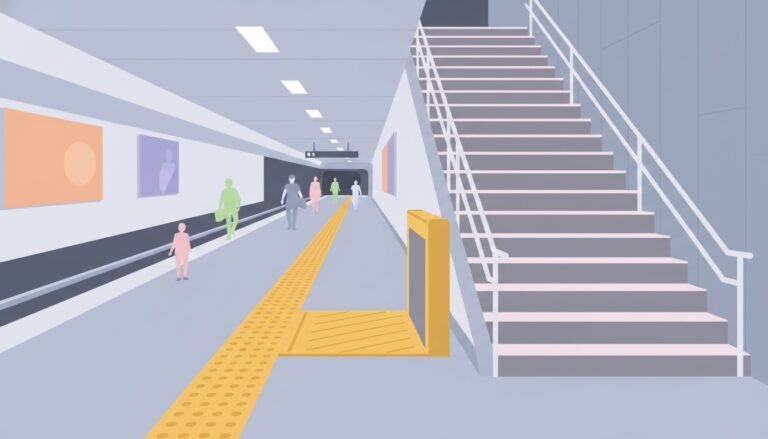
| 점자 블록 | Jeomja-block | Braille Block | The yellow textured paving on sidewalks for the visually impaired. Seoul has miles of these. |
| 동선 | Dongseon | Movement Flow | Originally an architectural term, now used generally for how people move through a space. |
| 전용 | Jeonyong | Exclusive Use | Seen on parking spots or seats. (e.g., 장애인 전용 – Disabled Only). Stronger than “Priority.” |
| 키오스크 | Kiosueku | Kiosk | The touch screens in cafes. Often criticized in news for being non-UD friendly for the elderly. |
Phase 8: Traveler’s Survival Kit (Accessibility Edition)
Navigating Seoul on wheels or with limited mobility? Keep this card handy.
🆘 Survival Phrases
1. 🇰🇷 “경사로가 있나요?” (Gyeong-sa-ro-ga innayo?)
* Is there a ramp? (Use this at restaurants before you commit to going in.)
2. 🇰🇷 “엘리베이터가 있는 출구는 어디예요?” (Ellibeiteo-ga inneun chulgu-neun eodiyeyo?)
* Which exit has the elevator? (Subway exits are huge; picking the wrong one means stairs.)
3. 🇰🇷 “휠체어 들어갈 수 있나요?” (Hwil-che-eo deureogal su innayo?)
* Can a wheelchair get in?📌 Editor’s Pro Tip:
Download KakaoMetro. It has a specific filter for “Elevator” routes and tells you exactly which train car (e.g., 4-1) is closest to the escalator/lift. Look for the wheelchair icon on the app.
Phase 9: Think Deeper — Preservation vs. Access
Heritage or Hindrance?
Korea faces a unique dilemma: How do you apply Universal Design to a 600-year-old palace like Gyeongbokgung? Traditional Hanok architecture relies on 기단 (stone platforms) to protect wood from moisture. This creates inevitable steps (턱).
Installing a metal ramp over ancient stone ruins the aesthetic and historical integrity. But not installing it tells a disabled person, “History is not for you.”
Recently, Changdeokgung Palace introduced subtle wooden ramps. It’s a compromise. In your country, how do historic sites handle this? Do they prioritize the stone or the person?
Phase 10: FAQ & Troubleshooting
Q: Can I use the ‘Priority Seat’ if the train is empty?
* Verdict: ⚠️ Proceed with Caution.
* If it’s the “Pink Seat” (Pregnant women), avoid it. Even if empty, sitting there as a man or non-pregnant woman often triggers silent judgment or photos taken by angry citizens. The ends of the train (Elderly/Disabled) are slightly more flexible if the train is truly empty, but you must pop up like a spring the moment an elderly person enters.
Q: Why do Korean elevators close so fast?
* It’s the 빨리빨리 (Hurry Hurry) culture. But look for the button 문열림 (Door Open) or a specialized button with a wheelchair icon—that one usually holds the door longer.
❌ Common Mistake:
Assuming 장애인 화장실 (Accessible Restroom) is always unlocked.
✅ Fix: Often, they are locked to prevent misuse (people smoking, etc.). You might need to ask staff: “화장실 문 좀 열어주세요” (Please open the restroom door).
Phase 11: Wrap-up & Mission
Summary: Today we looked at Seoul not through K-Drama filters, but through the lens of Universal Design—learning words like 턱, 배리어 프리, and 교통약자.
Action Missions:
* 🥉 Bronze: Open a map app and look for the wheelchair icon on your nearest subway station.
* 🥈 Silver: Next time you watch a Korean vlog or drama, spot the Yellow Braille Blocks on the sidewalk. They are literally everywhere once you start looking.
* 🥇 Gold: Visit a building in your area (or in Korea) and identify one “Barrier Free” element (ramp, auto-door, braille). Describe it in Korean: “이 건물은 [Element]가 있어서 좋네요.”
💬 Question:
Does your city prioritize speed (escalators) or access (elevators)? Let me know in the comments!
Phase 12: Interactive Quiz
- Situation: You see a sticker on a building entrance that says [Barrier Free]. What does this most likely mean?
- a) Admission is free.
- b) It is certified accessible for the mobility disadvantaged.
- c) There are no walls inside (Open Plan).
- True or False: In a crowded subway, it is socially acceptable for a healthy young student to sit in the pink priority seat if they are really tired.
- (True / False)
- Fill in the Blank: “Wow, this entrance has no threshold! It’s great!”
- “와, 여기는 [ ]이/가 없어서 좋네요!”
(Answers: 1-b, 2-False, 3-턱 [Teok])
Frequently Asked Questions (FAQ)
Q: What does "교통약자 (Gyo-tong-yak-ja)" mean in Korean and how do you pronounce it?
A: In Korean, "교통약자 (Gyo-tong-yak-ja)" is pronounced [Gyo-tong-yak-ja] and means: Transportation Vulnerable / Mobility Disadvantaged
Q: What does "턱이 없다 (Teog-i eop-da)" mean in Korean and how do you pronounce it?
A: In Korean, "턱이 없다 (Teog-i eop-da)" is pronounced [Teog-i eop-da] and means: Threshold-free / No step
Q: What does "배리어 프리 (Barrier Free)" mean in Korean and how do you pronounce it?
A: In Korean, "배리어 프리 (Barrier Free)" is pronounced [Bae-ri-eo Peu-ri] and means: Barrier-Free (UD Certification)







