

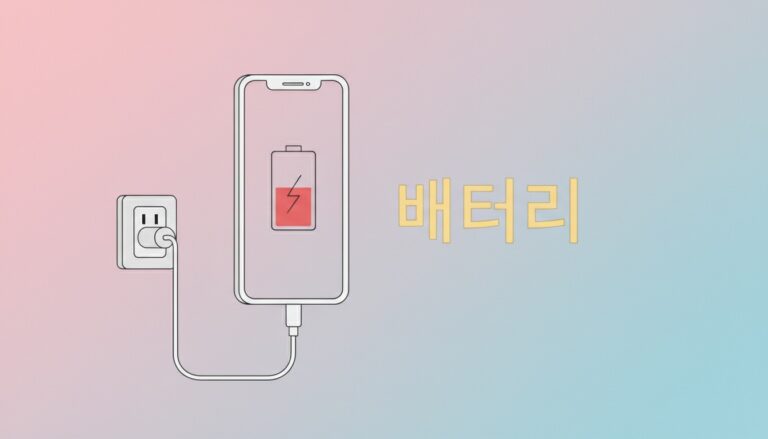
Phase 1: The Panic Moment 😱
Hello! Your Daily Hangul editor here.
Picture this: You are in the middle of Hongdae, navigating to that famous tteokbokki spot you saw on TikTok. Your map is open, you’re hungry, and suddenly… the screen goes black.
0%.
In K-Dramas, this is usually when the male lead magically appears with an umbrella or a car ride. In reality? You’re just a foreigner standing on a street corner wondering how to get back to your hotel.
Don’t panic. Korea is arguably the most “connected” country on earth. Power is everywhere, but you need the magic words to access it. Today, we aren’t just learning vocabulary; we are learning survival skills.
Phase 2: The Core Expressions 🔋
Here are the three phrases that will save your digital life.
1. 배터리가 없어요 (My battery is dead)
- Pronunciation: [bae-teo-ri-ga eop-seo-yo]
Sound-alike: “Bet-tuh-ree-ga Up-so-yo”- Meaning: “I don’t have battery.” (Literal) / “My battery is dead.” (Real nuance)
- K-Culture Moment: You’ll hear this in variety shows like Running Man when members are frantically trying to call their partners during a mission.
- Editor’s Insight: Korean uses the English word “Battery,” so you are already 50% fluent! usage of “up-so-yo” (don’t have) is very common. We don’t say “it died” (death is for living things!); we say it “doesn’t exist.”
- Situation Spectrum:
[🚫 Boss] ———— [⚠️ Colleague] ———— [✅ Stranger/Staff]
(Safe to use with almost anyone polite)2. 충전기 있어요? (Do you have a charger?)
- Pronunciation: [chung-jeon-gi i-sseo-yo?]
Sound-alike: “Choong-jun-gi E-so-yo?”- Meaning: “Is there a charger?” / “Do you have a charger?”
- Editor’s Insight: If you are at a restaurant or a friend’s house, this is the go-to phrase.
- 🤔 Think About It: In many Western countries, asking a restaurant to charge your phone might be rude. In Korea? It’s almost expected service. Why do you think that is?
3. 폰이 꺼졌어요 (My phone turned off)
- Pronunciation: [po-ni kkeo-jyeo-sseo-yo]
Sound-alike: “Pony Cuh-juh-so-yo”- Meaning: “The phone turned off.”
- Context: Use this to explain why you didn’t answer that call from your Korean friend earlier.
Phase 3: Textbook vs. Real Life 🗣️
| Situation | 📖 Textbook Korean | 🗣️ Real Korean | 💡 Why different? |
|---|---|---|---|
| Telling a friend | 배터리가 방전되었습니다. (The battery is discharged.) |
배터리 나갔어. (Battery went out.) |
“방전” is too scientific. “나갔어” is the slangy way to say it died. |
| Asking for a plug | 콘센트를 이용해도 됩니까? (May I utilize the outlet?) |
여기 충전 돼요? (Does charging work here?) |
Koreans value speed. We ask about the function, not the object. |
Phase 4: Cultural Deep Dive — The “K-Charge” Spirit 🇰🇷
4-1. The “Jeong” (Sharing) of Electricity
In some countries, “electricity theft” is a concern. In Korea, electricity is treated almost like water—it’s meant to be shared.
– Cafes: 90% of cafes in Seoul have outlets (콘센트) under the seats. It’s not rude to plug in; it’s why people go there.
– Restaurants: Many BBQ places have chargers at the table or behind the counter. Just hand your phone to the “Imo-nim” (auntie/staff).
4-2. K-Drama Tropes
Notice how in dramas like Crash Landing on You, missed calls due to dead batteries create huge misunderstandings? That’s because in a hyper-connected society like Korea, being unreachable is considered an emergency. If your phone is off, people worry instantly.
Phase 5: Immersive Roleplay 🎬
Setting: A busy BBQ restaurant in Gangnam. Friday night. Noisy, smells delicious. Your phone is at 2%.
Characters:
– YOU: Hungry traveler.
– Server: Busy part-time worker.
The Dialogue:
YOU: 저기요! 혹시 충전 돼요? 🔌
(Jeogiyo! Hoksi chungjeon dwaeyo?)
(English) Excuse me! By any chance, can I charge this?
Server: 네, 충전기 있으세요?
(Ne, chungjeon-gi isseuseyo?)
(English) Yes, do you have a charger?
🔀 Decision Point! Your Turn:
Option A: “네, 여기요.” (Yes, here it is.)
Option B: “아니요, 아이폰이에요.” (No, it’s an iPhone.)
✅ If you chose B:
YOU: 아니요, 없어요. 아이폰이에요.
(Aniyo, eop-seoyo. iPhone-ieyo.)
(English) No, I don’t. It’s an iPhone.
Server: (Pointing to the counter) 저기 카운터에 꽂으시면 돼요.
(Jeogi kaunteo-e kkojeusimyeon dwaeyo.)
(English) You can plug it in at the counter over there.
Phase 6: 10-Second Shadowing Drill 🎤
Read aloud with the emotion tags! Use the / to pause.
- 😢 (Sad/Worried) 배터리가 / 없어서 / 연락을 / 못 했어요.
(bae-teo-ri-ga / eop-seo-seo / yeon-la-geul / mot hae-sseo-yo)
I didn’t have battery, so I couldn’t contact you. -
😤 (Urgent) 제발 / 충전 / 좀 / 해주세요!
(jebal / chung-jeon / jom / hae-ju-se-yo!)
Please, charge it for me! (a bit dramatic)
Phase 7: K-Culture Glossary 📖
| Korean | Romanization | English | Context |
|---|---|---|---|
| 보조배터리 | bojo-battery | Power bank | Literal: “Assistant Battery.” Essential item for K-Pop concerts. |
| 콘센트 | konsenteu | Outlet/Socket | Konglish (from “Concentric plug”). Don’t say “outlet.” |
| 돼지코 | dwaeji-ko | Pig nose | Slang for the 220V plug shape (looks like a pig snout 🐷). |
Phase 8: Traveler’s Survival Kit 🧳
Stuck in Seoul with a dead phone? Here is your escape plan.
🆘 Survival Expression #1
– 🇰🇷 “여기 콘센트 어디 있어요?” (Yeogi konsenteu eodi isseoyo?)
– 🗣️ Meaning: “Where is the outlet here?”
– 📍 Where: Cafes, Train Stations (KTX).📌 Editor’s Travel Note
– Convenience Stores (GS25, CU): Most allow you to rent a power bank via an app, or they sell single-use battery packs.
– Subway Stations: Look for the “Battery Rental” kiosks (often called ‘T-Battery’ or similar services).
Phase 9: Think Deeper — The “Palli-Palli” Connection 🧠
Why is Korea so obsessed with staying charged?
Korea’s “Palli-Palli” (Hurry-Hurry) culture means efficiency is everything. Your phone isn’t just a phone; it’s your wallet (Samsung Pay), your subway ticket (T-Money), and your ID (Kakao Cert).
If your phone dies in Seoul, you literally disappear from the grid. You can’t pay for the bus or find your way home. That is why “charging accessibility” is almost a public service here.
💬 Your Turn: Does your country have public charging spots, or do you have to buy a coffee to use electricity?
Phase 10: FAQ & Troubleshooting 🛠️
Q: Can I ask a stranger on the subway to borrow their power bank?
A: Maybe. K-Pop fans are usually generous (especially if you like the same group!). But generally, ask the staff at a facility first. If it’s an emergency, say “Joisonghandeyo…” (I’m sorry, but…) first.
❌ Common Mistake:
Don’t say “Phone dead.” (폰 죽었어 – Pon jugeosseo). While understandable, it sounds like your phone is literally destroyed/broken forever.
✅ Say: “배터리 나갔어” (Battery went out/left).
Phase 11: Wrap-up & Mission 🚀
Today we learned that in Korea, a dead battery is a solvable problem, not a tragedy.
Action Mission:
– 🥉 Bronze: Look at your phone charger and say “Chung-jeon-gi” 3 times.
– 🥈 Silver: Go to a cafe (even in your country) and find the outlet. Whisper “Yeogi konsenteu isseoyo.”
– 🥇 Gold: Next time you are at a Korean restaurant, ask the staff “Hoksi chungjeon dwaeyo?” (Can I charge this?)
K-Culture Mission: Watch a K-Drama episode tonight. Count how many times a character fails to answer the phone. Was it a dead battery? Or were they just avoiding the villain?
Phase 12: Quiz 📝
1. You are at a cafe. You want to find a place to plug in your laptop. What do you ask?
– A) 배터리 주세요. (Give me a battery.)
– B) 콘센트 어디 있어요? (Where is the outlet?)
– C) 핸드폰 없어요. (I don’t have a phone.)
2. True or False:
– “It is rude to charge your phone at a BBQ restaurant in Korea.” (True / False)
(Scroll down for answers)
.
.
.
Answers:
1. B (A is asking for a physical battery, C is a lie!)
2. False (It is very common and accepted!)
Frequently Asked Questions (FAQ)
Q: What does "배터리가 없어요 (My battery is dead)" mean in Korean and how do you pronounce it?
A: In Korean, "배터리가 없어요 (My battery is dead)" is pronounced [bae-teo-ri-ga eop-seo-yo] and means: "I don't have battery." (Literal) / "My battery is dead." (Real nuance)
Q: What does "충전기 있어요? (Do you have a charger?)" mean in Korean and how do you pronounce it?
A: In Korean, "충전기 있어요? (Do you have a charger?)" is pronounced [chung-jeon-gi i-sseo-yo?] and means: "Is there a charger?" / "Do you have a charger?"
Q: What does "폰이 꺼졌어요 (My phone turned off)" mean in Korean and how do you pronounce it?
A: In Korean, "폰이 꺼졌어요 (My phone turned off)" is pronounced [po-ni kkeo-jyeo-sseo-yo] and means: "The phone turned off."







