

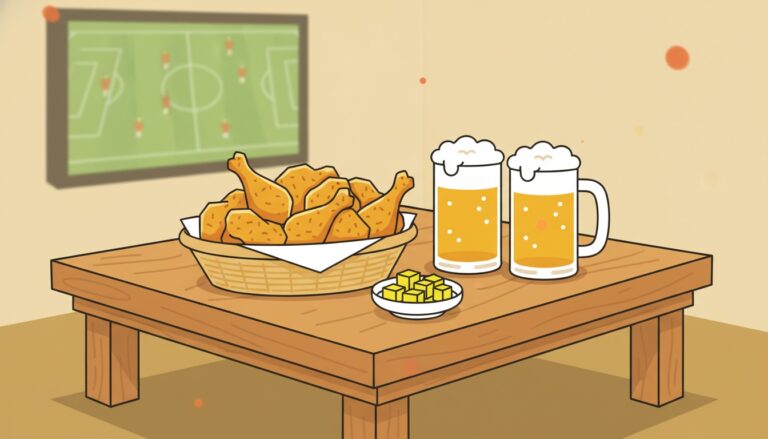
Phase 1: The ‘Chimaek’ Crisis
Hello! It’s your Daily Hangul editor here.
Picture this: It’s 10 PM in Mapo-gu. You walk into a fried chicken restaurant. The smell of garlic and frying oil hits you, but the sound hits you harder. Everyone—and I mean everyone—is staring at the TV in the corner. Suddenly, half the room screams in joy, and the other half groans and puts their heads on the table.
Use your eyes (nunchi). Someone just scored.
But who? And is the game over?
If you check a dictionary, you’ll find formal sentences suitable for a news anchor. But if you use those in a pub, people will look at you like you’re an alien. Today, we’re learning how to check sports results like a local—whether you’re watching Son Heung-min score a goal or suffering through a baseball game that’s gone into overtime.
This isn’t just about numbers; it’s about joining the collective adrenaline.
Phase 2: The Scoreboard (Deep Dive)
Here are the three phrases that will save you from confusion.
1. 몇 대 몇이에요?
- Pronunciation: [myeot dae myeot-i-e-yo?] + (Sounds like saying “Mutt day mutt” quickly)
- Meaning: What is the score? (Literal: How many vs. how many?)
- K-Culture Moment: You’ll hear this constantly in variety shows (like Running Man) when teams are competing. It’s the default way to ask for the score in any context, even rock-paper-scissors.
- Editor’s Insight: The word 대 (dae) means “versus.” So 2:1 is spoken as “two dae one” (i-dae-il). Don’t just ask “Score?” (jeom-su?). Ask “Myeot dae myeot?”
- Situation Spectrum:
[🚫 Formal Speech] ———— [⚠️ Colleagues] ———— [✅ Everyone Else]
(It’s polite enough for strangers in a bar if you add ‘yo’ at the end.)- 🤔 Think About It: Why does Korean prioritize the relation (versus) over the result (score)? It puts the conflict front and center.
2. 누가 이기고 있어요?
- Pronunciation: [nu-ga i-gi-go i-sseo-yo?]
- Meaning: Who is winning (right now)?
- Editor’s Insight: Use this when the game is still happening. If the game is finished, you say “누가 이겼어요?” (Who won?). Mixing up present progressive and past tense is the #1 mistake I hear students make during World Cup season.
- Situation Spectrum:
[🚫 Boss] ———— [⚠️ Strangers] ———— [✅ Friends]3. 대박! 역전이다!
- Pronunciation: [dae-bak! yeok-jeon-i-da!]
- Meaning: Wow! It’s a comeback/turnover!
- K-Drama Vibe: You know that scene where the underdog protagonist is losing everything, then suddenly turns the tables in the last episode? That is 역전 (Yeokjeon). Koreans love a generic underdog story. In sports, a comeback victory is often called a “drama.”
- Editor’s Insight: Shout this. Do not whisper it. If you whisper “yeokjeon,” nobody will believe you.
Phase 3: Textbook vs. Real Life
News anchors speak clearly. Drunk soccer fans do not. Here is the difference.
| Situation | 📖 Textbook Korean | 🗣️ Real Korean | 💡 The Vibe Shift |
|---|---|---|---|
| Asking the score | 현재 스코어가 어떻게 됩니까? (How is the score?) | 지금 몇 대 몇이야? (What’s x vs x?) | Efficiency. Nobody wants to speak long sentences when a goal is imminent. |
| Watching a tie | 경기가 무승부로 끝났습니다. (The match ended in a draw.) | 아, 비겼네. (Ah, it’s tied.) | “Bi-gyeot-ne” conveys the disappointment of a result with no winner. |
| Bad result | 우리 팀이 졌습니다. (Our team lost.) | 망했다… (We’re doomed/screwed…) | “Mang-haet-da” is the universal sound of despair in Korea. |
Bottom Note: B1 learners, stick to “몇 대 몇이에요?” It’s safer than slang, but understanding “망했다” helps you read the room.
Phase 4: Cultural Context — The “Chimaek” Factor
4-1. It’s Not About the Sport, It’s About the Chicken
In Korea, watching sports is essentially a valid excuse to eat Chimaek (Chicken + Maekju/Beer). If you are in a pub watching a game, you don’t need to analyze the offside rule. You just need to know when to clink glasses.
The “Nunchi” (Eye-measure) Rule:
If everyone sighs, do not cheer. I once saw a tourist cheer for the opposing team in a localized pub in Busan (Lotte Giants fans are fierce). The silence was terrifying. Read the room. If the table next to you is cursing, wear a sad face.
4-2. The “Fighting” Spirit
You know this word. “Hwaiting!” (Fighting!). It doesn’t mean you want actual violence. It means “Do your best!” or “Don’t give up!” Use it liberally. Even if your team is losing 5-0.
Phase 5: Roleplay — The Pub Scene
Setting: A crowded pub in Gangnam. A huge screen is showing the Korea vs. Japan soccer match (the most intense rivalry). You are sitting with Min-su, a passionate fan.
Min-su: (Screaming at TV) 아! 저걸 놓치냐! 진짜 답답해!
(Ah! jeo-geol no-chi-nya! jin-jja dap-dap-hae!)
(English) Ah! He missed that?! It’s so frustrating!
YOU: (You just arrived from the restroom and missed the play)
(Choose your response below!)
🔀 Your Turn! What do you say?
- A) “점수가 몇 점입니까?” (Formal/Textbook)
- B) “지금 몇 대 몇이야?” (Natural/Casual)
- C) “심판이 누구예요?” (Who is the referee?)
Min-su: 지금 1대 0이야. 우리가 지고 있어. 어우, 짜증나.
(Ji-geum il-dae-yeong-i-ya. U-ri-ga ji-go i-sseo. Eo-u, jja-jeung-na.)
(English) It’s 1-0 right now. We are losing. Ugh, so annoying.
YOU: 아직 시간 남았으니까 [______] 할 수 있어!
(There’s still time left, so we can [______]!)
✅ Best Choice for Blank: 역전 (Yeokjeon/Comeback)
“아직 시간 남았으니까 역전 할 수 있어!” (We can still make a comeback!)
Phase 6: 10-Second Shadowing Drill
Let’s practice the emotion. Don’t be robotic.
- Curious & Urgent:
지금 / 몇 대 몇이에요? (Ji-geum / myeot dae myeot-i-e-yo?) - Disappointed:
아… / 또 졌어… (Ah… / tto jyeo-sseo…)
(Meaning: Ah… we lost again…) - Excited:
대박! / 우리가 이겼다! (Dae-bak! / u-ri-ga i-gyeot-da!)
Phase 7: K-Culture Mini Glossary
| Korean | Romanization | Meaning | Context |
|---|---|---|---|
| 직관 | jik-gwan | Watching live | Going to the actual stadium instead of watching on TV. |
| 졌잘싸 | jyeot-jal-ssa | Lost but fought well | An abbreviation used when the team lost, but played heroically. Very common on social media. |
| 편파 중계 | pyeon-pa jung-gye | Biased broadcasting | In Korea, commentators openly root for the Korean team. It’s not neutral, and that’s the fun of it. |
Phase 8: Traveler’s Survival Kit
Watching a game at a baseball stadium (like Jamsil) is a top-tier travel experience. Here is what you need.
🆘 Survival Phrases
– 🇰🇷 “치킨 배달 돼요?” (Chi-kin bae-dal dwae-yo?)
– 🗣️ Meaning: Can you deliver chicken here? (Yes, in Korean baseball stadiums, you can often get food delivered to your seat or entrance.)
– 🇰🇷 “응원석 어디예요?” (Eung-won-seok eo-di-ye-yo?)
– 🗣️ Meaning: Where is the cheering section?
– 💡 Pro Tip: Korean baseball is 90% cheering and dancing. If you want quiet, sit in the ‘table seats.’ If you want to party, sit near the cheerleaders (First base is usually the home team).
Phase 9: Think Deeper — “Han” and Sports
Language & Emotion:
Have you noticed how dramatic Korean sports commentary is? It ties into the cultural concept of “Han” (deep sorrow/resentment) and “Heung” (collective joy). When Korea loses, it’s a national tragedy. When they win, the streets stop. This binary outcome is reflected in the language—there are very few “mild” ways to say you lost. You either “fought well” (Heung) or you “were destroyed” (Han).
🧠 Think About It: How does your country react to losing a big game? Is it a joke, a riot, or a tragedy? How does that change the words you use?
Phase 10: Troubleshooting & FAQ
Q: Can I ask a stranger “Who is winning?” in Panmal (casual language)?
A: Absolutely not. Even if you are excited, sticking to “yo” (polite ending) is safer. Use “몇 대 몇이에요?” instead of “몇 대 몇이야?”. The only exception is if you are screaming at the TV screen itself.
Q: What if I don’t know the team names?
A: Just say “우리 편” (Uri pyeon – Our side/team) vs “상대 편” (Sangdae pyeon – Opponent team). In Korea, if you are in a Korean pub, “Uri pyeon” is always Korea (or the local city team).
❌ Common Mistake:
Saying “Score is 2 to 1” as “이 투 일” (Two to One using English structure). NO.
✅ Correct: “이 대 일” (Yi dae il).
Phase 11: Wrap-up
Today we learned how to survive the noise of a Korean sports pub.
Action Missions:
– 🥉 Bronze: Say “몇 대 몇이에요?” out loud three times fast.
– 🥈 Silver: Watch a highlight clip of Son Heung-min and listen for the commentator screaming “Goal!”
– 🥇 Gold: Go to a Korean fried chicken place (even in your country) and ask the staff “Do you like baseball?”
💬 Comments: Are you a baseball fan or a soccer fan? Or just a chicken fan? Let me know below!
Phase 12: Quiz
1. Situation: You walk into a room and everyone is cheering. You want to know the score. You say:
a) 점수가 예뻐요? (Is the score pretty?)
b) 몇 대 몇이에요? (What’s the score?)
c) 안녕하세요. (Hello.)
2. True or False:
In Korea, it is rude to eat chicken while watching baseball.
(Answer: False. It is practically mandatory.)
3. Fill in the blank:
“We were losing, but we made a [______]!” (Turning the game around)
(Answer: 역전 / Yeokjeon)
Frequently Asked Questions (FAQ)
Q: What does "몇 대 몇이에요?" mean in Korean and how do you pronounce it?
A: In Korean, "몇 대 몇이에요?" is pronounced [myeot dae myeot-i-e-yo?] and means: What is the score? (Literal: How many vs. how many?)
Q: What does "누가 이기고 있어요?" mean in Korean and how do you pronounce it?
A: In Korean, "누가 이기고 있어요?" is pronounced [nu-ga i-gi-go i-sseo-yo?] and means: Who is winning (right now)?
Q: What does "대박! 역전이다!" mean in Korean and how do you pronounce it?
A: In Korean, "대박! 역전이다!" is pronounced [dae-bak! yeok-jeon-i-da!] and means: Wow! It's a comeback/turnover!







