

Phase 1: The Immersive Hook
Greeting: 안녕하세요! This is your Daily Hangul editor, checking in from the heart of Seoul.
Imagine this: You’ve seen it on Netflix’s Street Food, you’ve seen it in countless K-Dramas where the protagonists drown their sorrows in soju and greasy pancakes. You are standing in the middle of Gwangjang Market (광장시장).
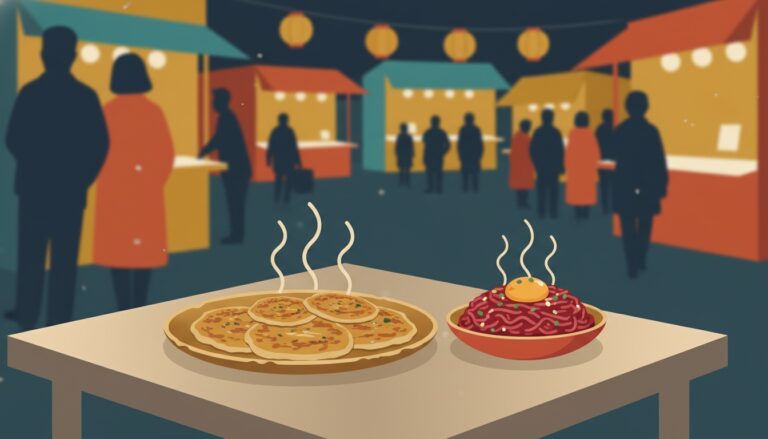
It is sensory overload in the best way possible. The smell of frying oil, the shouting of merchants, the mountains of bright red Yukhoe (beef tartare), and the sizzling Bindaetteok (mung bean pancakes).
You find a tiny empty spot on a bench. The Ajumma (auntie/vendor) is incredibly busy flipping pancakes. If you wait for her to come to you with a gentle “May I take your order?” like in a textbook… you will starve.
In Gwangjang Market, silence is not golden; it’s invisible. Today, we’re going to learn how to speak up, claim your seat, and order like a local in the delicious chaos of Korea’s most famous market.
Phase 2: Deep Dive into Core Expressions
Here are the three phrases that will get you fed.
1. 이모! 여기 육회 하나, 빈대떡 하나요!
- Pronunciation: [Imo! Yeogi yuk-hoe ha-na, bin-dae-tteok ha-na-yo!]
- Sound-alike: E-mo! Yuh-gee yook-hweh ha-na, bin-det-tok ha-na-yo!
- Meaning: Auntie! One beef tartare and one mung bean pancake here, please!
- K-Culture Moment: You know those variety shows like Running Man where they rush into a market? They never whisper. They project their voices.
- Editor’s Insight: Calling the vendor 이모 (Imo – Aunt) is the secret weapon of Korean hospitality. It instantly creates a bond. Technically, you can say 사장님 (Sajangnim – Boss), but Imo feels warmer in a market setting. Key tip: Raise your hand and make eye contact when you say this.
- Situation Spectrum:
[🚫 Formal Biz Meeting] ———— [⚠️ Fancy Restaurant] ———— [✅ Market/Pocha]- 🤔 Think About It: Why do Koreans call strangers “Aunt” or “Uncle”? It reflects the “We” culture (Jeong), treating everyone like extended family.
2. 막걸리도 한 병 주세요.
- Pronunciation: [Mak-geol-li-do han byeong ju-se-yo.]
- Sound-alike: Mak-gol-lee-doh han byung joo-seh-yo.
- Meaning: Please give me a bottle of Makgeolli (rice wine), too.
- K-Food Context: Eating Bindaetteok without Makgeolli is like eating a burger without fries. The fizz of the rice wine cuts through the grease of the pancake. It’s the perfect pairing (called Gung-hap).
- Editor’s Insight: The particle -도 (do) means “also.” You’re adding this to your main order.
3. 선불인가요?
- Pronunciation: [Seon-bul-in-ga-yo?]
- Sound-alike: Sun-bool-in-ga-yo?
- Meaning: Do I pay upfront?
- Editor’s Insight: In chaotic market stalls, it’s hard for vendors to track who ate what. Many stalls operate on Seonbul (Prepayment). Asking this shows you understand the system and aren’t planning to dine and dash.
Phase 3: Textbook vs. Real Life
| Situation | 📖 Textbook Korean | 🗣️ Real Market Korean | 💡 Why the difference? |
|---|---|---|---|
| Calling server | 저기요, 주문하시겠습니까? (Excuse me, may I order?) | (Raising Hand) 이모! 주문이요! (Auntie! Order!) | Markets are loud. Speed and volume matter more than grammar. |
| Ordering | 육회 1인분 주세요. (Please give me 1 serving of Yukhoe.) | 육회 하나요! (One Yukhoe!) | “1인분” (1 serving) is formal. “하나” (one) is faster. |
| Paying | 계산은 어디서 합니까? (Where do I make the payment?) | 얼마예요? 카드 돼요? (How much? Card okay?) | Directness is key in fast-paced environments. |
💡 Bottom Note: In a B2 context, using full sentences is fine, but shortening them makes you sound like a Dan-gol (regular customer).
Phase 4: Cultural Deep Dive
4-1. Hapseok (합석) Culture
In Western restaurants, sitting at a table with strangers is rare. In Gwangjang Market, it is mandatory. This is called Hapseok. If there are two empty seats on a bench, and you are two people, you sit. Do not expect a private table.
– The Vibe: You might end up rubbing elbows with a businessman on one side and a tourist on the other. It’s part of the charm.
– Pro Tip: A polite nod (Mok-rye) to your neighbors when you sit down is sufficient.
4-2. The “Service” (서비스) Phenomenon
Sometimes, the Imo might slap a small bottle of soda or some extra soup on your table without you ordering it, saying “Service!” This means it’s free. It’s a gesture of gratitude.
– Your reaction: Don’t ask “Why?” Just smile bright and say “Wow, gamsahamnida!” (Thank you!).
Phase 5: Immersive Roleplay
Setting: Friday, 8 PM. The center of Gwangjang Market. It’s packed. You spot two seats at a famous stall.
Characters:
– YOU: Hungry traveler.
– IMO: Busy stall owner, flipping pancakes with one hand, counting cash with the other.
Dialogue:
YOU: (Approaching the bench, shouting over the noise) 이모! 여기 앉아도 돼요?
(Imo! Yeogi anjado dwaeyo? / Auntie! Can I sit here?)
IMO: (Nods without looking up) 어, 앉아! 뭐 줄까?
(Eo, anja! Mwo julkka? / Yeah, sit! What do you want?)
YOU: 육회 하나랑 빈대떡 하나 주세요.
(Yukhoe hana-rang bindaetteok hana juseyo. / One beef tartare and one pancake, please.)
IMO: 술은? 막걸리 안 마셔?
(Sureun? Makgeolli an masyeo? / Alcohol? Not drinking Makgeolli?)
🔀 Decision Point: The Upsell!
A) “No, water is fine.”
B) “네! 지평 막걸리 한 병 주세요!” (Yes! Give me one bottle of Jipyeong Makgeolli!)
C) “I don’t like alcohol.”✅ Best Choice: B. Even if you don’t drink much, ordering a drink ensures you are a “good customer” because food margins are low. Plus, it completes the cultural experience.
IMO: 그래, 여기 있어. 선불이야. 3만원.
(Okay, here it is. Prepayment. 30,000 won.)
YOU: (Handing over card) 여기요! 잘 먹겠습니다!
(Here. I will eat well!)
Phase 6: 10-Second Shadowing Drill
Let’s practice the rhythm. In the market, you need to be punchy!
😤 Confident Tone:
이모! / 여기 / 빈대떡 하나 / 막걸리 하나 / 주세요!
(Imo! / yeogi / bindaetteok hana / makgeolli hana / juseyo!)
Phase 7: K-Culture Glossary
| Korean | Rom. | Meaning | Context |
|---|---|---|---|
| 육회 | Yukhoe | Beef Tartare | Raw beef seasoned with sesame oil, pear, and egg yolk. A Gwangjang staple. |
| 빈대떡 | Bindaetteok | Mung Bean Pancake | Thick, fried pancake made of ground mung beans. Very savory. |
| 안주 | Anju | Food for alcohol | Food specifically meant to be eaten with drinks. |
| 느끼하다 | Neukkihada | Greasy/Rich | Used to describe the pancake. Reason why you need spicy sauce or kimchi. |
| 시장 인심 | Sijang Insim | Market Heart | The generous spirit of traditional markets (extra food, lower prices). |
Phase 8: Traveler’s Survival Kit (Gwangjang Edition)
🆘 Survival Expression #1
– 🇰🇷 “화장실 어디예요?” (Hwajangsil eodi-yeyo?)
– 🗣️ Meaning: Where is the bathroom?
– 📍 Pro Tip: Market bathrooms can be hard to find and sometimes lack toilet paper. Carry a small pack of tissues!🆘 Survival Expression #2
– 🇰🇷 “포장해 주세요.” (Pojang-hae juseyo.)
– 🗣️ Meaning: Please wrap/pack this to go.
– 📍 Usage: If you can’t finish that giant pancake, take it back to your hotel.📌 Editor’s Travel Note:
– Cash vs. Card: Most Gwangjang stalls now accept credit cards! However, having 10,000 KRW bills (Won) is faster and preferred for small purchases.
Phase 9: Think Deeper — “Why Seonbul?”
Language & Trust:
Why do some places require Seonbul (prepayment) while others trust you to pay later? In a high-trust society like Korea, paying at the end is the norm. However, Gwangjang Market is a space of transience—thousands of people moving constantly. The switch to “Seonbul” isn’t about mistrust; it’s about efficiency for the Imo who is cooking, serving, and cleaning alone. It allows the customer to leave immediately when finished without waiting for the check.
💬 Your Turn: In your country, is street food usually paid for before or after eating?
Phase 10: FAQ & Troubleshooting
Q: Can I share one serving of food between two people?
A: Generally, no. This is called “1 person 1 menu” (1인 1메뉴). Stalls have limited seating. If you aren’t hungry, order one food item and one drink, or ask politely if sharing is okay, but don’t be surprised if they say no.
Q: Is the raw beef safe?
A: Gwangjang’s Yukhoe alley is famous and has high turnover, meaning the meat is usually very fresh. However, if you have a sensitive stomach, stick to the cooked Bindaetteok.
❌ Common Mistake: Waiting to be seated by a host.
✅ Fix: Scan for an empty seat and ask “Here okay?” (Yeogi okay?). Initiative is key!
Phase 11: Wrap-up
One-Liner: To survive Gwangjang Market, call the vendor “Imo,” order confidently with “Hana” (one), and embrace the chaos of sharing tables.
Action Mission:
– 🥉 Bronze: Say “Imo! Yukhoe hana juseyo!” aloud three times.
– 🥈 Silver: Watch a YouTube video of Gwangjang Market (search: “Gwangjang Market Street Food”) and shadow the customers ordering.
– 🥇 Gold: Go to a Korean restaurant in your city and try asking for “Makgeolli” to go with your pancake!
Phase 12: Quiz
1. You sit down, but the vendor is ignoring you because it’s loud. What do you do?
– A) Wait patiently. She will come eventually.
– B) Raise your hand and shout “Imo! Order please!”
– C) Leave and find a quieter place.
2. The vendor gives you a free bottle of cider (sprite). What is this called?
– A) Seonbul
– B) Hapseok
– C) Service
3. True or False: You should always wait for a host to seat you at a street stall.
Answers:
1. B (Aggressive politeness is the market way!)
2. C (Service is a free gift.)
3. False (Find a seat yourself!)
Frequently Asked Questions (FAQ)
Q: What does "이모! 여기 육회 하나, 빈대떡 하나요!" mean in Korean and how do you pronounce it?
A: In Korean, "이모! 여기 육회 하나, 빈대떡 하나요!" is pronounced [Imo! Yeogi yuk-hoe ha-na, bin-dae-tteok ha-na-yo!] and means: Auntie! One beef tartare and one mung bean pancake here, please!
Q: What does "막걸리도 한 병 주세요." mean in Korean and how do you pronounce it?
A: In Korean, "막걸리도 한 병 주세요." is pronounced [Mak-geol-li-do han byeong ju-se-yo.] and means: Please give me a bottle of Makgeolli (rice wine), too.
Q: What does "선불인가요?" mean in Korean and how do you pronounce it?
A: In Korean, "선불인가요?" is pronounced [Seon-bul-in-ga-yo?] and means: Do I pay upfront?







