

Phase 1: The “Where is my Spoon?” Panic
Hello! This is your Daily Hangul Editor.
Imagine this: You are the main character in a K-Drama. You’ve just sat down at a bustling pork belly (Samgyeopsal) restaurant in Hongdae. The smell of grilling meat is amazing. The side dishes (banchan) arrive instantly. But there’s a problem.
There are no spoons or chopsticks.
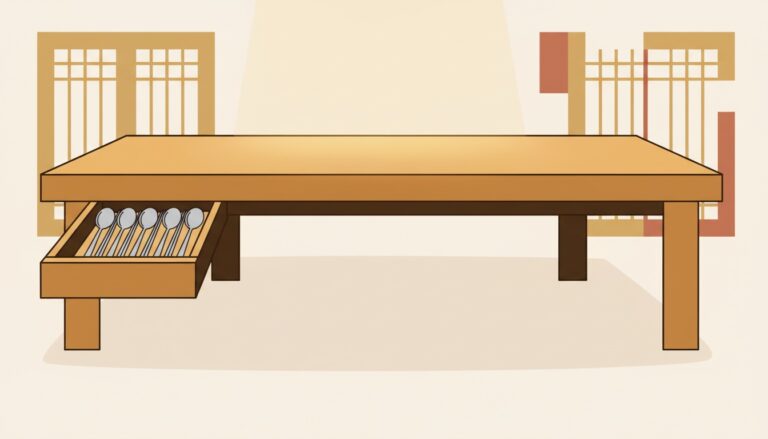
You look around. The waiter is busy. You start to raise your hand to ask, “Excuse me! No spoon!” but then you see your Korean friend reach under the table, slide open a secret compartment, and magically pull out metal chopsticks.
Welcome to the world of Sujeo-tong (수저통).
If you don’t know about this hidden drawer, you might sit there hungry while everyone else starts eating. Or worse, you might keep annoying the busy staff for something that is literally right next to your knee. Today, we aren’t just learning words; we are learning how not to look like a confused tourist.
Phase 2: Deep Dive into Core Expressions
Here are the words you need to survive the Korean table setting ritual.
1. 수저 (Sujeo)
- Pronunciation: [Su-jeo] (Sounds like ‘Sue’ + ‘Joe’)
- Meaning: Spoon (Sut-garak) + Chopsticks (Jeot-garak)
- Context: Koreans rarely say “Pass me the spoon and chopsticks.” We just say “Sujeo.”
- K-Culture Moment: In historical dramas, you see silver spoons changing color to detect poison. Today, we just use stainless steel, but the word remains.
- Situation Spectrum:
[🚫 Formal Ban] ———— [⚠️ Caution] ———— [✅ Go Ahead]
(✅ Safe to use with everyone)- 🤔 Think About It: Why do Koreans have a specific word that combines spoon and chopsticks? It implies they are a set—you can’t have a meal without both.
2. 여기 있어요 (Yeogi isseoyo)
- Pronunciation: [Yeo-gi i-sseo-yo]
- Meaning: Here it is / Here you go.
- Real Nuance: Use this when you are the one taking the cutlery out of the drawer and handing it to your friends. It’s polite and helpful.
- Situation Spectrum:
[🚫 Friends Only] ———— [⚠️ Mix] ———— [✅ Universal]
(✅ Use with anyone)3. 휴지 (Hyuji)
- Pronunciation: [Hyu-ji] (Hyu as in ‘Huge’, Ji as in ‘Gee’)
- Meaning: Tissue / Napkin
- Editor’s Insight: The hidden drawer usually has two things: Sujeo and Hyuji. If you spill some sauce, check the drawer before calling the staff!
Phase 3: Textbook vs. Real Life
| Situation | 📖 Textbook Korean | 🗣️ Real Korean (Street) | 💡 Why different? |
|---|---|---|---|
| Asking for a spoon | “숟가락 좀 주세요.” (Please give me a spoon.) | (Silent) Opens drawer | Koreans value efficiency. Why ask when it’s there? |
| Handing it to a friend | “여기 숟가락과 젓가락이 있습니다.” | “자!” (Ja!) or “여기.” (Here.) | Close friends prefer speed over full sentences. |
Bottom Note: If the drawer is actually empty, then you can say: “여기 수저 없어요” (Yeogi sujeo eop-seoyo / There is no cutlery here).
Phase 4: Cultural Deep Dive — The “Maknae” Duty
4-1. The Unspoken Rule of the Youngest
In Korea, if you are the youngest person (Maknae) at the table, sitting closest to the utensil drawer is your unspoken duty. You don’t just sit there. You open the drawer, take out sets of spoons and chopsticks, and place them on napkins in front of the older people before the food arrives.
4-2. K-Drama Connection
Have you seen office dramas like Misaeng? Watch the team dinners (Hoesik). The junior staff are frantically setting the table. If you do this proactively as a foreigner, your Korean friends will look at you with shock and respect. They might say, “Wow, you are completely Korean now!” (한국 사람 다 됐네요!)
Phase 5: Interactive Roleplay
Setting: It’s Friday night at a loud BBQ place in Gangnam. You are with Min-ji (your Korean friend) and her older brother (Oppa).
Min-ji: (Rubbing stomach) 아, 배고파. 고기 빨리 먹고 싶다.
(Ah, baegopa. Gogi ppalli meokgo sipda.)
(English: Ah, I’m hungry. I want to eat meat quickly.)
Oppa: (Looking at the table) 어? 수저가 없네?
(Eo? Sujeoga eomne?)
(English: Huh? There’s no cutlery?)
🔀 YOUR TURN! The drawer is right next to you. What do you do?
- A) Raise your hand and yell “Sajang-nim! Spoon please!”
- B) Open the drawer, take them out, place them for everyone and say “Yeogi isseoyo.”
- C) Stare at the Oppa and wait for him to find it.
✅ Best Choice: B
Why? Option A makes you look like a novice (the staff will point to the drawer annoyed). Option C is rude because the drawer is next to you. Option B makes you the MVP of the dinner.
You: (Placing the spoon) 여기 있어요.
(Yeogi isseoyo.)
Oppa: 오~ 센스쟁이! 고마워요.
(Oh~ Sense-jaeng-i! Gomawoyo.)
(English: Oh, you have great social sense! Thanks.)
Phase 6: 10-Second Shadowing Drill
Practice this so it comes out naturally when you open the drawer.
- Emotion: 😊 Helpful and bright
- Sentence: 여기 / 수저 / 있어요.
- Pronunciation: Yeo-gi / Su-jeo / i-sseo-yo.
- Meaning: Here is the cutlery.
Phase 7: K-Culture Glossary
| Korean | Romanization | English | Context |
|---|---|---|---|
| 수저통 | Sujeo-tong | Cutlery Box | The wooden or metal box (often inside the table) holding spoons/chopsticks. |
| 막내 | Maknae | Youngest | The person responsible for setting the table and pouring water. |
| 물은 셀프 | Mureun Self | Water is Self-service | A sign you see often. Don’t wait for water; go get it from the purifier! |
| 앞치마 | Ap-chi-ma | Apron | Essential for BBQ to protect your clothes from oil splatters. |
Phase 8: Traveler’s Survival Kit
Finding the spoon is step one. Here are 3 more things you need at a Korean restaurant.
🆘 Survival Expression #1: The Water
– 🇰🇷 “물은 셀프인가요?” (Mureun self-in-gayo?)
– 🗣️ Meaning: Is water self-service?
– 💡 Pro Tip: If you see a water purifier near the entrance with a stack of metal cups, just go get it. No need to ask.🆘 Survival Expression #2: The Bell
– 🇰🇷 “저기요!” (Jeogiyo!)
– 🗣️ Meaning: Excuse me! (To call staff)
– 💡 Pro Tip: Look for a call button (ding-dong) on the table—often right next to the spoon drawer. Pressing it is better than yelling.📌 Editor’s Travel Note
Many modern restaurants now use tablets (t-order) at the table to order. Sometimes there is even a button on the screen for “Request Apron” or “Request Water.” Korea moves fast!
Phase 9: Think Deeper — Why the Hidden Drawer?
Space vs. Hygiene:
Have you noticed how small Korean restaurant tables can be? They are often packed with a grill, stew pot, alcohol bottles, and 5-6 side dishes. There is simply no room for a cutlery box on top of the table. The side drawer is a brilliant design for space efficiency.
However, some people argue about hygiene—everyone touching the spoons inside the drawer. This is why you will sometimes see spoons individually wrapped in paper, or sterilized electric dispensers in high-end places. What do you think? Is it clever design or a germ trap?
Phase 10: FAQ & Troubleshooting
Q: Should I put the spoon on top of a napkin?
A: This is a classic debate! Putting it on a napkin (Hueji) keeps the spoon off the potentially dirty table. However, some cheap napkins have dust or chemicals. The Verdict: If the table looks sticky, use a napkin. If the restaurant uses paper placemats, put the spoon on the mat.
❌ Common Mistake: Sticking your chopsticks vertically into your rice bowl.
✅ Fix: Never do this. It looks like incense burned at a funeral (ancestral rites). Always lay them flat on the table or across your bowl when resting.
Phase 11: Wrap-up & Mission
Summary: In Korea, look under the table for spoons (Sujeo), and if you are the youngest, set the table for everyone to show good manners.
🏆 Action Missions:
– 🥉 Bronze: Say “Sujeo” and “Yeogi isseoyo” aloud 3 times.
– 🥈 Silver: Watch a scene of a Korean meal on YouTube and spot who sets the table.
– 🥇 Gold: Go to a Korean restaurant. Find the drawer. Set the table for your friends before they realize what you’re doing.
Phase 12: Interactive Quiz
1. You sit down and the table is empty. What is the first thing you should check?
A) The kitchen
B) The side of the table
C) Your pockets
2. True or False?
“It is polite to stick your chopsticks vertically in the rice when you are taking a break.”
3. Situation: You opened the drawer, but it’s empty. What do you say?
A) “Sujeo eop-seoyo.” (There is no cutlery.)
B) “Annyeong-haseyo.” (Hello.)
C) “Mas-isseoyo.” (It’s delicious.)
Answers:
1. B (Check for the drawer!)
2. False (Big taboo! It reminds Koreans of funerals.)
3. A (Time to ask the staff for a refill.)
Frequently Asked Questions (FAQ)
Q: What does "수저 (Sujeo)" mean in Korean and how do you pronounce it?
A: In Korean, "수저 (Sujeo)" is pronounced [Su-jeo] and means: Spoon (Sut-garak) + Chopsticks (Jeot-garak)
Q: What does "여기 있어요 (Yeogi isseoyo)" mean in Korean and how do you pronounce it?
A: In Korean, "여기 있어요 (Yeogi isseoyo)" is pronounced [Yeo-gi i-sseo-yo] and means: Here it is / Here you go.
Q: What does "휴지 (Hyuji)" mean in Korean and how do you pronounce it?
A: In Korean, "휴지 (Hyuji)" is pronounced [Hyu-ji] and means: Tissue / Napkin







