

Phase 1: The “Cheaper Than Therapy” Solution
Hello! I’m your Daily Hangul editor.
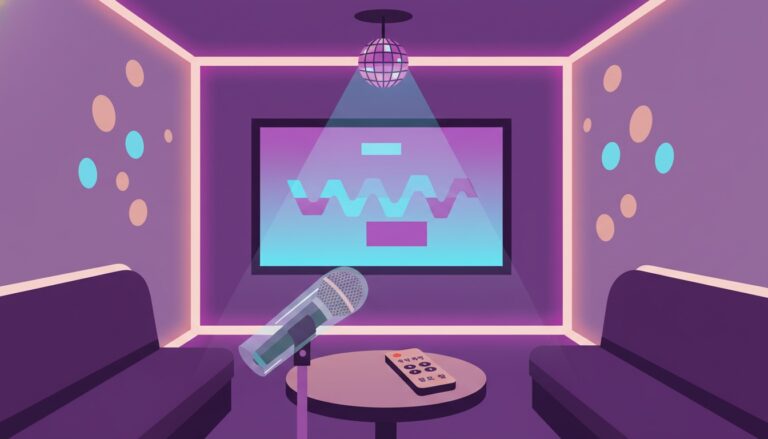
Picture this: You’ve had a long day. Maybe your boss was unreasonable, or maybe you just feel that specific kind of Seoul exhaustion where the city feels too loud yet you feel too quiet. In a K-Drama, this is the moment the protagonist buys a bottle of Soju at a convenience store. But in real life? We look for a neon sign that says “코인 노래방” (Coin Noraebang).
It’s small, it’s cheap (usually 1,000 won for 2-3 songs), and it is the ultimate judgment-free zone. I have seen shy students transform into rock stars inside these tiny booths. But here is the problem: You walk in, grab the mic, and realize… the remote control is in Korean, and you don’t know how to say “I need to scream my lungs out.”
Today, we aren’t just learning words; we are learning how to survive a Korean stress-relief ritual. Let’s get loud.
Phase 2: Deep Dive — Essential Expressions
1. 스트레스 풀다 (Seu-teu-re-seu pul-da)
- Pronunciation: [seu-teu-re-seu pul-da]
Tip: ‘Pul’ sounds like ‘pull’ but with your tongue tapping the roof of your mouth quickly.- Meaning: To relieve/release stress.
- K-Culture Moment: You will hear this in almost every office drama. A character sighs heavily, loosens their tie, and says, “아, 스트레스 풀어야 돼” (Ah, I need to relieve stress) before dragging a colleague to eat spicy chicken feet or sing.
- Editor’s Insight: Korean treats stress like a knot that needs to be untied (“풀다”). It’s active. You don’t just relax; you actively untie the tension.
- Situation Spectrum:
[🚫 Formal Speech] ———— [⚠️ Colleagues] ———— [✅ Friends]
(Safe to use with almost anyone if you add ‘-yo’ at the end)- 🤔 Think About It: Why do you think Korean uses the verb “untie” for stress? In English, we “relieve” or “manage” it. Does “untying” imply it’s a temporary fix?
2. 지르다 (Ji-reu-da)
- Pronunciation: [ji-reu-da]
Tip: ‘Eu’ sounds like the disgusted noise you make when you step in a puddle.- Meaning: To yell / to scream / to belt out (a song).
- K-Culture Moment: Think of that high note in a K-Pop ballad (like IU or Ailee). That is “지르다.” When your friend picks a rock song, they might say, “오늘 그냥 질러!” (Just scream it out today!)
- Editor’s Insight: This isn’t just about volume; it’s about emotion. You “ji-reu-da” to get the frustration out of your chest.
- Situation Spectrum:
[🚫 Boss] ———— [⚠️ Close Coworkers] ———— [✅ Besties]3. 18번 (Si-pal-beon)
- Pronunciation: [sip-pal-beon]
Warning: Be careful with pronunciation. Emphasize the ‘P’ sound gently. If you say it too hard, it sounds like a curse word!- Meaning: Your “Go-to” song / Favorite song to sing.
- K-Culture Moment: In variety shows, MCs often ask idols, “What is your 18-beon?” It refers to the song you sing best and most often.
- Editor’s Insight: This word comes from Kabuki theater history (the 18 best plays), but now it purely means your signature karaoke track.
Phase 3: Textbook vs. Real Life
| Situation | 📖 Textbook Korean | 🗣️ Real Korean (Street) | 💡 Why different? |
|---|---|---|---|
| Suggesting Karaoke | 노래방에 갈까요? (Shall we go to the singing room?) | 코노 각? (Ko-no gak?) | “코노” is slang for Coin Noraebang. “각” implies “is the timing right?” |
| Choosing a song | 무슨 노래를 부를 거예요? (What song will you sing?) | 뭐 부를 거야? (Mwo bu-reul-geo-ya?) | In the booth, efficiency is key. Shorten everything. |
| Asking to skip intro | 전주를 건너뛰어도 돼요? (May I skip the prelude?) | 간주 점프! (Gan-ju Jump!) | Because “Gan-ju Jump” is literally written on the remote button. |
💡 Editor’s Note: “코노 각?” is extremely casual. Use it with friends. If you are with a senior coworker, stick to “노래방 가실래요?”
Phase 4: Cultural Deep Dive — The Art of “Hon-Ko-No”
4-1. Read the Room (Nunchi)
Even in a Coin Noraebang, Nunchi matters.
1. Don’t hog the mic: If you put in 1,000 won (usually 3 songs), don’t sing all three if you’re with a friend. Alternate.
2. The “Priority” Button: There is a button called “우선예약” (Priority Reservation). If you press this while your friend is queuing songs, your song jumps to the front. Do not do this unless you want a fight.
4-2. K-Drama Trope: The Sad Ballad
You’ve seen it. The main character gets dumped, goes to a karaoke booth alone, and sings a heartbreaking ballad while crying.
* Reality Check: This actually happens. It is called “Hon-Ko-No” (Honja = Alone + Coin Noraebang). It is a socially accepted way to deal with sadness. Nobody judges the person singing IU’s “Through the Night” off-key in Room 4.
Phase 5: Immersive Roleplay
Setting: It’s Friday night in Hongdae. You and your Korean friend, Jisoo, just finished spicy tteokbokki. You are both sweating and stressed from exams.
Jisoo: 아, 매워! 야, 우리 소화도 시킬 겸 코노 어때?
(Ah, maewo! Ya, uri so-hwa-do si-kil gyeom ko-no eo-ttae?)
(Ah, so spicy! Hey, how about Coin Karaoke to digest the food?)
🔀 Your Turn! How do you respond?
Option A: “좋아요. 노래방에 갑시다.” (Polite, standard)
Option B: “콜! 나 스트레스 풀고 싶었어.” (Natural, enthusiastic)
Option C: “싫어, 나 노래 못해.” (Refusal)
✅ Best Choice: B (“Call! I wanted to relieve stress.”)
* “Call” (콜) is widely used to say “Deal” or “I’m in.” Option A is too stiff for a friend.
(Scene continues inside the booth)
Jisoo: (Putting in 1,000 won bill) 너 뭐 부를 거야? 18번 있어?
(Neo mwo bu-reul geo-ya? 18-beon isseo?)
(What are you gonna sing? Do you have a go-to song?)
YOU: 음… 요즘 K-pop 듣는데. NewJeans 노래 알아요?
(Umm… I listen to K-pop these days. Do you know NewJeans’ songs?)
Jisoo: 당연하지! 야, 그럼 우리 같이 지르자!
(Dang-yeon-ha-ji! Ya, geu-reom u-ri ga-chi ji-reu-ja!)
(Of course! Hey, then let’s scream/sing it out together!)
Phase 6: 10-Second Shadowing Drill
Try saying this out loud. Imagine you are holding a microphone.
“오늘 / 스트레스 / 확 / 날려버리자!”
(O-neul / seu-teu-re-seu / hwak / nal-lyeo-beo-ri-ja!)
- Meaning: Let’s blow away the stress completely today!
- Emotion: 😤 Energetic & Determined
- Guide: Put a strong accent on “Hwak” (it implies “completely” or “suddenly”).
Phase 7: K-Culture Mini Dictionary
| Korean | Romanization | Meaning | Context |
|---|---|---|---|
| 혼코노 | Hon-ko-no | Solo Coin Karaoke | A combination of Alone + Coin + Noraebang. Very popular culture. |
| 서비스 | Seo-bi-seu | Service (Free time) | Usually in big Karaoke places, the owner gives extra time. Rare in Coin Karaoke. |
| 탬버린 | Taem-beo-rin | Tambourine | The ultimate tool for the person not singing to keep the vibe up. |
| 발라드 vs 댄스 | Ballad vs Dance | Genre choice | Koreans often choose Ballads to release sadness (Han) and Dance to release energy (Heung). |
Phase 8: Traveler’s Survival Kit (The Remote Control)
You are in the booth. The machine is in Korean. Don’t panic. Here are the 3 buttons you need to know.
🆘 Remote Control Decoder
1. 시작 (Si-jak): Start. (The big button, usually distinct).
2. 취소 (Chwi-so): Cancel. (Use this if you picked the wrong song).
3. 간주 점프 (Gan-ju Jump): Skip Intro. (Koreans are impatient. If the intro is long, hit this to start singing immediately).💡 Pro Tip: Need to find a song? Look for “인기차트” (Popular Chart) on the screen to see what everyone else is singing.
Phase 9: Think Deeper — Why Sad Songs?
The Paradox of “Han” (Resentment/Sorrow)
When Westerners want to relieve stress, they often choose upbeat, happy songs. But in Korea, you will often hear people screaming heartbreaking ballads about lost love to relieve stress. Why?
It relates to the cultural concept of “Han” (한). Instead of ignoring sadness with happy distractions, Korean culture often encourages indulging in the emotion to purge it. By singing a sad song with all your might, you externalize the pain. It’s cathartic.
🧠 Think Deeper: Does your culture prefer to “fix” sadness with happy things, or “purge” sadness by feeling it deeply?
Phase 10: FAQ & Troubleshooting
Q: Can I go to a Coin Karaoke alone?
A: Yes! That is the whole point of Hon-ko-no. In fact, many booths are designed for 1-2 people.
Q: Do I need cash?
A: Traditionally, yes (500 won or 1,000 won bills). But recently, many machines accept cards (Samsung Pay, etc.). Just in case, keep 3,000 won in cash in your pocket.
❌ Common Mistake: Taking the microphone cover home.
✅ Fix: You will see a pile of disposable microphone covers at the entrance or counter. Take one packet (2 covers), use them, and throw them away in the trash bin inside the booth when you leave. Do not keep them as a souvenir!
Phase 11: Wrap-up & Mission
Summary: Today we learned how to use Coin Karaoke to “untie” (pul-da) our stress, scream (“ji-reu-da”) our favorite songs, and navigate the remote control.
🚀 Your Mission:
* 🥉 Bronze: Listen to a K-Pop ballad and identify the “Ji-reu-da” (high note/screaming) part.
* 🥈 Silver: Search YouTube for “Coin Noraebang V-log” and watch how they use the remote.
* 🥇 Gold: Go to a Korean Coin Karaoke (or one in your K-town), put 1,000 won in, and sing your 18-beon!
💬 Comment below: What is your 18-beon (go-to song) when you are stressed? I’ll recommend a Korean song that matches your vibe!
Frequently Asked Questions (FAQ)
Q: What does "스트레스 풀다 (Seu-teu-re-seu pul-da)" mean in Korean and how do you pronounce it?
A: In Korean, "스트레스 풀다 (Seu-teu-re-seu pul-da)" is pronounced [seu-teu-re-seu pul-da] and means: To relieve/release stress.
Q: What does "지르다 (Ji-reu-da)" mean in Korean and how do you pronounce it?
A: In Korean, "지르다 (Ji-reu-da)" is pronounced [ji-reu-da] and means: To yell / to scream / to belt out (a song).
Q: What does "18번 (Si-pal-beon)" mean in Korean and how do you pronounce it?
A: In Korean, "18번 (Si-pal-beon)" is pronounced [sip-pal-beon] and means: Your "Go-to" song / Favorite song to sing.







