

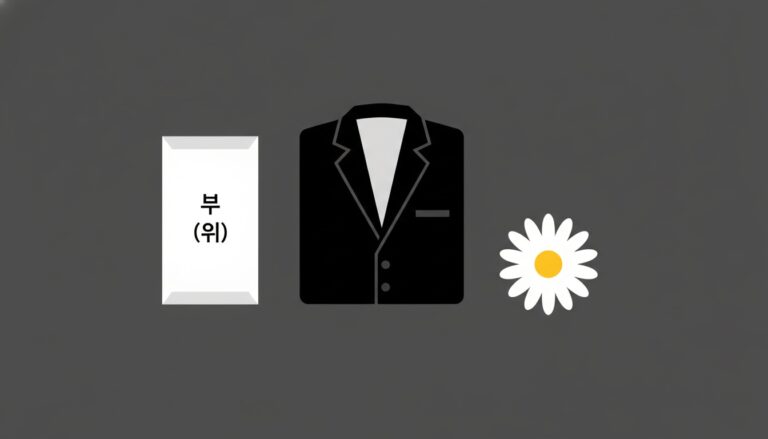
Phase 1: The “Silent” Drama Scene 🎬
Hello! It’s your editor from Daily Hangul.
Imagine this: You are watching a heavy scene in a K-Drama like My Mister (나의 아저씨). The protagonist walks into a room filled with the scent of incense and white chrysanthemums. He stands before a photo, bows deeply, and then turns to the family. The air is heavy. He says… absolutely nothing.
Wait, what? No “I’m sorry”? No “My condolences”?
If you are invited to a Korean funeral, your heart probably beats faster than when you’re ordering at a busy cafe. You might worry: “Do I bow once? Twice? Do I shake hands?”
Don’t worry. I’ve had students who were so nervous they almost bowed to the wrong person. Today, we are going to learn the art of “Sangju-wa Matjeol” (Bowing to the Chief Mourner). It is less about words and more about the weight of your movement.
This guide comes from real questions my students asked before attending the funerals of colleagues’ parents. Let’s make sure you handle this moment with the grace of a local.
Phase 2: The Heavy Words (and Silence) 🗣️
In a Korean funeral, body language speaks louder than words. But there is one “Ultimate Phrase” you should know, even if it’s hard.
1. 삼가 고인의 명복을 빕니다
- Pronunciation: [Sam-ga go-in-ui myeong-bok-eul bim-ni-da]
- Sound Analogy: Sam (like Uncle Sam) + ga (garden) / go-in (going) / myeong-bok (my young book) / bim-ni-da (beam-knee-da)
- Meaning: (Literal) I respectfully pray for the deceased’s happiness in the afterlife. / (Real) “Rest in peace.”
- K-Culture Moment: You will see this written on ribbons of funeral wreaths (Hwahn) standing outside the funeral hall. In dramas, characters often murmur this very quietly.
- Editor’s Insight: This is Level 99 difficulty for A2 learners. If you stutter, it ruins the solemn mood. Pro Tip: If this is too hard, just bow silently. A sincere silence is better than a broken sentence here.
- Situation Spectrum:
[🚫 Casual Friends] ———— [⚠️ Text Messages] ———— [✅ Formal Bowing]
(Note: This is strictly formal. Never say this casually.)- 🤔 Think About It: Why is this sentence so long and indirect compared to “I’m sorry”? Korean culture values formal distance to show respect during tragedies.
2. (The Silent Nod & Eye Contact)
- Pronunciation: … (Silence)
- Meaning: “I am here with you.”
- K-Culture Moment: After the deep bow to the Chief Mourner (Sangju), the guest often just holds the mourner’s hands for a second or nods. In Hospital Playlist, the doctors comfort each other this way.
- Editor’s Insight: Eye contact here shouldn’t be too intense. Look slightly down. It’s a “sad eye contact.”
- Situation Spectrum:
✅ ALWAYS OKAY
Phase 3: Textbook vs. Real Life 🥊
| Situation | 📖 Textbook Korean | 🗣️ Real Korean (Survival) | 💡 Why the difference? |
|---|---|---|---|
| Talking to Mourner | “얼마나 상심이 크십니까?” (How great is your grief?) | (Just silence + slight nod) | In deep grief, words often feel empty. Presence matters more. |
| Leaving | “안녕히 계십시오.” (Goodbye formally) | “수고하세요” or just bow | “Goodbye” implies you are leaving them in sadness. Just bow and leave. |
Bottom Note: As a foreigner, if you just perform the bowing ritual correctly, you are already in the top 1% of respectful guests. Words are secondary.
Phase 4: Cultural Deep Dive — The “Math” of Bowing 🧮
4-1. The 2 vs. 1 Rule (Crucial!)
Here is where K-Drama gets real. The number of bows changes the meaning entirely.
- 2 Bows (+ 1 slight bow): For the Deceased (the photo/altar). This separates the dead from the living.
- 1 Bow: For the Living (the Chief Mourner/Sangju).
⚠️ Danger Zone: If you bow twice to the living person (the Sangju), it implies they are dead too. It is a huge taboo.
4-2. K-Culture Connection: The “Yukgaejang” (육개장) Context
After the intense bowing session, you move to the dining area. Have you noticed in dramas like Move to Heaven that everyone eats spicy red beef soup (Yukgaejang)?
* Why? The red color is believed to ward off ghosts/bad spirits. Also, funerals often last for 3 days (non-stop), so guests need a hearty, spicy meal to stay awake and keep the mourners company.
Phase 5: Immersive Roleplay 🎭
Setting: A funeral hall in the basement of a university hospital. It is quiet, smelling of incense. You are wearing a black suit.
Characters:
* YOU: A foreign colleague of the deceased’s son.
* Sangju (Min-su): The Chief Mourner (wearing a hemp armband).
(Scene: You enter the room. You sign the guest book and put your envelope in the box. Now, you stand on the rug in front of the altar.)
YOU: (Step 1: Burn incense or place a white flower. Step 2: Bow to the photo twice. Step 3: Turn to Min-su.)
Sangju (Min-su): (Looks at you with tired, red eyes and bows.)
🔀 Your Turn! How many times do you bow to Min-su?
– A) Two times (to show extra respect).
– B) One deep bow (Mutual bow).
– C) A handshake and a hug.✅ Best Choice: B) Just one deep bow down to the floor (Matjeol). You get up, and Min-su gets up.
Sangju (Min-su): 와줘서 고마워요. (Wa-jwoseo goma-woyo / Thank you for coming.)
YOU: …
🔀 Your Turn! What do you say?
– A) “삼가 고인의 명복을 빕니다.” (Standard, Formal)
– B) “좋은 곳으로 가셨을 거예요.” (He/She went to a better place.)
– C) (Just nod silently and hold his hand for a second)✅ Best Choice: A or C. C is safer and very emotional. A is perfect if your pronunciation is ready.
Phase 6: 10-Second Shadowing Drill 🎧
Let’s practice the “Ultimate Phrase.” Keep your voice low and calm.
- 😢 Solemnly:
삼가 / 고인의 / 명복을 / 빕니다.
(Sam-ga / go-in-ui / myeong-bok-eul / bim-ni-da.)
Phase 7: K-Culture Mini Glossary 📓
| Korean | Romanization | Meaning | Context |
|---|---|---|---|
| 상주 | Sangju | Chief Mourner | Usually the eldest son. He stays at the funeral home for 3 days. |
| 조의금 | Jo-ui-geum | Condolence Money | Money you give in an envelope. Usually 3, 5, or 100,000 KRW (Odd numbers are lucky). |
| 맞절 | Matjeol | Mutual Bow | Bowing to each other at the same time on the floor. |
| 빈소 | Binso | Memorial Room | The room where the altar and photo are set up. |
Phase 8: Traveler’s Survival Kit (Funeral Edition) 🆘
Even if you are just traveling, you might be invited if you make close Korean friends.
🆘 Survival Tips #1: The Socks Rule
– NEVER enter a funeral hall with bare feet. You must take off your shoes.
– Must Have: Black socks. If you are wearing white ankle socks (or no socks), run to a convenience store (CVS) and buy black socks before entering.📌 Editor’s Note: The Money Envelope
– Don’t use colorful envelopes. Use the standard white ones provided at the funeral hall entrance.
– Write your name vertically on the back left side.
Phase 9: Think Deeper — Why the Floor? 🧠
Language & Body: Have you noticed that in Western culture, “respect” is often shown by standing up or looking in the eye? In Korea, the ultimate respect is lowering yourself.
By bowing fully to the floor (Keun-jeol), you are making yourself as small and low as possible, physically acknowledging the weight of the loss and the hierarchy of the moment. It’s not submission; it’s a shared grounding in grief.
💬 Your Turn: Does your culture have a specific gesture for grief? Do you touch, hug, or keep distance?
Phase 10: FAQ & Troubleshooting 🛠️
Q: I am Christian/Catholic. I am uncomfortable bowing to a photo/ghost. What do I do?
A: This is a very common situation in Korea too! If you cannot bow to the altar for religious reasons, you can stand in front of the photo, close your eyes, and pray silently for a moment (Mok-ryeom). However, you should still bow (or nod deeply) to the living family (Sangju) as a sign of respect for their loss.
Q: Can I smile to comfort them?
A: No. Keep a neutral, solemn face in the Binso (altar room). You can smile faintly when you move to the dining area and share memories, but not in front of the altar.
❌ Common Mistake: Saying “안녕하세요” (Hello) brightly when entering.
✅ Fix: Just enter silently with a slight bow. No happy greetings.
Phase 11: Wrap-up & Mission 🚀
One-Liner: At a Korean funeral, silence and black socks are your best friends.
Action Mission:
* 🥉 Bronze: Practice the “2 bows for the dead, 1 bow for the living” rule physically in your room.
* 🥈 Silver: Watch a funeral scene in a K-Drama (Search YouTube for “My Mister Funeral Scene”) and observe the bowing count.
* 🥇 Gold: If you have a Korean friend, ask them: “Have you ever been a Sangju?” It’s a deep conversation starter.
Phase 12: Quiz — K-Culture Challenge 🧩
1. You are standing in front of the Chief Mourner (Sangju). How many times do you bow?
– A) Two times
– B) One time
– C) Zero times
2. True or False: You should wear bright colors to cheer up the family.
– (T / F)
3. Situation: You forgot black socks and are wearing sandals. What do you do?
– A) Just go in, it’s summer.
– B) Go to a convenience store and buy black socks.
(Answers: 1-B, 2-F, 3-B)
Frequently Asked Questions (FAQ)
Q: What does "삼가 고인의 명복을 빕니다" mean in Korean and how do you pronounce it?
A: In Korean, "삼가 고인의 명복을 빕니다" is pronounced [Sam-ga go-in-ui myeong-bok-eul bim-ni-da] and means: (Literal) I respectfully pray for the deceased's happiness in the afterlife. / (Real) "Rest in peace."
Q: What does "(The Silent Nod & Eye Contact)" mean in Korean and how do you pronounce it?
A: In Korean, "(The Silent Nod & Eye Contact)" is pronounced [... (Silence] and means: "I am here with you."







