

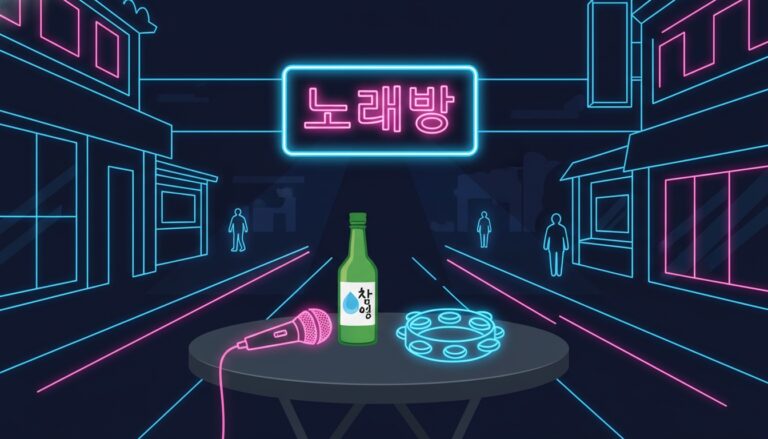
Phase 1: The “After-Party” Panic (Immersive Hook)
Hello! This is your Daily Hangul Editor.
Picture this: It’s 8:30 PM on a Friday. You’ve just finished a massive meal of Samgyeopsal (pork belly) with your team. You smell like smoke and garlic, your stomach is full, and you are ready to go home and crash. You start putting on your coat.
But then, the team leader (Teamjang-nim) stands up, flushes red from the soju, and shouts:
“자, 2차 가야지! 노래방 콜?”
(Ja, i-cha gayaji! Noraebang call?)
In K-Dramas, this is usually where the montage begins—flashing neon lights, tambourines shaking, and the shy new employee suddenly rapping like a superstar. But in reality? This is the moment of truth. Do you stay, or do you run?
Today, we are decoding the chaos of 2차 (Round 2) and the Noraebang (Karaoke). This isn’t just about singing; it’s about office politics, reading the air (nunchi), and knowing exactly when to hit the “Cancel” button.
Phase 2: Deep Dive into Real Expressions
Here are the three phrases that will save your life when the dinner moves to the next location.
1. 2차 [I-cha]
- Pronunciation: [ee-cha] + sounds like “Eat-cha”
- Meaning: Round 2 (The second venue)
- Real Nuance: It literally means “second stage,” but in Hoesik (company dinner) culture, it implies a change in venue and vibe. 1차 (Round 1) is usually a meal. 2차 is usually a pub or karaoke. If you hear “3차” (Sam-cha), prepare for a very late night.
- K-Culture Moment: In almost every office drama (think Misaeng), the real bonding—and the biggest mistakes—happen here.
- Situation Spectrum:
[🚫 Formal Meeting] ———— [✅ After Dinner] ———— [✅ Friends]- 🤔 Think About It: Why does Korean socializing require moving locations? Why not just stay in one place for 5 hours? (Hint: It refreshes the mood!)
2. 분위기 띄우다 [Bun-wi-gi ttui-u-da]
- Pronunciation: [bun-we-gi ttui-u-da]
- Meaning: To liven up the mood / To break the ice
- Real Nuance: Crucial for Noraebang. You don’t have to be a good singer, but you must keep the energy up. If you sing a sad ballad when everyone is dancing, you are “killing the mood” (분위기 깨다).
- Editor’s Insight: If you see a colleague shaking a tambourine aggressively, they are trying to ttui-u-da (float/lift) the atmosphere.
- Situation Spectrum:
[⚠️ Funeral] ———— [✅ Hoesik] ———— [✅ Party]3. 18번 [Sip-pal-beon]
- Pronunciation: [sip-pal-beon] (Be careful! Keep the ‘p’ soft, or it sounds like a swear word!)
- Meaning: Your “Go-to Song” / Signature Song
- Real Nuance: “What is your 18-beon?” means “What is the song you sing best/most often?” You should always have one prepared.
- K-Culture Moment: Idols on variety shows are often asked to sing their 18-beon to prove their vocal skills.
- 🤔 Think About It: The number 18 comes from Kabuki theater tradition (the 18 best plays), adopted into Korean culture to mean “best skill.”
Phase 3: Textbook vs. Real Life
Let’s look at how a textbook teaches you to invite someone to karaoke vs. how we actually say it on the streets of Hongdae.
| Situation | 📖 Textbook Korean | 🗣️ Real Korean | 💡 Why is it different? |
|---|---|---|---|
| Suggesting Round 2 | 2차에 가시겠습니까? (Would you like to go to round 2?) | 2차 콜? / 2차 가자! (Round 2, call? / Let’s go!) | “Call?” comes from poker terminology. It’s concise and energetic. |
| Picking a song | 노래를 예약해 주세요. (Please reserve a song.) | 이거 예약 좀! (Reserve this for me plZ!) | Amid loud music, short sentences work best. |
| Asking to skip | 간주를 점프해 주세요. (Please jump over the interlude.) | 간주 점프! / 간점! (Intro Jump!) | Koreans hate waiting. Even for 10 seconds of instrumental intro. |
💡 Editor’s Note: If you are with the CEO, stick closer to the Textbook column. If you are with your immediate team, mix in the Real Korean.
Phase 4: Cultural Deep Dive — The Hierarchy of the Mic
4-1. Nunchi in the Noraebang
In a Western karaoke bar, you sing what you want. In a Korean Hoesik, the song choice is political.
– The Golden Rule: Never pick a song that is more famous than the boss’s song immediately after he sings.
– The Ballad Ban: Unless it’s 2 AM and everyone is crying, avoid slow, sad songs. It kills the heung (excitement).
– The Priority: Usually, the highest-ranking person sings first (or is invited to). If they refuse, the youngest (maknae) often has to sing a fast song to start the energy.
4-2. K-Drama Trope: The Necktie Headband
You’ve seen it in dramas: a middle-aged businessman wearing his necktie around his forehead like a bandana.
– What it means: It signals “I am letting go of my rank/dignity for tonight.” It is a visual permission slip for everyone else to relax. If your boss does this, you must clap the loudest.
Phase 5: Interactive Roleplay
Setting: Outside the BBQ restaurant. 9:00 PM. The team is buzzing with alcohol.
Characters:
– YOU: New foreign employee, tired but trying to be polite.
– Manager Kim: 40s, energetic, loves drinking.
Manager Kim: (Clapping hands) 자, 고기 다 먹었으니까 소화시켜야지? 노래방 어때?
(Ja, gogi da meogeosseunikka sohwasikyeoyaji? Noraebang eottae?)
(Okay, we ate the meat so we need to digest it, right? How about Karaoke?)
🔀 Your Turn! How do you respond?
Option A: “아니요, 저는 집에 가겠습니다.” (No, I will go home.)
Option B: “좋아요! 제가 분위기 띄우겠습니다!” (Great! I will liven up the mood!)
Option C: “노래방이요? 저는 노래를 못해요…” (Karaoke? I can’t sing…)✅ Best Choice: Option B
Why? Even if you are bad at singing, showing enthusiasm is key in Korean culture. It shows “team spirit.”
⚠️ Analysis of A: Too direct. It puts a damper on the group mood. Better to go for 30 minutes and sneak out later.
⚠️ Analysis of C: Koreans will just say, “It’s okay!” and drag you there anyway. Modesty doesn’t work here.
(Roleplay continues if you chose B)
Manager Kim: 오~ 역시! 가자! 오늘 내가 서비스 많이 달라고 할게!
(Oh~ As expected! Let’s go! I’ll ask for lots of ‘service’ today!)
(🎭 Stage Direction: You walk to the Noraebang. Manager Kim hands you the remote.)
Manager Kim: 자, 첫 곡은 우리 OO씨가 골라봐. 18번 뭐야?
(Okay, our OO picks the first song. What’s your 18-beon?)
Phase 6: 10-Second Shadowing Drill
Let’s practice the magic phrase to bond with your coworkers.
😊 (Energetically):
제가 / 분위기 / 띄워볼게요!
(Je-ga / bun-wi-gi / ttui-wo-bol-ge-yo!)
“I’ll try to liven up the mood!”
Phase 7: K-Culture Glossary (Noraebang Edition)
| Word | Romanization | Meaning | Context |
|---|---|---|---|
| 서비스 | Service | Free stuff | In Karaoke, this refers to “extra time” added to the machine for free by the owner. |
| 탬버린 | Tambourine | Tambourine | The ultimate tool of survival. If you can’t sing, shake this enthusiastically. |
| 막내 | Maknae | Youngest member | The person usually responsible for pouring drinks and reserving songs. |
| 회식 | Hoesik | Company Dinner | The dreaded (or loved) gathering involving food and alcohol. |
Phase 8: Survival Kit — The Remote Control
Walking into a Korean Noraebang, the remote looks like the cockpit of a spaceship. Here are the 3 buttons you must know to survive.
🆘 Survival Buttons
1. 시작 (Si-jak): Start. (Obvious, but essential)
2. 예약 (Ye-yak): Reserve. Pick a song from the book/screen and hit this to add it to the queue.
3. 취소 (Chwi-so): Cancel. Use this if you picked the wrong song, OR if the boss waves his hand saying “Cut it off!”
4. 간주점프 (Gan-ju Jump): Skip Intro. Pro Tip: Press this if the song has a 1-minute piano intro. Everyone is impatient.📌 Editor’s Travel Note
Coin Noraebangs (코인 노래방) are very popular for solo travelers! You pay per song (usually 500-1000 KRW for 2 songs) rather than by the hour. No boss, no pressure. Just you and BTS.
Phase 9: Think Deeper — “Why so late?”
Work Hard, Play Hard, Bond Hard.
Why do Koreans go to Round 2 and Round 3? Why not just have dinner and leave?
Traditionally, Korean work culture is hierarchical and rigid. You can’t speak freely to your boss in the office. Alcohol and the chaotic environment of a Noraebang act as a social lubricant that temporarily flattens this hierarchy. It allows for Jeong (deep emotional bond) to form. The shared experience of embarrassing yourselves together creates a sense of “We are one team.”
💬 Your Turn: Does your country have a culture where you party with your boss? Or is work and life strictly separated? Let me know in the comments!
Phase 10: FAQ & Troubleshooting
Q: Do I really HAVE to sing? I have stage fright.
A: Officially? No. Unofficially? Yes. But here is the hack: Pick a very popular, upbeat English pop song (like “Uptown Funk” or “YMCA”). You don’t need to sing well; you just need to shout the chorus. Everyone else will sing along, drowning you out. Mission accomplished.
Q: Can I leave after Round 1?
A: Yes, but you need a “soft excuse.” Don’t just say “I’m tired.” Say, “I would love to go, but I have a family matter/early morning meeting.” Apologize profusely.
❌ Common Mistake: Singing a quiet song while people are drinking and talking.
✅ Fix: If people are busy pouring drinks, pick a background song. If people are looking at the screen, pick a performance song.
Phase 11: Wrap-up & Mission
Summary: Hoesik isn’t just drinking; it’s an extension of work. “2차” means the night is young, and your “18-beon” is your weapon of choice.
Action Missions:
– 🥉 Bronze: Go to YouTube and search for “Korean Karaoke Chart.” Listen to the Top 3.
– 🥈 Silver: Pick your own “18-beon” (Go-to song) that you would sing in Korea.
– 🥇 Gold: Go to a Coin Noraebang (or local karaoke) and find the “Start” and “Cancel” buttons on the remote!
K-Culture Mission: Watch a clip of the drama “My Mister” (나의 아저씨) or “Misaeng” (미생) featuring a Hoesik scene. Notice who is sitting where and who is singing!
Phase 12: Quiz — The Situation Challenge
Situation: You are at a Noraebang. The Manager (50 years old) just finished singing an old trot song. The room is quiet.
Q: What is the BEST reaction?
1. Clap politely and sit down.
2. Immediately reserve your favorite heavy metal song.
3. Cheer loudly, hit the tambourine, and say “One more song!” (앵콜!)
4. Check your phone for the time.
Answer: 3. Cheer loudly.
Explanation: The Manager wants validation. Silence is the enemy. Even if the song was boring, you must act like you just saw Beyoncé.
Frequently Asked Questions (FAQ)
Q: What does "2차 [I-cha]" mean in Korean and how do you pronounce it?
A: In Korean, "2차 [I-cha]" is pronounced [ee-cha] and means: Round 2 (The second venue)
Q: What does "분위기 띄우다 [Bun-wi-gi ttui-u-da]" mean in Korean and how do you pronounce it?
A: In Korean, "분위기 띄우다 [Bun-wi-gi ttui-u-da]" is pronounced [bun-we-gi ttui-u-da] and means: To liven up the mood / To break the ice
Q: What does "18번 [Sip-pal-beon]" mean in Korean and how do you pronounce it?
A: In Korean, "18번 [Sip-pal-beon]" is pronounced [sip-pal-beon] and means: Your "Go-to Song" / Signature Song







