

Hello! It’s your Daily Hangul editor here.
Imagine this scene: You’ve just finished a delicious delivery of Chimaek (Chicken + Beer) in your Seoul apartment. You feel great. But then, you look at the table. Chicken bones, greasy boxes, radish containers, empty cans… panic sets in.
In K-Dramas, the main character just ties a bag and runs out to meet their crush at the recycling station. In reality? You stand there terrified because Korean recycling rules are intense.
And standing between you and a successful trash run is the ultimate boss: The Gyeongbi Ajeossi (Security Guard Uncle).
He knows everything. He knows who didn’t separate the vinyl from the plastic. He sees all.
Today, we are going to learn how to approach him and ask for help without looking like a clueless outsider. Let’s survive Korean recycling together.
Phase 2: The “Save Me” Phrases
Here are the only three phrases you really need to survive Tuesday morning recycling duty.
1. 아저씨 (Ajeossi)
- Pronunciation: [Ajeossi] + Ah-juh-shee
- Meaning: Middle-aged man / Uncle (affectionate title for the guard)
- K-Culture Moment: In the drama Sweet Home, the guard is scary. In Reply 1988, the adults are like family. Your guard is likely somewhere in between.
- Editor’s Insight: Never call him “Security Guard” (Gyeongbi-won). That sounds cold and distant, like you are his boss. Calling him “Ajeossi” immediately makes you the “polite young person in Apt 302.”
- Situation Spectrum:
[🚫 Formal Meeting] ———— [⚠️ Young Stranger] ———— [✅ Service Workers/Guards]2. 이거 어떻게 버려요? (Igeo eotteoke beoryeoyo?)
- Pronunciation: [Igeo eotteoke beoryeoyo] + Ee-geo uh-tteo-keh buh-ryeo-yo?
- Meaning: How do I throw this away?
- Real Nuance: “I am confused and trying to follow the rules. Please teach me.”
- Situation: You are holding a Pringles can (is it paper? is it metal?). You make eye contact with the Ajeossi.
- 🤔 Think About It: Korean verbs often come at the end. Literally, this is “This + How + Throw away?” It focuses on the method, not just the location.
3. 이거 음식물이에요? (Igeo eumsikmul-ieyo?)
- Pronunciation: [Igeo eumsikmul-ieyo] + Ee-geo eum-shing-mool-ee-eh-yo?
- Meaning: Is this food waste?
- The Trap: Chicken bones are NOT food waste. Eggshells are NOT food waste. If you put these in the food bin, you might get a scolding. When in doubt, ask this question.
Phase 3: Textbook vs. Real Life
Textbooks make you sound like a robot. Let’s sound like a local.
| Situation | 📖 Textbook Korean | 🗣️ Real Korean | 💡 Why different? |
|---|---|---|---|
| Asking where to throw trash | 쓰레기장은 어디입니까? (Where is the garbage dump?) | 이거 어디다 버려요? (Where do I toss this?) | “Garbage dump” sounds too serious. We focus on the action of “throwing.” |
| Asking for category | 이것은 플라스틱입니까? (Is this plastic?) | 이거 플라스틱 맞아요? (Is this right for plastic?) | “Is it right?” checks for confirmation rather than just a definition. |
Phase 4: Cultural Context — The Art of ‘Nunchi’
1. The “Hesitant Approach”
Do not just walk up to the Ajeossi and shout your question. Koreans value non-verbal signals.
– Step 1: Approach slowly with the trash in your hands.
– Step 2: Bow slightly (just a head nod).
– Step 3: Look a bit confused/troubled.
This signals: “I am sorry to bother you, but I want to do the right thing.”
2. The K-Drama Connection
In Korean thrillers, the recycling station is often where secrets are found. In reality, it’s a community hub. The Ajeossi is the gatekeeper of this hub. If you are polite to him, he might even give you a free box when you need to move house later!
Phase 5: Roleplay — The Pizza Box Dilemma
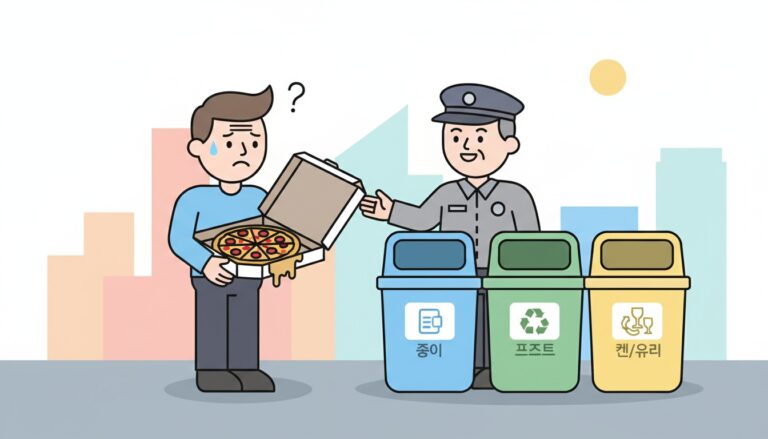
Setting: It’s 8 PM on a Thursday. The recycling area is dimly lit. You are holding a greasy pizza box. You know paper goes in “Paper,” but this box is dirty.
Characters:
– YOU: Hungry, tired, confused foreigner.
– Ajeossi: Wearing a grey uniform, listening to the radio, looks stern but kind.
Start Dialogue:
YOU: (Approaching carefully) 안녕하세요, 아저씨…
(Annyeonghaseyo, ajeossi…)
(Hello, Uncle…)
Ajeossi: 어, 왔어? 뭐 버리게?
(Eo, wasseo? Mwo beorige?)
(Oh, you’re here? What are you throwing away?)
YOU: 이거… 피자 박스인데, 어떻게 버려요?
(Igeo… pizza box-inde, eotteoke beoryeoyo?)
(This is… a pizza box, how do I throw it away?)
Ajeossi: (Inspects the box closely) 기름 묻었네?
(Gireum mudeonne?)
(It has oil on it?)
🔀 Decision Point! How do you reply?
- A) “네, 조금요.” (Yes, a little.)
- B) “아니요! 깨끗해요!” (No! It’s clean! — Lying is bad!)
- C) (Just stare blankly)
✅ Best Choice: A
YOU: 네, 조금요.
(Ne, jogum-yo.)
Ajeossi: 에이, 그럼 종이 아니야. 일반 쓰레기에 넣어.
(Ey, geureom jongi aniya. Ilban sseuregi-e neoeo.)
(Ey, then it’s not paper. Put it in General Waste.)
YOU: 아, 네! 감사합니다!
(Ah, ne! Gamsahamnida!)
Phase 6: 10-Second Shadowing Drill
Let’s practice the magic sentence. Say this while holding an imaginary piece of trash.
😊 Slightly confused but polite tone:
저기요 / 아저씨, / 이거 / 비닐 맞아요?
(Jeogiyo / ajeossi, / igeo / binil majayo?)
Excuse me / Uncle, / this / is it right for vinyl (plastic film)?
Phase 7: K-Culture Mini Glossary
| Korean | Romanization | Meaning | Context |
|---|---|---|---|
| 종량제 봉투 | Jongnyangje bongtu | Standard garbage bag | You must buy these specific bags at the convenience store. You cannot use black plastic bags! |
| 분리수거 | Bunli-sugo | Recycling | Literally “Separate Collection.” The national sport of Korea. |
| 일반 쓰레기 | Ilban sseuregi | General Waste | Anything that cannot be recycled (dirty tissues, greasy boxes). |
Phase 8: Traveler’s Survival Kit
Even if you are just traveling, you will have trash. You bought a coffee, walked around Hongdae, and now the cup is empty. Where does it go?
🆘 Survival Expression
– 🇰🇷 “이거 여기 버려도 돼요?” (Igeo yeogi beoryeodo dwaeyo?)
– 🗣️ Meaning: Can I throw this away here?
– 📍 Where to use: Asking a staff member at a cafe, convenience store, or street vendor.
– 💡 Pro Tip: Korean streets have very few trash cans. Usually, you give your trash back to the place you bought it, or carry it to a subway station bathroom.
Phase 9: Think Deeper — Why so strict?
Have you noticed how specific Koreans are about recycling? Peeling labels off bottles, rinsing yogurt cups… why?
🧠 The Logic:
Korea is a small peninsula with a high population density and very limited land for landfills. We import most of our energy resources. Recycling isn’t just an “eco-friendly choice” here; it’s a survival strategy for the country. When the Ajeossi scolds you for mixing trash, he isn’t just being grumpy—he’s protecting the community system. It’s a collective effort.💬 Your Turn: Does your country have strict recycling laws, or is it more relaxed? Tell me in the comments!
Phase 10: FAQ & Troubleshooting
Q: The Ajeossi helped me a lot. Can I give him a tip?
A: No money! That’s awkward. Instead, buy him a small canned coffee or a Vita500 drink from the convenience store. Hand it to him with two hands and say “Gamsahamnida.” You will instantly become his favorite resident.
Q: What if I throw trash in the wrong place and run away?
A: CCTV is everywhere. In some apartment complexes, they will track you down and fine you. Don’t risk it!
❌ Common Mistake: Putting egg shells in food waste.
✅ Fix: Egg shells are hard. They go in General Waste (standard bag). Animals cannot eat them, so they are not food waste.
Phase 11: Wrap-up & Mission
One-Liner: When in doubt, ask the Ajeossi, and never treat greasy pizza boxes as paper!
🔥 Action Mission:
– 🥉 Bronze: Practice saying “Igeo eotteoke beoryeoyo?” three times.
– 🥈 Silver: Go to a Korean convenience store and find the “Jongnyangje bongtu” (standard trash bags). Just looking is okay!
– 🥇 Gold: If you live in Korea, ask your security guard a question about trash separation this week. Even a simple greeting works!
See you next time, and happy recycling!
Frequently Asked Questions (FAQ)
Q: What does "아저씨 (Ajeossi)" mean in Korean and how do you pronounce it?
A: In Korean, "아저씨 (Ajeossi)" is pronounced [Ajeossi] and means: Middle-aged man / Uncle (affectionate title for the guard)
Q: What does "이거 어떻게 버려요? (Igeo eotteoke beoryeoyo?)" mean in Korean and how do you pronounce it?
A: In Korean, "이거 어떻게 버려요? (Igeo eotteoke beoryeoyo?)" is pronounced [Igeo eotteoke beoryeoyo] and means: How do I throw this away?
Q: What does "이거 음식물이에요? (Igeo eumsikmul-ieyo?)" mean in Korean and how do you pronounce it?
A: In Korean, "이거 음식물이에요? (Igeo eumsikmul-ieyo?)" is pronounced [Igeo eumsikmul-ieyo] and means: Is this food waste?







