

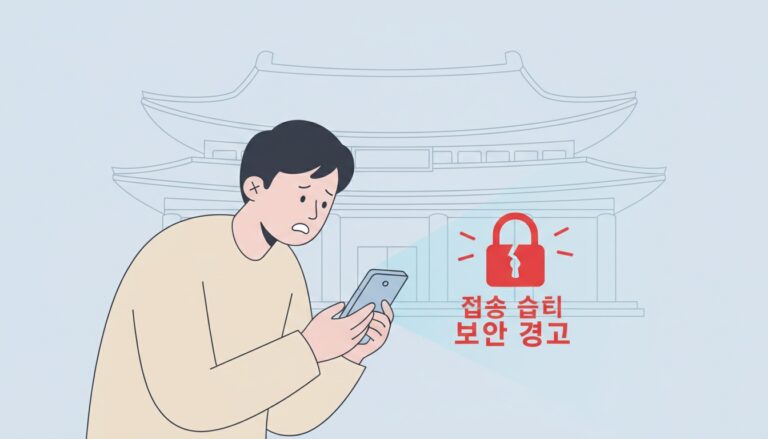
Phase 1: The “Red Text of Doom” (Immersive Hook)
Greeting: Hello! Your Daily Hangul editor here.
Picture this: It’s 7:58 PM. You are on your laptop, heart racing. You are about to buy tickets for a massive K-Pop concert (maybe BTS or BLACKPINK?) on Interpark. The countdown hits zero. You click “Buy.” You get to the payment screen.
Your fingers are shaking. You type your banking password. error. You type it again, carefully. error. One last try… and then you see the red text: “비밀번호 오류 횟수 초과 (Password error limit exceeded).”
Your account is locked. The tickets are gone. 😱
If you’ve lived in Korea for more than a month, you know the terror of Korean internet banking security. It is famously strict. If you get it wrong 3 or 5 times, you are locked out completely. Today, let’s learn how to walk into a bank, look the teller in the eye, and say, “Please save my digital life.”
Phase 2: Core Expressions Deep Dive
Here are the three sentences you need to survive a banking crisis.
1. 비밀번호 오류 횟수를 초과했어요.
- Pronunciation: [bimil-beonho o-ryu hoesu-reul chogwa-haesseoyo] + (Think: “cho-gwa” sounds like a sound effect for overflowing water)
- Meaning: I exceeded the password error limit.
- Literal: Password error number of times exceeded.
- K-Culture Moment: This is the phrase that kills the vibe in every K-Drama online shopping scene. The protagonist usually sighs deeply and slams the laptop shut.
- Editor’s Insight: This sounds formal because banking is formal. “초과 (Chogwa)” means “exceed.” Use this when you want to sound professional and precise about why your account is locked.
- Situation Spectrum:
[🚫 Friends] ———— [⚠️ Co-workers] ———— [✅ Bank Teller]🤔 Think About It: Why does Korea use the word “Exceeded” (초과) instead of just “Wrong too many times”? It reflects a culture that values precise reporting in administrative settings.
2. 인터넷 뱅킹이 잠겼어요.
- Pronunciation: [inteonet baengking-i jam-gyeosseoyo]
- Meaning: My internet banking is locked.
- Nuance: “잠기다 (jamgida)” is passive. It implies, “It got locked (not necessarily my fault!)”
- K-Culture Moment: You might hear “잠겼어 (It’s locked)” when someone tries to enter a house with the wrong door code in a thriller movie.
- Editor’s Insight: This is the most natural, common way to explain the result. It’s slightly less formal than expression #1 but perfectly polite with the ‘yo’ ending.
- Situation Spectrum:
[✅ Friends] ———— [✅ Co-workers] ———— [✅ Bank Teller]3. 비밀번호를 재설정하고 싶어요.
- Pronunciation: [bimil-beonho-reul jaeseoljeong-hago sipeoyo]
- Meaning: I want to reset my password.
- Editor’s Insight: “재 (Jae)” means “re-” (again) and “설정 (Seoljeong)” means “set/setup.” You will see “설정” in the settings menu of every Korean app (KakaoTalk, Baedal Minjok). Memorize this word!
- Situation Spectrum:
[🚫 Friends] ———— [✅ Service Centers] ———— [✅ Bank Teller]
Phase 3: Textbook vs. Real Life
| Situation | 📖 Textbook Korean | 🗣️ Real Life Korean | 💡 Why the difference? |
|---|---|---|---|
| Explaining the problem | 비밀번호를 5회 틀렸습니다. (I got the password wrong 5 times.) | 비번을 까먹어서 잠겼어요. (Forgot my ‘PW’ so it’s locked.) | “비번” is short for 비밀번호. Koreans love shortening 4-syllable words to 2. |
| Asking for help | 어떻게 해결할 수 있습니까? (How can this be resolved?) | 이거 어떻게 풀어요? (How do I unlock/untie this?) | “풀다 (Pulda)” means to untie/solve/unlock. It’s a very physical, active verb used for stress, knots, and passwords. |
Bottom Note: At the bank counter, stick to the Textbook or Phase 2 expressions. Use Real Life versions when complaining to your Korean friends about your bank trouble.
Phase 4: Cultural Deep Dive — The “ActiveX” Trauma
4-1. Non-verbal: The “ID Card” Ritual
When you go to fix this, the teller will 100% ask for your ID (ARC or Passport). When handing it over:
– Do: Use two hands. It shows respect for the transaction.
– Don’t: Slide it across the counter like a poker chip.
4-2. K-Culture Connection: Why is it so hard?
If you watch older K-Dramas, you might see scenes where characters need a “Certificate” (공동인증서) to pay for anything. Korea developed its own unique security web in the 90s. While it’s getting better (easier apps like Toss or KakaoBank), traditional banks still prioritize extreme security over convenience.
Think About It: In many Western countries, if you forget a password, you get an email link. In Korea, you often have to visit the branch in person. Why? Because in Korea, face-to-face verification is considered the only “true” security against fraud.
Phase 5: Immersive Roleplay
Setting: A busy bank branch in Hongdae during lunch hour. The ticket machine beeps loudly. Number 402 is called. That’s you.
Characters:
– YOU: A foreigner desperate to pay rent.
– Bank Teller: Efficient, fast, typing at the speed of light.
(Dialogue)
Teller: 402번 고객님, 오세요. 무슨 업무 도와드릴까요?
(402-beon gogaeknim, oseyo. Museun eomu dowadeurilkkayo?)
(Customer 402, please come here. How can I help you?)
YOU: 안녕하세요. 저… 인터넷 뱅킹이 잠겼어요.
(Annyeonghaseyo. Jeo… inteonet baengking-i jam-gyeosseoyo.)
(Hello. Um… my internet banking is locked.)
Teller: 아, 비밀번호 오류 횟수 초과하셨나요?
(Ah, bimil-beonho o-ryu hoesu chogwa-hasyeonnayo?)
(Ah, did you exceed the password error limit?)
YOU: 네, 맞아요. 비밀번호를 자꾸 틀려서요.
(Ne, majayo. Bimil-beonho-reul jakku teullyeoseoyo.)
(Yes, that’s right. Because I kept getting the password wrong.)
Teller: 신분증 가지고 오셨나요?
(Sinbun-jeung gajigo osyeonnayo?)
(Did you bring your ID card?)
🔀 Decision Point: Do you have your ARC?
- A) “네, 여기 있어요.” (Hand over ARC)
- B) “아! 여권 사진 찍어둔 건 있는데…” (Show photo of Passport)
- C) “신분증이요? 없는데요?” (No ID)
✅ Best Choice: A.
⚠️ Why B and C Fail: Korean banks are inflexible. A photo of an ID is never accepted for banking business. You must have the physical Alien Registration Card (ARC) or Passport.
Phase 6: 10-Second Shadowing Drill
Let’s practice the sentence you’ll say while holding back tears of frustration.
Emotion: 😢 Anxious & Apologetic
“비밀번호를 / 자꾸 틀려서 / 잠겼어요.”
(bimil-beonho-reul / jakku teullyeoseoyo / jam-gyeosseoyo)
“I kept getting the password wrong, so it got locked.”
Phase 7: K-Culture Mini Glossary
| Korean | Romanization | Meaning | Context |
|---|---|---|---|
| OTP | [OTP] | One Time Password | A small device or card that generates a random number. Essential for transfers in Korea. Don’t lose this! |
| 보안카드 | [boan-kadeu] | Security Card | A plastic card with 30-40 secret codes on it. The “old school” version of OTP. |
| 재발급 | [jaebalgeup] | Re-issuance | Use this if you lost your security card. “보안카드 재발급해 주세요.” |
Phase 8: Traveler’s & Expat’s Survival Kit
Even if you are just traveling, you might need to visit a bank for currency exchange problems. But for residents, this is crucial.
🆘 Survival Expression #1
– 🇰🇷 “신분증 여기 있습니다.” (Sinbun-jeung yeogi isseumnida.)
– 🗣️ Meaning: Here is my ID.
– 📍 Use: Everywhere (Bank, Hospital, Club, Convenience store for alcohol).
– 💡 Pro Tip: In Korea, your Alien Registration Card (ARC) is more powerful than a passport for banking. Always bring it.📌 Editor’s Bank Note
– Banking Hours: Most Korean banks close at 4:00 PM. Yes, it is very early. Some have “extended hours” branches, but don’t count on it. Go during lunch!
Phase 9: Think Deeper — “Palli Palli” vs. Security
Korea is famous for “Palli Palli” (Hurry, Hurry) culture. Deliveries arrive in hours; internet is the fastest in the world. Yet, banking feels incredibly slow and bureaucratic. Why?
This paradox comes from a history of rapid digitization. Korea put everything online before security technology was fully mature, leading to heavy regulations (like ActiveX) that stuck around. It creates a unique tension: Koreans want things fast, but they accept high friction in banking as the cost of safety.
💬 Your Turn: In your country, is banking fast and risky, or slow and safe? Let us know in the comments!
Phase 10: FAQ & Troubleshooting
Q: Can I unlock my account over the phone?
A: Usually, no. Especially for foreigners. Because they need to verify your identity strictly, they almost always require a branch visit for a password reset.
Q: My name is too long for the banking app!
A: Common struggle. Korean systems often have a character limit. Sometimes your name is cut off (e.g., “ALEXANDER MICHAE” instead of “MICHAEL”). Memorize exactly how your name is spelled on the bank book (Passbook/통장) — spaces and all.
❌ Common Mistake: Using your “English name” instead of your “Legal Name.”
✅ Fix: Banks only care about what is on your ARC. If your ARC says “SMITH JOHN,” you are “SMITH JOHN,” not “John Smith.”
Phase 11: Wrap-up
One-Liner: When you get locked out, don’t panic—just bring your ARC to the branch before 4 PM and say “Jam-gyeosseoyo” (It’s locked).
Action Missions:
– 🥉 Bronze: Say “인터넷 뱅킹이 잠겼어요” 3 times while looking at your reflection.
– 🥈 Silver: Check your own banking app. Find the “설정” (Settings) menu.
– 🥇 Gold: (If you live in Korea) Visit a bank to update your phone number or just ask for a new bank book cover to practice the interaction!
K-Culture Mission: Watch a scene from the drama “Start-Up” or any office drama. Look for the colorful ID cards hanging around their necks. That ID is their life key!
See you next time, and may your passwords always be correct! 👋
Frequently Asked Questions (FAQ)
Q: What does "비밀번호 오류 횟수를 초과했어요." mean in Korean and how do you pronounce it?
A: In Korean, "비밀번호 오류 횟수를 초과했어요." is pronounced [bimil-beonho o-ryu hoesu-reul chogwa-haesseoyo] and means: I exceeded the password error limit.
Q: What does "인터넷 뱅킹이 잠겼어요." mean in Korean and how do you pronounce it?
A: In Korean, "인터넷 뱅킹이 잠겼어요." is pronounced [inteonet baengking-i jam-gyeosseoyo] and means: My internet banking is locked.
Q: What does "비밀번호를 재설정하고 싶어요." mean in Korean and how do you pronounce it?
A: In Korean, "비밀번호를 재설정하고 싶어요." is pronounced [bimil-beonho-reul jaeseoljeong-hago sipeoyo] and means: I want to reset my password.







