

Buying Upcycled in Seoul: Look Good, Do Good
Phase 1: The “Hip” Side of Saving the Planet
Hello! Daily Hangul Editor here.
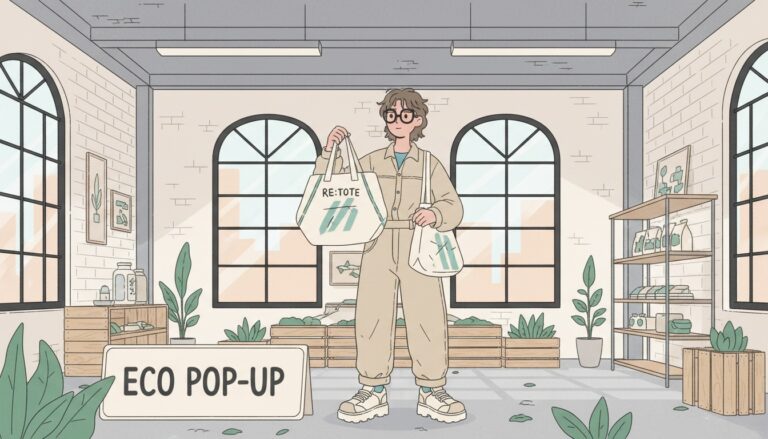
Picture this: You are walking through the back alleys of Seongsu-dong—often called the Brooklyn of Seoul. It’s gritty, industrial, but incredibly stylish. You walk into a shop that looks like an art gallery. There’s a bag on the shelf made from an old truck tarp or a discarded diving suit. It looks cool. It looks expensive.
In a K-Drama, this is where the quirky, artistic lead character works. In real life, this is the heart of Korea’s “Value Consumption” (가치 소비, Gachi-sobi) trend.
K-Pop idols aren’t just wearing luxury brands anymore; they are increasingly spotted wearing upcycled accessories to show they care. If you want to join this conversation—not just as a shopper, but as a conscious consumer—you need more than just “How much is this?”
Today, we’re learning how to navigate a Korean eco-shop without looking like a confused tourist. Let’s get hip.
Phase 2: Deep Dive into Expressions
Here are three phrases that will make the shop staff look at you with respect.
1. 이거 혹시 재활용 소재로 만든 건가요?
(Igeo hoksi jaehwaryong sojae-ro mandeun geongayo?)
- Pronunciation: E-geo hoke-she jae-hwa-ryong so-jae-ro man-deun geon-ga-yo?
(Tip: ‘Hoke-she’ sounds like a sharp intake of breath before asking a favor.)- Meaning: “Is this, by any chance, made of recycled materials?”
- Real Nuance: You aren’t just asking “Is this recycled?” The word 혹시 (hoksi) softens the blow. It makes you sound polite and tentative, rather than demanding. It’s the magic word of Korean etiquette.
- K-Culture Moment: In almost every rom-com, when someone approaches their crush to ask a risky question, they start with “Hoksi…”
- Situation Spectrum:
[🚫 Formal Ban] ———— [⚠️ Caution] ———— [✅ Casual/Polite]
(Perfect for shop staff or strangers. ✅)- 🤔 Think About It: Why do Koreans add “by any chance” (hoksi) even when the question is simple and harmless? It’s about burden reduction. You are signaling, “It’s okay if it’s not, don’t feel bad saying no.”
2. 업사이클링 제품치고는 디자인이 너무 세련됐어요.
(Eopsaikeulling je-pum-chigo-neun dijaini neomu seryeondwaesseoyo.)
- Pronunciation: Up-cycling je-pum-chee-go-neun…
- Meaning: “For an upcycled product, the design is very sophisticated.”
- Real Nuance: The grammar point ~치고는 (~chigo-neun) is the star here. It means “considering it is X.” It implies you had a lower expectation, and this exceeded it. It’s a high-level compliment.
- Editor’s Insight: Koreans love the word 세련되다 (sophisticated/polished). It’s a better compliment than just “pretty” (예쁘다) when you are in a high-end environment.
- Situation Spectrum:
[🚫 Boss] ———— [⚠️ Stranger] ———— [✅ Shop Staff]
(Use this to praise the shopkeeper’s curation skills. ✅)- 🤔 Think About It: Is “considering it is recycled” actually a backhanded compliment? In English, maybe. In Korean, using ~chigo-neun expresses genuine surprise at the quality overcoming a stereotype.
3. 좋은 취지인 것 같아서 이걸로 구매할게요.
(Joeun chwiji-in geot gataseo igeollo gumaehalgeyo.)
- Pronunciation: Jo-eun chwee-jee-in got ga-ta-seo…
- Meaning: “It seems like a good cause/intent, so I’ll buy this one.”
- Real Nuance: You aren’t buying it just because it’s pretty. You are buying the story. 취지 (Chwiji) refers to the purpose or meaning behind an action. This phrase marks you as a “concept consumer.”
- K-Culture Moment: Imagine a celebrity charity auction scene. They buy items not for the item itself, but for the “Chwiji.”
- Situation Spectrum:
[🚫 Kids] ———— [⚠️ Friends] ———— [✅ General]
(Makes you sound mature and thoughtful. ✅)
Phase 3: Textbook vs. Real Life
Let’s be real. Textbooks sound like news anchors. You want to sound like a local in Hongdae.
| Situation | 📖 Textbook Korean | 🗣️ Real Korean | 💡 Why different? |
|---|---|---|---|
| Asking material | 이 제품의 재료는 무엇입니까? (What is the material of this product?) | 이거 뭐로 만든 거예요? (What’s this made of?) | “무엇입니까” is for interrogations. “뭐로” is for chatting. |
| Praising | 환경 보호에 도움이 되겠군요. (It will help environmental protection.) | 와, 완전 친환경적이네요! (Wow, totally eco-friendly!) | “Eco-friendly” (Chin-hwangyeong) is a buzzword. “Protection” sounds like policy. |
| Declining a bag | 봉투는 필요 없습니다. (I do not need a bag.) | 아, 저 가방 있어요. (Ah, I have a bag.) | We justify the refusal by showing we are prepared. It’s softer. |
Bottom Note: Don’t be afraid to use English loan words like “Eco” (에코) or “Recycling” (리사이클링). They are part of modern Korean vocabulary now.
Phase 4: Cultural Deep Dive
4-1. The “Tumbler” Flex (Non-verbal)
In Korea, carrying your own tumbler (reusable cup) is a subtle flex. It says, “I am busy, I drink coffee, but I am responsible.” When you hand your tumbler to a cafe staff member, do it with two hands if they are older, but confidently. Many cafes give a 300-500 won discount. It’s small money, but it’s about the smart consumer image.
4-2. K-Pop & The “Album Waste” Guilt
If you follow K-Pop, you know the struggle. Fans buy 50 albums to get into a fansign event, and the plastic waste is massive. Recently, a huge cultural conversation has started.
* The Term: “Gigo” (기부 + Gung). Fans often donate (Gibu) the extra albums to orphanages or schools, but sometimes these places refuse them because there are too many.
* The Shift: Idols now talk about “Platform Albums” (digital codes without CDs). If you mention to a Korean friend, “I bought the platform version for the environment,” they will immediately understand you are a “Woke Fan.”
Phase 5: Immersive Roleplay
Scenario: It is Saturday afternoon in Seongsu-dong. You are in a pop-up store that sells bags made from retired paragliders. The music is lo-fi hip hop. The staff, Minji (20s, trendy mullet hair, wearing an apron), approaches you.
Minji: 고객님, 그 가방 실제 패러글라이더 천으로 만든 거예요. 세상에 하나밖에 없는 디자인이죠.
(Gogaek-nim, geu gabang silje paereogeullaideo cheon-euro mandeun geoyeyo. Sesang-e hana-bakke eomneun dijain-ijyo.)
(Customer, that bag is made of actual paraglider cloth. It’s the only design of its kind in the world.)
(🎭 Stage Direction: You look at the price tag. It is 150,000 won ($115). It is pricey.)
YOU: 와, 진짜 가볍네요. 근데…
(Wa, jinjja gabyeomneyo. Geunde…)
(Wow, it’s really light. But…)
Minji: 가격이 좀 있죠? 공정이 까다로워서 그래요.
(Gagyeogi jom itjyo? Gongjeong-i kkadarowoseo geuraeyo.)
(The price is a bit high, right? It’s because the process is tricky.)
🔀 Your Turn! How do you react?
- A) “너무 비싸요. 깎아주세요.” (Too expensive. Discount please.)
- B) “아, 좋은 취지인 건 알겠는데, 좀 더 둘러볼게요.” (Ah, I get the good intent, but I’ll look around more.)
- C) “업사이클링 제품치고는 좀 비싼 것 같아요.” (For an upcycled product, it seems a bit expensive.)
✅ Best Choice: B — Korean pop-up stores are fixed price. Asking for a discount (A) is awkward here. B is the most polite “Soft No.” You acknowledge the value (Chwiji) but protect your wallet.
⚠️ Choice C Analysis: This is grammatically correct but socially risky. It sounds like you are devaluing the artist’s work directly to their face.
Phase 6: 10-Second Shadowing Drill
Let’s practice the “Soft Refusal.” You like the idea, but not the price. Use a regretful tone.
- Emotion: 😢 (Regretful / Apologetic)
- Sentence: 아… / 디자인은 예쁜데 / 가격이 / 좀 / 부담스럽네요.
- Romanization: Ah… / dijaineun yeppeunde / gagyeogi / jom / budamseureomneyo.
- Meaning: Ah… / the design is pretty but / the price is / a bit / burdensome.
Phase 7: K-Culture Mini Glossary
| Korean | Romanization | English | Context |
|---|---|---|---|
| 줍깅 | Jup-ging | Plogging | Picking up trash while jogging. A trendy activity for volunteer clubs. |
| 용기내 챌린지 | Yonggi-nae Challenge | Container Challenge | Bringing your own container for food takeout. ‘Yonggi’ means both ‘Container’ and ‘Courage’. A pun! |
| 라벨 제거 | Rabel jegeo | Label removal | The act of ripping plastic labels off bottles before recycling. Essential Korean etiquette. |
| 당근 | Dang-geun | Karrot Market | Korea’s #1 secondhand app. “Did you Dang-geun it?” means “Did you buy/sell it used?” |
Phase 8: Traveler’s Survival Kit (Eco Edition)
In Korea, “Is that to go?” involves plastic regulations you need to know.
🆘 Survival Phrase #1: The Cafe Law
– 🇰🇷 “먹고 갈게요.” (Meokgo galgeyo) vs “가지고 갈게요.” (Gajigo galgeyo)
– Meaning: “I’ll eat here” vs “I’ll take it to go.”
– Why it matters: By law, cafes cannot give you a plastic cup if you stay inside. If you say you are leaving and then sit down, the staff might come over nervously because they can get fined.🆘 Survival Phrase #2: The Bag Question
– 🇰🇷 “봉투 필요하세요?” (Bongtu piryo-haseyo?)
– Standard Answer: “아니요, 괜찮아요.” (Aniyo, gwaenchannayo – No, I’m okay.)
– Pro Tip: Convenience stores charge 20-50 won for a plastic bag. It’s not about the money; it’s about the hassle of coins. Just carry a tote bag.
Phase 9: Think Deeper — The Price of Virtue
Media vs. Reality:
In K-Dramas, the poor heroine often makes things out of recycled materials because she has no money. In reality, Upcycling in Korea is expensive. Brands like FREITAG or local Korean eco-brands are status symbols. Carrying a dirty-looking recycled bag actually signals, “I have enough money to care about ethics.”
Does this exist in your country? Is eco-friendly a luxury or a necessity? In Korea, it sits strictly in the “Hip & Trendy” luxury zone for the younger generation (Mz Generation).
💬 Your Turn: Would you pay more for a bag because it was made from trash? Let me know in the comments!
Phase 10: FAQ & Troubleshooting
- Q: Can I use the word “Cheap” (Ssa-da) when talking about recycled goods?
- A: Be careful. If you say “It looks cheap” (Ssa-boyeoyo), it’s an insult. If you want to say the price is good, use “Gaseongbi” (Cost-performance ratio). “Gaseongbi-ga jonneyo” (Good value for money).
- Q: Where do I find these shops?
- A: Search for “Zero Waste Shop” (제로웨이스트 샵) on Naver Maps. Hotspots are Mapo-gu (Mangwon-dong) and Seongsu-dong.
❌ Common Mistake: Throwing a bottle with liquid into the recycling bin.
✅ Fix: You must empty (biuda) and rinse (heng-guda) it. If a Korean sees you throwing a half-full latte into the bin, they will judge you silently but intensely!
Phase 11: Wrap-up & Mission
Summary: Today we learned how to shop for upcycled goods using soft openers (Hoksi), high-level compliments (~Chigo-neun), and value-driven decisions (Chwiji).
Action Missions:
* 🥉 Bronze: Say “Hoksi…” before asking a question in English today to feel the hesitation.
* 🥈 Silver: Look at an object near you and describe it using “~Chigo-neun” (e.g., “For a cheap pen, it writes well.”).
* 🥇 Gold: Go to a cafe, use your tumbler, and say “Tumbler-e dam-a juseyo” (Please put it in the tumbler).
K-Culture Mission: Watch an episode of “I Live Alone” (Na Honja Sanda). Look for the recycling bins in the celebrities’ houses. They are obsessed with separating trash correctly!
Phase 12: Quiz — Are you an Eco-Insider?
1. Situation: The clerk says the bag is 200,000 won because it’s handmade. You think it’s expensive but you respect the effort. What do you say?
– A) “너무 비싸요! 깎아주세요!” (Too expensive! Discount!)
– B) “좋은 취지인 건 알겠는데, 가격이 좀 부담스럽네요.”
– C) “이거 재활용품이잖아요. 왜 비싸요?” (This is recycled. Why expensive?)
2. Culture: True or False? In Korea, you can sit in a cafe with a plastic takeout cup for “just 10 minutes.”
– (Answer: False. The law is strict. If you sit, you need a mug or glass.)
(Answers: 1-B, 2-False)
Frequently Asked Questions (FAQ)
Q: What does "혹시" mean in Korean and how do you pronounce it?
A: In Korean, "혹시" is pronounced [hoksi] and means: softens the blow. It makes you sound polite and tentative, rather than demanding. It’s the magic word of Korean etiquette.
Q: What does "~치고는" mean in Korean and how do you pronounce it?
A: In Korean, "~치고는" is pronounced [~chigo-neun] and means: is the star here. It means "considering it is X." It implies you had a lower expectation, and this exceeded it. It’s a high-level compliment.
Q: What does "세련되다" mean in Korean and how do you pronounce it?
A: In Korean, "세련되다" is pronounced [sophisticated/polished] and means: . It’s a better compliment than just "pretty" (예쁘다) when you are in a high-end environment.
Q: What does "취지" mean in Korean and how do you pronounce it?
A: In Korean, "취지" is pronounced [Chwiji] and means: refers to the purpose or meaning behind an action. This phrase marks you as a "concept consumer."







