

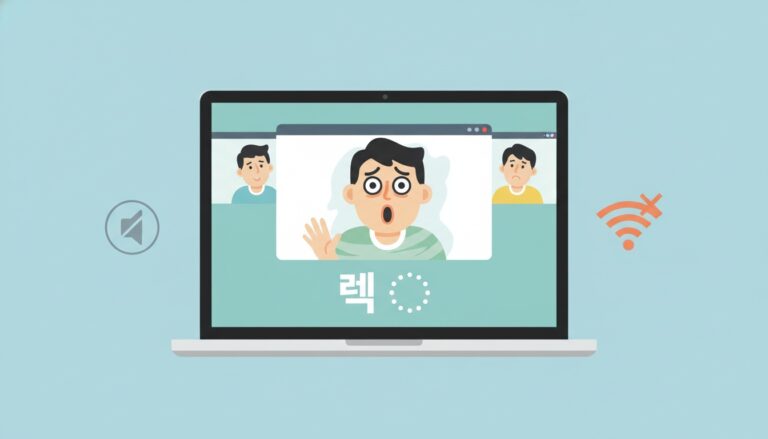
Phase 1: The Panic of the “Frozen Screen”
Hello! Daily Hangul Editor here.
Picture this: It’s Monday morning, 9:00 AM. You are on a Zoom call with your team based in Seoul. You’ve prepared your presentation perfectly. You open your mouth to say “Good morning,” but suddenly, your video freezes in the most unflattering expression possible—mouth half-open, eyes blinking.
In a K-Drama, this is the comedic moment where the protagonist spills coffee on their keyboard. But in real life? It’s pure stress. Korea’s “Ppalli-ppalli” (Hurry-hurry) culture doesn’t disappear just because we are online. In fact, silence on a video call in Korea feels twice as heavy as silence in a conference room.
Today, we are going to fix that. I’m going to teach you how to handle technical glitches with grace, how to interrupt your boss without getting fired, and why saying “Can you hear me?” is a dead giveaway that you are a beginner. Let’s get your digital Nunchi up to speed.
Phase 2: The C1 Deep Dive — Beyond “Can You Hear Me?”
We are skipping the basics. You know “들리세요?” (Can you hear me?). At the C1 level, we need precision.
1. 하울링이 너무 심해요 (Hauling-i neomu simhaeyo)
- Pronunciation: [Ha-ul-ling-i neo-mu sim-hae-yo] (Sounds like ‘Howl’ + ‘ing’)
- Meaning: “There is too much feedback/echo.”
- Editor’s Insight: This is classic Konglish. In English, you might say “feedback” or “echo.” In Korea, we call that screeching audio loop “Howling.” If you use this word, your IT team will instantly know what you mean. It sounds technical and pro.
- Situation Spectrum:
[🚫 Casual Only] ———— [✅ Standard] ———— [✅ Formal]- 🤔 Think About It: Why does Korean adopt English words like “Howling” for tech terms, but changes the meaning slightly? It’s often because the auditory experience (the sound of a wolf howling) was easier to communicate than the technical term “feedback loop.”
2. 화면 공유가 풀린 것 같습니다 (Hwamyeon gongyu-ga pullin geot gatseumnida)
- Pronunciation: [Hwa-myeon gong-yu-ga pul-lin geot gat-seum-ni-da]
- Meaning: “It seems the screen share has been disconnected/dropped.”
- K-Culture Moment: Imagine a serious boardroom scene in the drama Misaeng. The intern trips over a wire, and the presentation screen goes black. The silence is deafening. That is when you use this phrase.
- Editor’s Insight: Don’t just say “An boyeoyo” (I can’t see). Use “풀리다” (to come undone/loose). It implies a technical error rather than accusing the presenter of failing to show it. It’s softer and more professional.
- Situation Spectrum:
[🚫 Friends] ———— [✅ Colleagues] ———— [✅ Boss]3. 제가 튕겨서 다시 들어왔습니다 (Jega twing-gyeo-seo dasi deureo-wat-seumnida)
- Pronunciation: [Je-ga twing-gyeo-seo…]
- Meaning: “I got kicked out (of the server) and just logged back in.”
- Editor’s Insight: The verb “튕기다” (Twing-gi-da) literally means to bounce or spring off. In digital contexts, it means the server crashed or your internet died and kicked you out. It is the perfect excuse because it blames the internet, not your tardiness.
Phase 3: Textbook vs. Real Life
| Situation | 📖 Textbook Korean | 🗣️ Real Korean (Smart Work Edition) | 💡 Why the difference? |
|---|---|---|---|
| Audio Check | 제 목소리 잘 들리십니까? (Can you hear my voice well?) | 혹시 제 말 끊기나요? (Am I breaking up?) | “Can you hear me” puts the burden on the listener. “Am I breaking up” checks the connection quality. |
| Starting Preso | 이제 발표를 시작하겠습니다. (I will start the presentation now.) | 자료 띄우고 시작하겠습니다. (I’ll pull up the materials and start.) | “띄우다” (to float/launch) is the specific verb for putting a file on a screen. It sounds much more active. |
| Mute Request | 마이크를 꺼 주세요. (Please turn off your microphone.) | 잠시 음소거 부탁드려도 될까요? (Could I ask for mute for a moment?) | Direct commands feel aggressive in Korean work culture. We frame it as a “favor.” |
Bottom Note: In a casual team meeting, you might hear “마이크 뮤트 좀요” (Mic mute, please). Korean office workers love mixing English nouns with Korean grammar.
Phase 4: Cultural Deep Dive — Digital Nunchi (눈치)
1. The “Nodding” Obligation
In a Western Zoom call, if you are listening, you might just stare at the screen. In Korea, a motionless face looks like a frozen screen—or worse, a bored employee. You need to perform “Virtual Listening.”
– Nod your head slightly every few sentences.
– If the speaker is a superior, lean in slightly towards the camera.
– Tip: If you turn off your camera without explanation, it’s often interpreted as “I am leaving the room” or “I am doing something else.” Always ask permission: “Connection is unstable, so I will turn off video for a moment.”
2. The Exit Protocol
In K-Dramas, the CEO leaves the room first. On Zoom, the CEO clicks “Leave Meeting” first. If you log off before the boss finishes saying “Sugo-ha-syeot-seumnida” (Good job everyone), it’s like slamming the door in their face. Wait for the host to end it, or for the senior person to disappear from the grid.
Phase 5: Immersive Roleplay
Setting: It’s a strategy meeting on Microsoft Teams. You are “Kim Manager” (Foreigner). The team is discussing the Q3 budget. The connection is terrible.
Characters:
– YOU (Kim Manager): Trying to present the budget.
– Director Park (50s): Impatient, old-school boss.
– Minji (20s): Helpful junior staff.
(Dialogue Start)
YOU: 자, 3분기 예산안 보시죠. (Okay, let’s look at the Q3 budget.)
Director Park: 김 매니저, 잠깐만. 목소리가 왜 이래? 로봇 같아.
(Kim Manager, hold on. Why is your voice like that? You sound like a robot.)
🔀 Decision Point! How do you respond?
– A) “아, 인터넷이 안 좋아요.” (Ah, internet is bad.)
– B) “죄송합니다. 연결이 불안정한 것 같아서 비디오 끄고 진행하겠습니다.” (Sorry. Connection seems unstable, so I’ll turn off video and proceed.)
– C) “제 컴퓨터 문제입니다.” (It is my computer’s problem.)
✅ Best Choice: B
Analysis: Option A is an excuse. Option C takes too much blame. Option B offers a solution immediately. In Korean business, identifying the problem is less important than fixing the workflow quickly.
(Continued…)
YOU: (Turns off camera) 이제 잘 들리시나요? (Can you hear me well now?)
Minji: 네, 이제 하울링도 없고 깔끔해요! 화면만 공유 다시 해 주시면 될 것 같아요.
(Yes, no howling now, it’s clean! I think you just need to share the screen again.)
YOU: 네, 바로 자료 띄우겠습니다. 잠시만요.
(Okay, I’ll pull up the materials right away. One moment.)
Phase 6: 10-Second Shadowing Drill
Practice this until you can say it while fixing your Wi-Fi router.
😓 Apologetic but Professional:
죄송합니다 / 연결 상태가 안 좋아서 / 다시 들어오겠습니다.
(Jwesong-hamnida / yeongyeol sangtaega an joaseo / dasi deureo-oget-seumnida)
“Sorry / the connection isn’t good / so I’ll log back in.”
Phase 7: K-Culture Mini Glossary
| Korean | Romanization | Meaning | Context |
|---|---|---|---|
| 재택근무 | Jaetaek-geunmu | Work from home (WFH) | The formal term for remote work. |
| 화상 회의 | Hwasang hoe-ui | Video conference | “Hwasang” means image/video, “Hoe-ui” means meeting. |
| 렉 걸리다 | Rek geollida | To lag / glitch | From the English word “Lag.” Used when screen freezes. |
| 음소거 | Eumsogeo | Mute | Literally “sound elimination.” |
Phase 8: The “Coffice” (Coffee + Office) Survival Kit
Since you are mastering remote work, you might be working from a Korean cafe (a “Coffice”).
🆘 Survival Expression #1: The Outlet Hunt
– 🇰🇷 “혹시 콘센트 자리 있나요?” (Hoksi consent jari innayo?)
– 🗣️ Pro Tip: Koreans use the word “Consent” (콘센트) for power outlets/sockets. If you ask for an “outlet,” they might look at you confused. We borrowed this from the German Konzentriering via Japan.
🆘 Survival Expression #2: The Wi-Fi Ritual
– 🇰🇷 “와이파이 비번 어디 적혀 있어요?” (Wifi bibeon eodi jeokyeo isseoyo?)
– 🗣️ Pro Tip: “Bibeon” is short for Bimil-beonho (Password). Usually, it is on the receipt or a tiny sticker on the wall.
Phase 9: Think Deeper — Hierarchy in the Cloud
Does the rigid Korean age/status hierarchy disappear when we move to Zoom? Surprisingly, no.
Language researchers have noticed that honorifics (Jondaemal) act as a safety buffer in online communication. Without body language, text or voice alone can sound cold. So, Koreans often increase their level of politeness online to compensate for the lack of physical presence. We use more “Please…” (부탁드립니다) and softer endings (-네요, -인 것 같아요) to ensure we aren’t misread as aggressive. The technology is modern, but the social software running on it is still deeply traditional.
Phase 10: Troubleshooting & FAQ
Q: My Korean boss keeps interrupting me on Zoom due to lag. Should I stop talking immediately?
A: Yes. In Korean culture, speaking over a superior (even accidentally) is uncomfortable. If you clash audio, stop immediately, say “먼저 말씀하세요” (Please speak first), and wait. It shows respect and solves the audio conflict.
❌ Common Mistake: Saying “What?” (뭐라고요?) when you can’t hear.
✅ Fix: This sounds rude to superiors. Use “잘 못 들었습니다” (I couldn’t hear you well) or “다시 말씀해 주시겠어요?” (Could you say that again?).
Phase 11: Wrap-up & Mission
One-Liner: Don’t just say “I can’t hear you”; diagnose the problem (Howling? Lag? Mute?) to sound like a pro.
🚀 Action Mission:
– 🥉 Bronze: Say “화면 공유하겠습니다” out loud next time you open a file on your computer.
– 🥈 Silver: In your next call with a Korean friend, pretend you are lagging and use “제 목소리 끊기나요?”
– 🥇 Gold: Go to a Korean cafe (or any cafe) and ask for the “Consent” (Power outlet) location using the Korean term.
💬 Question: Have you ever had a “Zoom disaster” involving a cultural misunderstanding? Tell me in the comments!
Frequently Asked Questions (FAQ)
Q: What does "하울링이 너무 심해요 (Hauling-i neomu simhaeyo)" mean in Korean and how do you pronounce it?
A: In Korean, "하울링이 너무 심해요 (Hauling-i neomu simhaeyo)" is pronounced [Ha-ul-ling-i neo-mu sim-hae-yo] and means: "There is too much feedback/echo."
Q: What does "화면 공유가 풀린 것 같습니다 (Hwamyeon gongyu-ga pullin geot gatseumnida)" mean in Korean and how do you pronounce it?
A: In Korean, "화면 공유가 풀린 것 같습니다 (Hwamyeon gongyu-ga pullin geot gatseumnida)" is pronounced [Hwa-myeon gong-yu-ga pul-lin geot gat-seum-ni-da] and means: "It seems the screen share has been disconnected/dropped."
Q: What does "제가 튕겨서 다시 들어왔습니다 (Jega twing-gyeo-seo dasi deureo-wat-seumnida)" mean in Korean and how do you pronounce it?
A: In Korean, "제가 튕겨서 다시 들어왔습니다 (Jega twing-gyeo-seo dasi deureo-wat-seumnida)" is pronounced [Je-ga twing-gyeo-seo...] and means: "I got kicked out (of the server) and just logged back in."







