

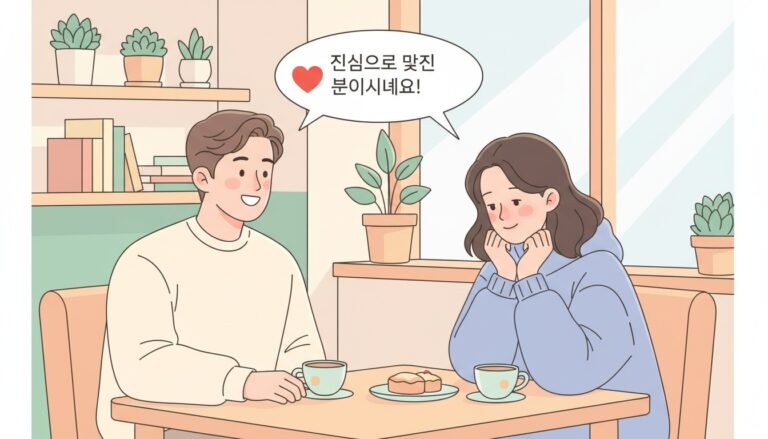
✨ Hello! This is your Daily Hangul Editor.
Have you ever met a Korean friend who was incredibly nice, helpful, or just radiantly positive, but all you could say was “You are good”?
I’ve seen so many of my students struggle with this. They meet a wonderful language partner or a kind coworker, and they want to express how great that person is, but their vocabulary feels stuck at the ‘textbook level.’
Describing personality is the fastest way to build a deeper connection. Today, we aren’t just learning words; we are learning how to give a genuine compliment that will make your Korean friends smile (and probably blush shyly).
This guide answers the real questions my students ask, like: “Does ‘nice’ mean the same thing in Korean?” Let’s dive in!
✅ Phase 2: Deep Dive into Core Expressions
Here are the top 3 ways to say someone has a good personality, specifically chosen for A2 (High Beginner) learners.
1. → ‘서ᄇ겨기 고가소’ (He/She has a good personality)
- Pronunciation: Seong-gyeok-i jo-a-yo
- (Sounds like: Song-gyuk-ee Jo-ah-yo)
- Meaning: ‘Has a good character/personality’ (Literal)
- Editor’s Insight: This is the safe, all-rounder phrase. You can use this for a friend, a coworker, or even someone you just met. It implies they are easy to get along with and positive.
- Situation: ⭐️ Casual & Formal (Polite)
2. → ‘사개소’ (You are kind/good-hearted)
- Pronunciation: Chak-hae-yo
- (Sounds like: Chak as in ‘chalk’ + hae as in ‘hey’ + yo)
- Meaning: ‘Kind’ or ‘Nice’
- Editor’s Insight: This is a very common compliment, but be careful! It implies innocence and pure-heartedness. Adults use it for children often, but between adults, it means someone is morally good and selfless.
- Situation: ⭐️ Casual (Friends/Close Acquaintances)
3. → ‘다거배소’ (You are sweet/caring)
- Pronunciation: Da-jeong-hae-yo
- (Sounds like: Dah-jung-hey-yo)
- Meaning: ‘Affectionate’ or ‘Sweet’
- Editor’s Insight: If a guy pulls out a chair for you or a friend speaks softly and listens well, they are 다거배소. This is a huge compliment, especially in dating scenarios!
- Situation: ⭐️ Casual & Romantic
⚡ Phase 3: Textbook vs. Real Life
Textbooks make you sound like a news anchor. Let’s sound like a local.
| Textbook (Don’t overuse these) | Real Korean (Use these to sound natural!) |
|---|---|
| 서ᄇ겨기 친가다오. (His/her personality is kind.) → Too stiff. Sounds like a formal report. |
천사예소. (He/She is an angel.) → Used when someone helps you unconditionally. |
| 재미예소. (He/She is funny.) → Correct, but basic. |
분위기 메이커예소. (He/She is a ‘mood maker’.) → Use this for the friend who makes everyone laugh at a party. |
💡 Editor’s Note: “Mood Maker” (분위기 메이커) is pure Konglish (Korean-English), but every Korean understands and loves this word!
🎭 Phase 4: Cultural Context (Manners)
The Art of Denial
If you tell a Korean friend, “서ᄇ겨기 조아소!” (You have a good personality!), they will 99% say:
- “아니에소~” (No, not really~)
Don’t panic! They are not rejecting your compliment. In Korea, humility is a virtue. Accepting a compliment immediately with “Yes, I know” can be seen as arrogant. Just smile and re-affirm it lightly.
🎬 Phase 5: Real-Life Scenario
Setting: A cafe in Hongdae. Alex is telling Min-ji about his new language exchange partner, Su-jin.
Min-ji: 수진 띠 어때소?
(How is Su-jin?)
Alex: 졍말 서ᄇ겨기 조아소.
(She really has a good personality.)
Min-ji: 그래소? 어떤 저미소?
(Really? In what way?)
Alex: 사람들한테 졍말 다거배소.
(She is really sweet/caring to people.)
(Acting Tip: When saying ‘다거배소’, put a hand on your chest to show heartfelt sincerity!)
🗣️ Phase 6: 10-Second Shadowing
Let’s practice the rhythm. Read the bold part louder.
“Min-su is really kind, so he is popular.”
민수는 / 졍말 사개소 / 인기가 마다소.
Min-su-neun / jeong-mal chak-hae-yo / in-gi-ga ma-na-yo.
❓ Phase 7: FAQ & Troubleshooting
- Q: Can I say “사개소” (You are kind) to my boss or teacher?
- Answer: ⚠️ Better not. While it’s a good word, telling a superior “You are a good/kind boy/girl” can sound like you are evaluating them. Instead, say “서ᄇ겨기 조으세소” (using honorific ‘se’) or simply “졍말 친절하세소” (You are very kind/polite).
🎁 Phase 8: Wrap-up & Mission
Today’s Summary:
1. 서ᄇ겨기 조아소 = The standard “good personality”.
2. 사개소 = Kind/Good-hearted (Be careful with bosses).
3. 다거배소 = Sweet/Caring (Great for romance/close friends).
🚀 Your Mission: Text a Korean friend or leave a comment on a Korean celebrity’s Instagram today using: “졍말 다거배소!” (You are really sweet!)
🧩 Phase 9: Pop Quiz
1. Which word describes a friend who always makes the atmosphere fun?
A) 천사 (Angel)
B) 분위기 메이커 (Mood Maker)
C) 사개소 (Kind)
2. If someone says “서ᄇ겨기 조아소” to you, what is the polite Korean response?
A) “인정.” (I admit it.)
B) “아니에소~” (No, not really~)
C) “땡큐.” (Thank you.)
3. True or False: You should frequently use “사개소” (You are kind) to your strict CEO.
A) True
B) False
(Answers: 1: B, 2: B, 3: B)
Frequently Asked Questions (FAQ)
Q: What does "→ ‘서ᄇ겨기 고가소’ (He/She has a good personality)" mean in Korean and how do you pronounce it?
A: In Korean, "→ ‘서ᄇ겨기 고가소’ (He/She has a good personality)" is pronounced [Seong-gyeok-i jo-a-yo] and means: a key conversational Korean expression covered in this lesson.
Q: What does "→ ‘사개소’ (You are kind/good-hearted)" mean in Korean and how do you pronounce it?
A: In Korean, "→ ‘사개소’ (You are kind/good-hearted)" is pronounced [Chak-hae-yo] and means: a key conversational Korean expression covered in this lesson.
Q: What does "→ ‘다거배소’ (You are sweet/caring)" mean in Korean and how do you pronounce it?
A: In Korean, "→ ‘다거배소’ (You are sweet/caring)" is pronounced [Da-jeong-hae-yo] and means: a key conversational Korean expression covered in this lesson.







