

Hello, K-Pop Stans! 👋
This is your Daily Hangul Senior Editor.
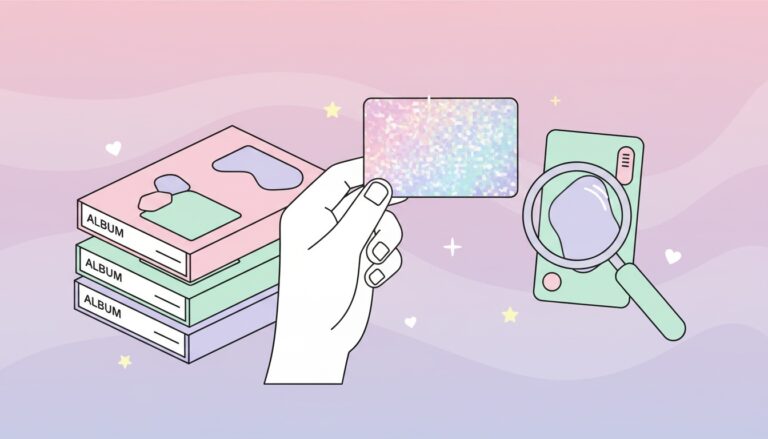
We’ve all been there. You ordered 5 copies of the new album, waited three weeks for shipping, and finally unboxed them with trembling hands… only to find zero photo cards of your Bias (your favorite member). 😱
Instead, you have five duplicates of the member you already have. Now, you need to enter the battlefield of Twitter (X) or Bunjang to trade or buy the card you need.
But wait! If you just use textbook Korean like “이거 팔아요?” (Do you sell this?), you might be ignored. The world of K-Pop trading has its own specialized language.
Today, I will teach you the essential insider terms to complete your photo card collection like a pro. Let’s get that Choeae!
1. Key Expressions Deep Dive 🧐
To survive in the K-Pop marketplace, you need to know these three words. They are B1 level because they are specific to “transactions,” but fans use them daily.
1. 최애 (Choeae)
- Pronunciation: [Choe-ae] It sounds like ‘Chwe-eh’ (say it quickly).
- Meaning: Ultimate Bias (Literally: Most Loved).
- Editor’s Insight: This isn’t just “favorite singer.” It’s the member you would take a bullet for. You don’t just ‘like’ them; you ‘cherish’ them.
- Situation: Casual & Fandom specific.
2. 양도 (Yangdo)
- Pronunciation: [Yang-do]
- Meaning: Transfer (Used for Selling/Buying).
- Editor’s Insight: Listen carefully! In the fan world, we rarely say “Buy” (사다) or “Sell” (팔다). We say “Transfer” (양도). It implies, “I am passing the ownership of this precious item to another fan,” rather than just a cold business deal.
- Situation: Transactional (Polite).
3. 하자 (Haja)
- Pronunciation: [Ha-ja]
- Meaning: Defect / Flaw / Scratch.
- Editor’s Insight: This is the most stressful word. Photo card collectors are perfectionists. Even a microscopic scratch is a ‘Haja.’
- Situation: Checking condition.
2. Textbook vs. Real Life (Fan Edition) 🆚
If you want to sound like a local fan, stop using the column on the left!
| Textbook Korean (A little awkward) | Real K-Pop Fan Korean (Natural) |
|---|---|
| 이 멤버 카드 있어요? (Do you have this member’s card?) |
최애 포카 구해요. (I’m looking for my Bias’s Poka.) |
| 이거 사고 싶어요. (I want to buy this.) |
양도받고 싶어요. (I want to receive the transfer.) |
| 이거 안 좋은 거예요? (Is this bad?) |
혹시 하자 있나요? (Does it have any defects?) |
💡 Note: ‘포카’ (Poka) is the slang short for Poto Card (Photo Card). Everyone uses this!
3. Cultural Context: The “Light Check” Ritual 🔦
In Korea, “Nunchi” (sensing the atmosphere) is important even online. When you ask about 하자 (Haja), sellers don’t just say “It’s fine.”
They provide a “빛비춤 영상” (Bit-bi-chum video).
This is a video where they tilt the card under a bright light to prove there are no hidden scratches. If you are buying, it is perfectly polite to ask:
* “빛비춤 인증 가능할까요?” (Is light-reflection verification possible?)
However, don’t be too demanding. If the card is very cheap, asking for a microscopic check might be considered rude!
4. Real Life Scenario: DMing a Seller 💬
Setting: You found someone on Twitter selling your Bias’s card. You are sending a DM.
Characters:
* Fan (You): Desperate buyer.
* Seller: Korean fan.
Fan (You): 안녕하세요! [멤버 이름] 포카 양도받고 싶어서 연락드려요.
(Hello! I’m contacting you because I want to receive the transfer of [Member’s Name]’s Poka.)
([Membeo ireum] Poka Yangdo-batgo sipeoseo yeollak-deuryeoyo.)
Seller: 네, 안녕하세요. 운미포 1.0입니다.
(Yes, hello. It’s 10,000 won excluding shipping.)
(Ne, annyeonghaseyo. Un-mi-po il-jeom-yeong-imnida.)
Fan (You): 혹시 하자 있을까요? 빛비춤 영상 볼 수 있을까요?
(Are there any defects by chance? Could I see a light-reflection video?)
(Hoksi Haja isseulkkayo? Bit-bi-chum yeongsang bol su isseulkkayo?)
Seller: 네, 지금 찍어서 보내드릴게요! (Send Video 📹)
(Yes, I’ll film it and send it now!)
(Ne, jigeum jjigeoseo bonae-deurilgeyo!)
(Acting Tip): When asking about defects (Haja), use “혹시” (Hoksi – by chance) to soften your tone. It sounds much more polite!
5. 10-Second Shadowing 🗣️
Practice this sentence to ask for the condition perfectly. Focus on the pause!
“혹시 큰 하자는 / 없는지 / 확인 부탁드려요!”
(Could you please check / if there are no / major defects?)
Pronunciation Guide:
* Hoksi keun Ha-ja-neun / eop-neun-ji / hwa-gin bu-tak-deu-ryeo-yo!
6. FAQ & Troubleshooting ⚠️
Q: Can I use “Banmal” (casual language) since we are both fans?
A: NO! 🙅♀️ Even if you are both fans, money is involved. Always use 존댓말 (Polite/Formal language) like “~요” or “~입니다” until you become close friends. Using casual speech in a transaction DM is a quick way to get blocked.
Q: What is “Un-mi-po” (운미포)?
A: It stands for “운송비 미포함” (Shipping fee NOT included). If they say “Un-po” (운포), it means shipping IS included. This saves you from awkward price misunderstandings!
7. Wrap-up & Mission 🎁
Today’s One-Liner: To buy a photo card, don’t say “Buy” (Sa-da), say “Transfer” (Yang-do)!
Your Mission: Go to Twitter or Instagram, search for #[YourBiasName]양도 (e.g., #JungkookYangdo), and just read the titles. Can you spot “하자” or “포카”?
If you found one, tell me in the comments whose photo card you are hunting for right now! 👇
8. Pop Quiz 📝
1. Which word means “Ultimate Bias” (your favorite member)?
A) Choe-ae (최애)
B) Maknae (막내)
C) Haja (하자)
2. You want to ask if the card has scratches. What do you say?
A) Yangdo isseoyo?
B) Haja isseoyo?
C) Poka isseoyo?
3. True or False: You should use casual language (Banmal) with sellers because you are all K-Pop family.
A) True
B) False
Click to see answers!
1. A (Choeae)
2. B (Haja isseoyo?)
3. B (False! Always use polite language in transactions.)
Frequently Asked Questions (FAQ)
Q: What does "'포카'" mean in Korean and how do you pronounce it?
A: In Korean, "'포카'" is pronounced [Poka] and means: is the slang short for
Q: What does "하자" mean in Korean and how do you pronounce it?
A: In Korean, "하자" is pronounced [Haja] and means: , sellers don't just say "It's fine."
Q: What does ""혹시"" mean in Korean and how do you pronounce it?
A: In Korean, ""혹시"" is pronounced [Hoksi - by chance] and means: to soften your tone. It sounds much more polite!
Q: What does "존댓말" mean in Korean and how do you pronounce it?
A: In Korean, "존댓말" is pronounced [Polite/Formal language] and means: like "~요" or "~입니다" until you become close friends. Using casual speech in a transaction DM is a quick way to get blocked.







