

Phase 1: Introduction
안녕하세요! This is your Senior Editor from Daily Hangul.
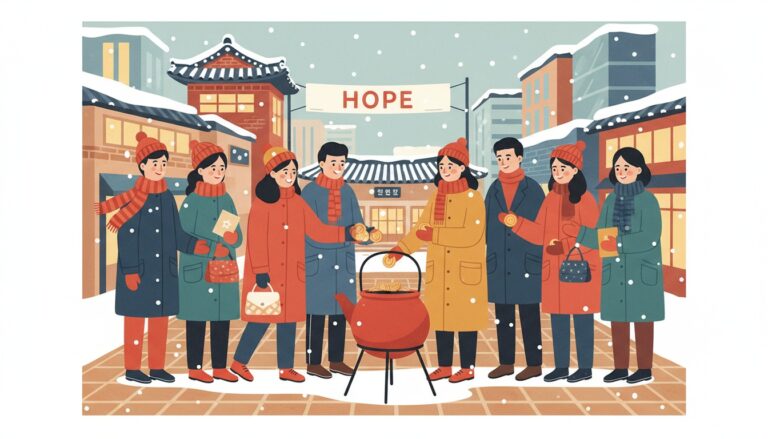
It’s December in Korea. The wind is biting cold, street vendors are selling Bungeoppang (fish-shaped pastry), and if you walk through a subway station or a busy street like Myeongdong, you’ll hear a familiar sound: the ringing bell of the Salvation Army Red Kettle (구세군 자선냄비).
Now, imagine your Korean coworkers or friends suggest gathering some money to help a local orphanage or buying coal briquettes (연탄) for the elderly. You want to chip in. A beginner would just say “돈 줄게요” (I will give money). But you? You are a B2 learner. You want to sound like a heartwarming, sophisticated member of the community, not just a walking wallet.
In this lesson, we are going beyond the dictionary definition of “donate.” We are learning how to express solidarity, humility, and the warm Korean spirit of Jeong (정).
Phase 2: Deep Dive into Core Expressions
Here are the three expressions that will turn you from a foreigner into a local ‘Insider’ (인싸).
1. 십시일반 (Sipsi-ilban)
- Pronunciation: Sip-shi-il-ban [Think of “Sip” + “She” + “Ill” + “Bun”]
- Meaning: Making a big impact by gathering small contributions from many people.
- Literal: “Ten spoons of rice make one bowl.”
- Editor’s Insight: This is the ultimate B2 idiom for charity. It implies, “Hey, if we all pitch in just a little bit, we can make a huge difference.” Using this shows you understand the collective culture of Korea.
- Situation Check: Perfect for office fundraising or group chats. (Formal & Casual)
2. 동참하다 (Dongcham-hada)
- Pronunciation: Dong-cham-ha-da [“Dong” sounds like the ‘dong’ in ding-dong + “Cham” rhymes with ham]
- Meaning: To participate / To join in (specifically for a cause).
- Nuance: “Join” (참여하다) is fine, but 동참하다 carries a nuance of joining a noble cause or a movement together. It sounds much more respectful.
- Situation Check: Very common in campaign slogans or formal suggestions.
3. 작은 성의 (Jageun seong-ui)
- Pronunciation: Ja-geun sung-ui [“Sung” like sung a song + “ui” is tricky… say ‘oo-ee’ quickly]
- Meaning: A small token of sincerity.
- Editor’s Insight: Koreans value humility. Even if you donate a million dollars, you don’t say “I’m giving a lot.” You say, “This is just my small sincerity.” It prevents the receiver from feeling burdened.
- Situation Check: Use this when handing over the donation envelope.
Phase 3: Textbook vs. Real Life
Let’s see how a textbook robot talks versus how a warm-hearted Seoulite talks.
| Textbook Korean (A little stiff) | Real Korean (Natural & Touching) |
|---|---|
| 돈을 기부하고 싶어요. (I want to donate money.) |
좋은 일에 동참하고 싶어요. (I want to join in on this good deed.) |
| 우리 돈을 모읍시다. (Let’s collect money.) |
우리 십시일반으로 조금씩 모아봐요. (Let’s gather a little bit each, spoon by spoon.) |
| 여기 제 돈이에요. (Here is my money.) |
약소하지만 제 작은 성의예요. (It’s humble, but here is my small token of sincerity.) |
Bottom Note: Notice how the “Real” column focuses on the meaning of the action, not just the cash itself.
Phase 4: Cultural Context & Manners
1. The “Anonymous Angel” (얼굴 없는 천사)
In Korea, every year-end, the news features stories of “Faceless Angels” who drop boxes of cash at fire stations and run away. The cultural ideal is that true charity is done secretly. If you donate, don’t brag about it too loudly. Humility is key.
2. Yeonmal-jeongsan (연말정산 – Year-end Tax Settlement)
Let’s be realistic. While Koreans have warm hearts, we also care about taxes! In December, you might hear people ask, “기부금 영수증 되나요?” (Can I get a donation receipt?). Asking for this isn’t rude; it’s smart financial planning for the year-end tax adjustment. It’s a very “adult” thing to ask.
Phase 5: Roleplay Script
Setting: An office break room. Colleagues are discussing the company’s year-end charity event.
Characters:
* Mark (You): Foreign employee, trying to rally the team.
* Ji-eun: Korean colleague, slightly hesitant about the budget.
Mark: (Holding a flyer) 지은 씨, 이번 회사 연말 모금 행사 봤어요?
(Ji-eun, did you see the company year-end fundraising event?)
Ji-eun: 네, 봤는데… 요즘 제가 지출이 많아서 좀 부담스럽네요.
(Yes, I saw it… but I’ve had a lot of expenses lately, so it’s a bit burdensome.)
Mark: (Smiling reassuringly) 에이, 큰돈 낼 필요 없어요. 그냥 커피 한 잔 값 아껴서 십시일반으로 하는 거죠.
(Ay, no need to pay a huge amount. We just save the cost of one coffee and do it ‘Sipsi-ilban’ style.)
Ji-eun: 듣고 보니 그렇네요. 저도 그럼 동참할게요!
(Hearing that, you’re right. I will participate too!)
Mark: 좋아요! 저도 작은 성의지만 좀 보탰어요.
(Great! I also added a bit, though it’s just a small token of sincerity.)
Phase 6: 10-Second Shadowing
Practice this sentence to convince your friends to join a cause. Focus on the pause after “haja.”
“부담 갖지 말고, / 십시일반으로 / 같이 동참하자!”
- Romanization: Budam gatji malgo, / sipsi-ilban-euro / gachi dongcham-haja!
- Meaning: Don’t feel burdened, / let’s all pitch in a little / and join this together!
Phase 7: FAQ & Troubleshooting
- Q: Can I ask my boss how much they donated?
- NO. Money talks are sensitive. Even for charity, asking “How much?” (얼마 냈어요?) can put them in an awkward spot if they gave less than expected. Just say, “Thank you for participating” (동참해 주셔서 감사합니다).
- Q: Is ‘불우이웃’ (The needy) a bad word?
- Maybe. It literally means “unfortunate neighbors.” While still used (e.g., 불우이웃 돕기), modern Korean prefers softer terms like 소외된 이웃 (marginalized neighbors) or 취약 계층 (vulnerable social groups) in formal writing. But for casual conversation, “어려운 이웃” (neighbors in difficulty) is safest and kindest.
Phase 8: Wrap-up
Today’s One-Liner:
Donation isn’t just about money; it’s about “Sipsi-ilban” (십시일반)—many hands making light work.
Your Mission:
Next time you see a Salvation Army pot or a donation box at a convenience store, put in your change and whisper to yourself: “작은 성의입니다.” (It’s my small sincerity.)
Comment below:
Have you ever seen the “Red Kettle” in Korea? Tell me about your experience!
Phase 9: Quiz
- Which idiom means “Ten spoons make one bowl of rice” (Collective effort)?
- a) 일석이조 (Ilseok-ijo)
- b) 십시일반 (Sipsi-ilban)
- c) 작심삼일 (Jaksim-samil)
- What is the more meaningful way to say “I want to join” a charity cause?
- a) 구경하고 싶어요 (I want to watch)
- b) 계산하고 싶어요 (I want to calculate)
- c) 동참하고 싶어요 (I want to participate)
- (True/False) It is polite to brag loudly about how much money you donated to show your power.
- [ ] True
- [ ] False
(Answers: 1. b, 2. c, 3. False)
Frequently Asked Questions (FAQ)
Q: What does "십시일반 (Sipsi-ilban)" mean in Korean and how do you pronounce it?
A: In Korean, "십시일반 (Sipsi-ilban)" is pronounced [Sip-shi-il-ban [Think of "Sip" + "She" + "Ill" + "Bun"] and means: Making a big impact by gathering small contributions from many people.
Q: What does "동참하다 (Dongcham-hada)" mean in Korean and how do you pronounce it?
A: In Korean, "동참하다 (Dongcham-hada)" is pronounced [Dong-cham-ha-da ["Dong" sounds like the 'dong' in ding-dong + "Cham" rhymes with ham] and means: To participate / To join in (specifically for a cause).
Q: What does "작은 성의 (Jageun seong-ui)" mean in Korean and how do you pronounce it?
A: In Korean, "작은 성의 (Jageun seong-ui)" is pronounced [Ja-geun sung-ui ["Sung" like sung a song + "ui" is tricky... say 'oo-ee' quickly] and means: A small token of sincerity.







