

Phase 1: Introduction
Hello! This is your Head Editor from Daily Hangul. 👋
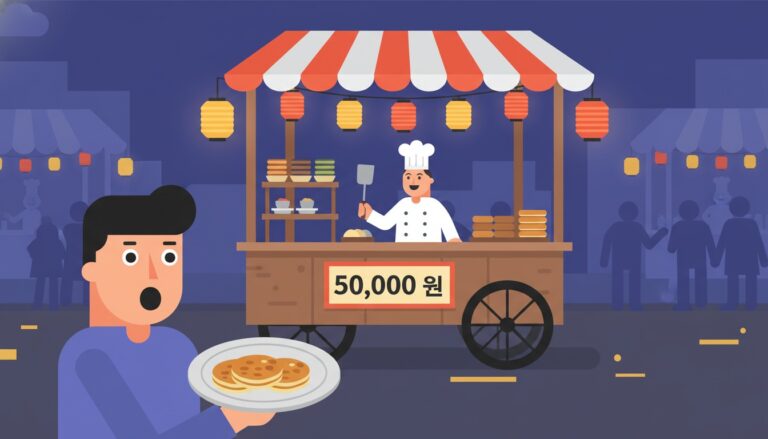
Imagine this: You’ve traveled all the way to a beautiful local festival (say, the famous Jinhae Cherry Blossom Festival). The atmosphere is buzzing, and the smell of savory Pajeon (green onion pancakes) hits your nose. You sit down at a plastic table, order a pancake and makgeolli, and when the bill comes… it’s 50,000 KRW ($38) for a tiny portion! 😱
Recently, this “Festival Price Gouging Controversy” (축제 바가지요금 논란) has been a huge issue in the Korean news. As a B2 learner, you need to know more than just “비싸요 (It’s expensive).” You need to know how to express disbelief, understand the cultural context, and protect yourself from becoming a ‘Hogang’ (pushover).
Today, I’m skipping the textbook politeness. We are going to learn the real language Korean locals use when they feel cheated.
Phase 2: Deep Dive into Key Expressions
Here are the 3 critical expressions you need to survive a “Rip-off” situation.
1. 바가지 쓰다 (Bagaji sseu-da)
- Pronunciation: ba-ga-ji sseu-da [Sounds like: bah-gah-jee ssuh-dah]
- Meaning:
- Literal: To wear a gourd (bowl) on one’s head.
- Real Nuance: To get ripped off / To be overcharged drastically.
- Editor’s Insight: This is the #1 keyword for this topic. If you wear a gourd on your head, you can’t see the sky—meaning you were fooled.
- Situation Check: Use this when talking to your friends about the experience. Don’t say it directly to the vendor unless you want a fight!
2. 이거 실화예요? (I-geo sil-hwa-ye-yo?)
- Pronunciation: ee-geo sil-hwa-yeh-yo?
- Meaning:
- Literal: Is this a true story?
- Real Nuance: “Are you serious?” / “Is this price for real?”
- Editor’s Insight: This is a trendy phrase used when reality is too shocking to believe. It’s perfect for B2 learners because it shows you understand modern internet slang but can use it in speech.
- Situation Check: Usable with friends or even politely (with a shocked face) to a vendor if the price is truly absurd.
3. 선 넘네 (Seon neom-ne)
- Pronunciation: seon num-neh
- Meaning:
- Literal: You are crossing the line.
- Real Nuance: “That’s too much.” / “You’re going too far.”
- Editor’s Insight: This is an idiomatic phrase used when someone violates social rules or common sense. Selling a $5 pancake for $30? That is definitely crossing the line.
- Situation Check: Mostly casual (Banmal). To make it polite/formal, say “좀 심하시네요” (Jom sim-ha-si-ne-yo).
Phase 3: Textbook vs. Real Life
Textbooks teach you to be a polite customer. Real life requires street smarts.
| Textbook Korean (Standard) | Real Korean (Street Smart) | Nuance |
|---|---|---|
| 가격이 너무 비쌉니다. (The price is too expensive.) | 완전 바가지네요. (It’s a total rip-off.) | Direct, emotional complaint. |
| 깎아 주실 수 있나요? (Can you give me a discount?) | 사장님, 에이~ 서비스 좀 더 주세요! (Boss, ayy~ give me some ‘service’!) | Negotiating with charm (Aegyo). |
| 저는 외국인입니다. (I am a foreigner.) | 저 호갱 아니에요! (I’m not a pushover!) | “I know local prices.” |
Note: ‘Hogaeng’ (호갱) is a combination of ‘Hogu’ (pushover) and ‘Gogaek’ (customer). It’s the person everyone wants to avoid becoming!
Phase 4: Cultural Context & Manners
🕵️ The “Menu Without Prices” Trap
In many controversial festival cases, the menu didn’t have prices listed.
* The Rule: If you don’t see a price tag, never order first.
* The Move: Point and ask, “이거 얼마예요? 양은 얼마나 돼요?” (How much is this? How big is the portion?) before you sit down.
🤐 Non-Verbal “Nunchi”
If the price is high, Koreans often use non-verbal cues before speaking.
1. Look at the menu.
2. Widen your eyes slightly.
3. Look at your friend with a “bewildered” expression.
4. Then say, “생각보다 비싸네요…” (It’s more expensive than I thought…).
This gives the vendor a chance to offer a discount or explain, without you directly attacking them.
Phase 5: Real-Life Scenario (Roleplay)
Setting: A food tent at a local fireworks festival.
Characters:
* Tom: Foreign resident (B2 level).
* Owner: Stall vendor (Ajumeoni).
Owner: 자, 여기 해물파전 나왔습니다~ 4만 원이에요.
(Ja, yeogi haemul-pajeon nawasseumnida~ Saman-won-ieyo.)
(Here is the seafood pancake. It’s 40,000 won.)
Tom: (Looking shocked at the small plate)
잠시만요, 4만 원이요? 이거 가격 실화예요?
(Jamsimanyo, saman-won-iyo? I-geo gagyeok sil-hwa-ye-yo?)
(Wait, 40,000 won? Is this price for real?)
Owner: 축제잖아요. 자리값도 있고 재료도 비싸서 그래요.
(Chukje-janayo. Jarigap-do itgo jaeryo-do bissaseo geuraeyo.)
(It’s a festival. Seat rental is high and ingredients are expensive.)
Tom: 에이, 그래도 양이 너무 적어요. 완전 바가지 요금 같은데요… 서비스로 음료수라도 주세요.
(Ei, geuraedo yang-i neomu jeogeoyo. Wanjeon bagaji yogeum gateundeyo… Seobiseu-ro eumryosu-rado juseyo.)
(Ayy, but the portion is too small. This feels like a total rip-off… At least give us a soft drink for ‘service’.)
Owner: (Laughing awkwardly) 알았어요. 콜라 하나 줄게.
(Arasseoyo. Cola hana julge.)
(Alright. I’ll give you a coke.)
Phase 6: 10-Second Shadowing
Read this aloud to practice your intonaion of disbelief. Pause where the slashes / are.
“와… / 이거 양 실화예요? / 가격이 좀 / 선 넘네.”
(Wow… is this portion size for real? The price is… crossing the line.)
Phase 7: FAQ & Troubleshooting
Q: Can I say “바가지” directly to an older vendor?
A: It is risky. It can sound aggressive. It’s better to say “생각보다 너무 비싸네요” (It’s way more expensive than I thought) with a sad face. Use “바가지” when venting to friends or writing a review.
Q: Is haggling common at festivals?
A: Unlike traditional markets, festival food stalls often have fixed (albeit high) prices. Instead of asking to cut the price (깎아 주세요), ask for Service (서비스 주세요 – extra side dish or drink). It works better!
Phase 8: Wrap-up
One-Liner Summary: Don’t just pay quietly! If the price is a “Sim-ha-da” (too harsh) situation, express your shock with “Sil-hwa-ye-yo?” and avoid being a “Hogaeng.”
🔥 Action Mission: Next time you go to a market or festival, look for a menu WITHOUT prices. Ask the price, and if it’s high, practice your “Shocked Nunchi Face” before walking away!
Have you ever been ripped off in Korea? Tell me your story in the comments! 👇
Phase 9: Pop Quiz
1. Which word means a “pushover” or someone easily cheated?
a) Gogaek (고객)
b) Hogaeng (호갱)
c) Sajang (사장)
2. How do you say “Is this for real?” in a trendy way?
a) Jinjja-ye-yo? (진짜예요?)
b) Sil-hwa-ye-yo? (실화예요?)
c) An-nyeong-ha-se-yo? (안녕하세요?)
3. True or False: You should always pay whatever the vendor asks, even if it’s $50 for a pancake.
(False! Speak up or walk away!)
(Answers: 1-b, 2-b, 3-False)
Frequently Asked Questions (FAQ)
Q: What does "바가지 쓰다 (Bagaji sseu-da)" mean in Korean and how do you pronounce it?
A: In Korean, "바가지 쓰다 (Bagaji sseu-da)" is pronounced [ba-ga-ji sseu-da [Sounds like: bah-gah-jee ssuh-dah] and means: Literal: To wear a gourd (bowl) on one's head.
Q: What does "이거 실화예요? (I-geo sil-hwa-ye-yo?)" mean in Korean and how do you pronounce it?
A: In Korean, "이거 실화예요? (I-geo sil-hwa-ye-yo?)" is pronounced [ee-geo sil-hwa-yeh-yo?] and means: Literal: Is this a true story?
Q: What does "선 넘네 (Seon neom-ne)" mean in Korean and how do you pronounce it?
A: In Korean, "선 넘네 (Seon neom-ne)" is pronounced [seon num-neh] and means: Literal: You are crossing the line.







