

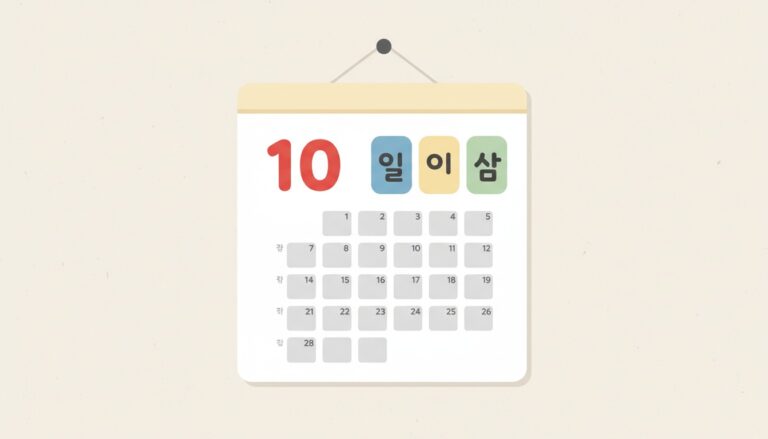
Phase 1: Greeting & Empathy
Hello! This is your Senior Editor at Daily Hangul.
Have you ever tried to book a KTX train ticket or make a restaurant reservation in Korea, only to freeze when asked for the date? You learned numbers, but suddenly your brain goes blank. “Wait, is it Hana-wol? Or Il-wol?”
One of my students, Sarah, once tried to book a hotel for October (Sip-wol) but accidentally kept saying 10 months (Sip-gaewol). The receptionist was very confused about why she wanted to stay for nearly a year!
Don’t worry. This is a classic A1 struggle. Korean has two number systems, and mixing them up is like wearing your shoes on the wrong feet—it works, but it feels weird and everyone notices.
Today, we are going to master Sino-Korean numbers specifically for Dates (Month/Day) so you never miss an appointment (or a flight) again. Let’s dive in!
Phase 2: Deep Dive (Core Expressions)
To say dates in Korean, we ONLY use Sino-Korean numbers (the ones that sound like Chinese: Il, I, Sam…). Never use Hana, Dul, Set for dates!
1. The Magic Formula: [Number] + 월 (Month)
- Pronunciation: [Wol] sounds a bit like the English word “Wall” but with a softer ‘L’.
- Meaning: Literally “Moon” or “Month”.
- How it works: January is 1-Month (Il-wol), February is 2-Month (I-wol).
- Editor’s Insight: It’s much easier than English! You don’t need to memorize distinct names like “January” or “August.” Just count 1 to 12.
2. The Tricky Twins: June & October
This is where 90% of beginners fail. Please pay attention here!
- June (6월):
- Wrong:
Yuk-wol(Too hard to pronounce smoothly) - Correct: Yu-wol (유월)
- Sound Analogy: Sounds like “You” + wall.
- Wrong:
- October (10월):
- Wrong:
Sip-wol(Sounds clunky) - Correct: Si-wol (시월)
- Sound Analogy: Sounds like “She” + wall.
- Wrong:
Editor’s Note: Koreans love efficiency. Dropping the final consonant (k/p) makes the flow much smoother. If you say Sip-wol, you sound like a robot!
3. Asking “What date is it?”
- Korean: 몇 월 며칠이에요?
- Pronunciation: [Myeot-wol Myeo-chil-i-e-yo?]
- Meaning: What month, what day is it?
- Situation Check: You can use this with almost anyone if you add the polite ending “-yo”.
Phase 3: Textbook vs. Real Life
Textbooks teach you to speak in full sentences. But in the streets of Hongdae or at a busy Starbucks, brevity is key.
| Textbook (Correct but Stiff) | Real Life (Natural & Quick) |
|---|---|
| 오늘은 5월 5일입니다. (Oneul-eun O-wol O-il-imnida) “Today is May 5th.” |
5월 5일이요. (O-wol O-il-iyo) “It’s May 5th.” |
| 12월 25일입니다. (Sibi-wol Isibo-il-imnida) |
12월 25일. (Sibi-wol Isibo-il) “Dec 25th.” (Casual/Friends) |
Pro Tip: In spoken Korean, we often link the sounds. 12월 isn’t Sib-i-wol, it sounds like Si-bi-wol. Link the final consonant to the next vowel!
Phase 4: Cultural Context & Manners
1. The “Big” to “Small” Rule
Americans write Month/Day/Year. Europeans write Day/Month/Year.
Koreans? We go from the biggest unit to the smallest: Year / Month / Day.
- Example: 2023년 10월 9일 (2023.10.09)
- If you fill out an immigration form at Incheon Airport, make sure you don’t swap the month and day, or your birthday might turn into a date that doesn’t exist!
2. Nunchi (Wits) for “Red Days”
If you are suggesting a date for a meeting, always check if it’s a “Red Day” (빨간 날 – Ppalgan-nal) on the calendar. These are public holidays. Suggesting a business meeting on a Red Day shows a lack of Nunchi (social sense)!
Phase 5: Roleplay Scenario
Setting: A customer (Alex) is checking the expiration date of a convenience store coupon with a staff member.
Characters:
* Alex: A hungry student.
* Staff: A helpful Korean part-timer.
(Alex hands over a coupon on his phone)
Alex: 이 쿠폰, 언제까지예요?
(I kupon, eonje-kkaji-yeyo?)
“Until when is this coupon valid?”
Staff: (Looking closely) 음… 6월 10일까지예요.
(Eum… Yu-wol sip-il-kkaji-yeyo.)
“Hmm… It’s until June 10th.”
Alex: 아, 6월이요? 감사합니다!
(Ah, Yu-wol-iyo? Gamsahamnida!)
“Ah, June? Thank you!”
Staff: 네, 며칠 안 남았어요.
(Ne, myeochil an namasseoyo.)
“Yes, there are only a few days left.”
Phase 6: 10-Second Shadowing
Let’s practice your rhythm. Remember, don’t chop the words like a robot. Flow like water!
Sentence: “My birthday is October 9th.”
제 생일은 / 10월(시월) / 9일이에요.
[Je saeng-il-eun / Si-wol / Gu-il-i-e-yo]
- Focus Point: Make sure you say Si-wol, NOT Sip-wol!
Phase 7: FAQ & Troubleshooting
Q: Can I use Native Numbers (Hana, Dul) for dates?
A: Absolutely not. If you say “Hana-wol” (One-Month), people might understand you are counting the duration of one month, but it sounds very strange for a date. Stick to Sino numbers (Il, I, Sam) for dates, money, and minutes.
Q: What about the year?
A: Years are also Sino numbers. 2024 is I-cheon-i-sip-sa-nyeon. It’s a mouthful, so for A1 level, focus on getting the Month and Day correct first!
Phase 8: Wrap-up
One-Liner Summary:
For dates, use Sino-Korean numbers (Il, I, Sam), and remember that June (Yu-wol) and October (Si-wol) are the cool rebels that drop their bottom sounds.
Your Mission:
Look at your phone’s lock screen right now. Say the date out loud in Korean. If it’s June or October, give yourself a high-five for remembering the special pronunciation!
Tell me in the comments: When is your birthday in Korean? (Example: 3월 15일)
Phase 9: Quick Quiz
1. How do you say “October” correctly in Korean?
a) Sip-wol
b) Si-wol
c) Yeol-wol
2. Which number system is used for dates?
a) Native Korean (Hana, Dul…)
b) Sino-Korean (Il, I, Sam…)
c) English Numbers
3. Fill in the blank: 6월 (June) is pronounced _____?
a) Yuk-wol
b) Yu-wol
c) Uk-wol
(Answers: 1-b, 2-b, 3-b)
Frequently Asked Questions (FAQ)
Q: What does "The Magic Formula: [Number] + 월 (Month)" mean in Korean and how do you pronounce it?
A: In Korean, "The Magic Formula: [Number] + 월 (Month)" is pronounced [Wol] and means: Literally "Moon" or "Month".







