

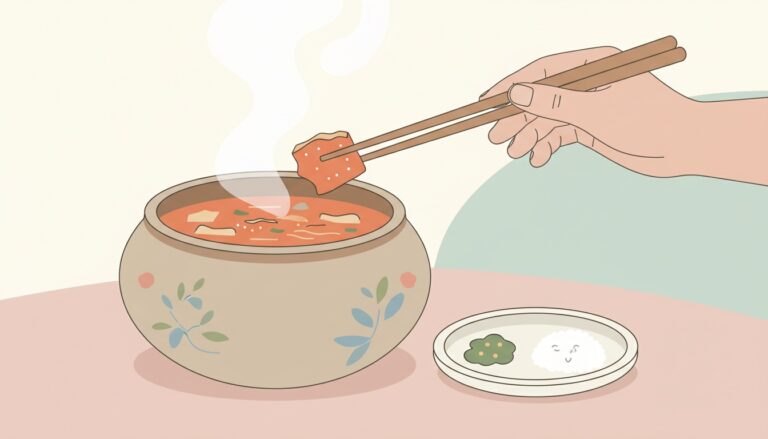
Phase 1: Welcome to the Kitchen! 🍳
Hello! This is your Daily Hangul Editor.
Picture this: You’ve just spent two hours making the perfect Dakgalbi (spicy stir-fried chicken). It smells amazing. Your Korean friends are sitting at the table, eyes wide with anticipation. Now, you need to move that masterpiece from the frying pan to the serving plates.
But wait… do you just point at the pan? Do you say “Put it here” in English?
This is the moment where many students freeze. In Western culture, we often plate food in the kitchen. In Korea, sharing from the table is an art form. If you don’t know the right verbs for “serving” or “taking a portion,” you might awkwardly gesture while the food gets cold.
Today, we are going to learn how to plate food and tell people to “help themselves” like a true local. These expressions will make you look like a caring, sophisticated host. Let’s dig in!
Phase 2: Deep Dive into Core Expressions 🥘
Here are the top 3 expressions you need when handling food and plates.
1. 담아 주세요 (Dama juseyo)
- Pronunciation: [Dam-a ju-se-yo]
- Sound analogy: “Dam” sounds like a beaver’s dam. “A” sounds like ah. “Ju-se-yo” flows quickly.
- Meaning: Please put it in/on (the dish/plate).
- Editor’s Insight: The base verb is 담다 (dam-da). Unlike
놓다(to just place something down),담다specifically means to put something into a container or vessel. It implies care. You don’t just “drop” food; you “contain” it nicely. - Situation Check: Used when asking someone to transfer food from a pot to a plate.
2. 좀 덜어 드세요 (Jom deoreo deuseyo)
- Pronunciation: [Jom deo-reo deu-se-yo]
- Sound analogy: “Deoreo” sounds a bit like Duh-ruh. “Deu” sounds like the disgusted noise you make when you step in gum (Eww but with a D -> Deu).
- Meaning: Please take a portion / Help yourself.
- Editor’s Insight: This is the Golden Verb of Korean dining: 덜다 (deol-da). It means to lessen or take a part of something. Since Koreans often eat from a main stew or pot, you tell guests to “deol-da” (move a portion to their own small plate).
- Situation Check: Perfect for communal dishes like stews (Jjigae) or big noodle bowls.
3. 식기 전에 드세요 (Sikgi jeone deuseyo)
- Pronunciation: [Sik-gi jeon-e deu-se-yo]
- Meaning: Please eat before it gets cold.
- Editor’s Insight: This isn’t just an instruction; it’s a sign of affection. Koreans care deeply about the temperature of food. Saying this shows you want them to enjoy the meal at its peak quality.
- Situation Check: Universal! Use it with friends, family, or your boss.
Phase 3: Textbook vs. Real Life 🗣️
Don’t sound like a robot! Here is how to upgrade your Korean.
| Textbook Korean (Correct but stiff) | Real Korean (Natural & Friendly) |
|---|---|
| 이 그릇에 음식을 넣으세요. (Please put food in this bowl.) |
여기 예쁘게 담아 주세요. (Please plate it nicely here.) |
| 음식을 가져가세요. (Take the food.) |
앞접시에 덜어 드세요. (Please take some onto your front plate.) |
| 많이 드세요. (Eat a lot.) |
부족하면 더 말해요! (If you need more, just say so!) |
Editor’s Note: Notice the word 예쁘게 (nicely/prettily)? Koreans love visual presentation. Adding this adverb makes you sound very culturally aware!
Phase 4: Cultural Context & Manners 🥢
The Magic of “Ap-jeop-si” (앞접시)
In the West, you get your own plate. In Korea, you get a main dish in the center and a small empty plate in front of you called 앞접시 (Front Plate).
- The Nunchi Rule: If you are the youngest or the host, it is good manners to scoop the food from the big pot into the other person’s ap-jeop-si first, saying “제가 덜어 드릴게요” (I will serve/portion it for you).
- Hygiene: Never eat directly from the big pot with your personal spoon if there is a ladle available! Use the ladle to 덜다 (move food) to your plate first.
Phase 5: Real Life Scenario 🎬
Setting: You are at a cooking class with a Korean friend, Min-ji. The Tteokbokki is finally ready.
Min-ji: 와, 냄새 진짜 좋다! 이제 먹자.
(Wow, it smells so good! Let’s eat now.)
You: 잠깐만! 이 접시에 담을게.
(Wait! I’ll put it on this plate.)
(Action: Carefully pouring the Tteokbokki onto a white dish)
Min-ji: 우와, 진짜 요리사 같다!
(Whoa, you look like a real chef!)
You: 자, 식기 전에 얼른 먹어.
(Here, eat quickly before it gets cold.)
Phase 6: 10-Second Shadowing 🎧
Let’s practice the most useful sentence. Read this aloud while imagining you are handing a ladle to a guest.
“Please take some onto your individual plate.”
앞접시에 / 덜어 / 드세요.
[Ap-jeop-si-e / deo-reo / deu-se-yo]
- Focus: Pause slightly after “Ap-jeop-si-e”. Stress the “Deo” in “Deoreo”.
Phase 7: FAQ & Troubleshooting 🧐
Q: Can I use 담다 for liquids like water?
A: Yes! You can say “컵에 물을 담다” (pour water into a cup). However, for pouring liquids specifically, 따르다 (pour) is also common. But 담다 is safe for any content going into a container.
Q: Is 덜어 먹다 rude?
A: No! It is actually polite. It implies hygiene. “같이 먹자” (Let’s eat together) often implies sharing the pot, but “덜어 먹자” implies using individual plates, which is preferred in modern settings.
Phase 8: Wrap-up & Mission 🎁
Summary:
* Use 담다 when putting food onto a serving plate.
* Use 덜다 when taking a portion from a shared pot to your own plate.
* Always tell people to eat before it gets cold (식기 전에).
Your Mission:
Next time you order a shared dish (like Pizza or Bingsu) with a friend, hand them a plate and say: “여기에 덜어 먹자!” (Let’s take a portion here and eat!)
Have you ever been confused by Korean table manners? Tell me in the comments! 👇
Phase 9: Pop Quiz 📝
1. Which verb do you use when moving Kimchi from a large jar to a small dinner plate?
A) 던지다 (Deon-ji-da)
B) 담다 (Dam-da)
C) 섞다 (Seok-da)
2. You want your friend to eat the soup before it gets cold. You say:
A) 식기 전에 드세요. (Sikgi jeone deuseyo)
B) 식은 후에 드세요. (Sigeun hue deuseyo)
C) 빨리 가세요. (Ppalli gaseyo)
3. What is the Korean name for the “individual front plate”?
A) 뒷접시 (Dwit-jeop-si)
B) 옆접시 (Yeop-jeop-si)
C) 앞접시 (Ap-jeop-si)
(Answers: 1. B, 2. A, 3. C)
Frequently Asked Questions (FAQ)
Q: What does "담아 주세요 (Dama juseyo)" mean in Korean and how do you pronounce it?
A: In Korean, "담아 주세요 (Dama juseyo)" is pronounced [Dam-a ju-se-yo] and means: a key conversational Korean expression covered in this lesson.
Q: What does "좀 덜어 드세요 (Jom deoreo deuseyo)" mean in Korean and how do you pronounce it?
A: In Korean, "좀 덜어 드세요 (Jom deoreo deuseyo)" is pronounced [Jom deo-reo deu-se-yo] and means: a key conversational Korean expression covered in this lesson.
Q: What does "식기 전에 드세요 (Sikgi jeone deuseyo)" mean in Korean and how do you pronounce it?
A: In Korean, "식기 전에 드세요 (Sikgi jeone deuseyo)" is pronounced [Sik-gi jeon-e deu-se-yo] and means: Please eat before it gets cold.







