

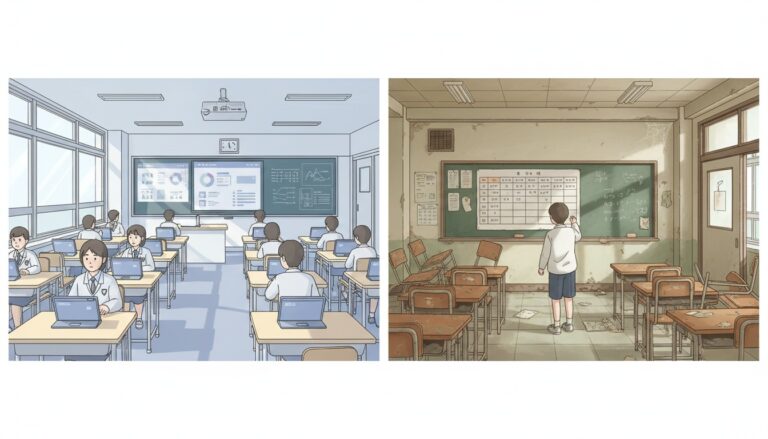
✅ Introduction: The Hot Potato of Korean Education
Hello! This is your Daily Hangul Head Editor.
Today, we are putting away the K-Pop lyrics and travel guides. We are stepping into the serious, intense, and often heated world of Korean Education Politics.
You’ve heard about the High School Credit System (고교 학점제), right? It’s a policy aiming to let students choose their classes like university students. Sounds great on paper, doesn’t it? But if you mention this to a Korean teacher or a parent of a teenager, you might see a deep sigh or a shake of the head.
At the C2 (Advanced) level, you need to go beyond “I like school” and be able to articulate “The systemic disparity between urban and rural educational infrastructure renders this policy nominal.”
This lesson comes directly from debates I’ve heard in the teachers’ lounge. Let’s learn how to critique reality like a true Korean intellectual.
✅ Deep Dive: 3 Critical Expressions for Debate
Here are the heavy-hitters you need to point out the flaws in the system.
1. 유명무실하다 (Nominal / In name only)
- Pronunciation: Yu-myeong-mu-sil-ha-da [Sounds like: You-myung-moo-sil-hada]
- Meaning: Literally “Has a name but no substance.” It refers to a policy or rule that exists officially but has no real effect or power.
- Editor’s Insight: This is a high-level Four-Character Idiom (사자성어). If you use this, Koreans will look at you with immense respect. Use it when the government announces a plan that looks fancy but changes nothing in reality.
- Situation Check: ⭕ Formal (Debates, Essays, News) | △ Casual (Only when complaining intellectually)
2. 교육 인프라의 격차 (Disparity in educational infrastructure)
- Pronunciation: Gyo-yuk in-peu-ra-ui gyeok-cha
- Meaning: The gap in resources (teachers, facilities, budget) between rich areas (like Gangnam) and rural areas.
- Editor’s Insight: This is the core argument against the credit system. “How can a small school in the countryside offer 50 different classes like a school in Seoul?” This phrase pinpoints that inequality.
- Situation Check: ⭕ Formal | ⭕ Professional
3. 현실적인 여건이 미비하다 (Realistic conditions are inadequate)
- Pronunciation: Hyeon-sil-jeok-in yeo-geon-i mi-bi-ha-da
- Meaning: The environment isn’t ready yet. “We aren’t set up for this.”
- Editor’s Insight: 미비하다 (Inadequate/Incomplete) is a very sophisticated way to say “we are not ready.” It sounds much more objective and analytical than just saying “준비가 안 됐어요 (We aren’t ready).”
- Situation Check: ⭕ Formal reports | ⭕ Serious discussions
✅ Textbook vs. Real Life: The Critical Tone
When criticizing policy, textbooks are too polite. Real Koreans use sharper language.
| Textbook Korean (Standard/Polite) | Real Korean (Critical/Sharp) |
|---|---|
| 준비가 덜 된 것 같아요. (It seems less prepared.) |
시기상조라고 봅니다. (I see it as premature/too early.) |
| 지방 학교는 선생님이 부족해요. (Rural schools lack teachers.) |
도농 간 격차가 더 심화될 겁니다. ( The urban-rural gap will deepen further.) |
| 그 정책은 효과가 없을 거예요. (That policy won’t be effective.) |
전형적인 탁상공론이죠. (It’s typical ‘desk theory’ / armchair philosophy.) |
Editor’s Note: 탁상공론 (Tak-sang-gong-ron) is a killer C2 word. It means arguing over a desk without knowing the reality of the field. Use this, and you win the debate.
✅ Cultural Context: The “Su-neung” Shadow
Why are Koreans so sensitive about this?
It all boils down to the Su-neung (CSAT). In Korea, the university entrance exam is viewed as the final judge of one’s 20-year effort.
- Fairness (공정성) is King: Any policy that makes things “variable” (like the Credit System) is feared because it might create loopholes for the privileged.
- Nunchi in Debate: Even if you disagree with the system, be careful who you blame. Blaming the “system” is safe. Blaming “teachers” or “parents” can be offensive. Stick to structural criticism like “infrastructure” or “budget.”
✅ Roleplay: The Teachers’ Lounge
Setting: Two high school teachers, Mr. Kim and Ms. Park, are drinking mix-coffee in the office, worried about the new semester.
Characters:
* Mr. Kim (Foreigner, C2 Level): A concerned educator.
* Ms. Park (Korean): A cynical veteran teacher.
Dialogue:
Mr. Kim: (Sighing while looking at a schedule)
고교 학점제 취지는 좋지만, 지방 학교 현실을 너무 모르는 것 같아요.
(Go-gyo hak-jeom-je chwi-ji-neun jo-chi-man, ji-bang hak-gyo hyeon-sil-eul neo-mu mo-reu-neun geot ga-ta-yo.)
“The intent of the High School Credit System is good, but they seem to be oblivious to the reality of rural schools.”
Ms. Park: (Nodding vigorously)
맞아요. 교사 수급도 안 되는데 무슨 과목 선택권을 준다는 건지… 완전 빛 좋은 개살구라니까요.
(Ma-ja-yo. Gyo-sa su-geup-do an doe-neun-de mu-seun gwa-mok seon-taek-gwon-eul jun-da-neun geon-ji… wan-jeon bit jo-eun gae-sal-gu-ra-ni-kka-yo.)
“Exactly. We can’t even supply enough teachers, so how can we give them course choices? It’s a complete ‘apricot with a good color’ (good on the outside, tart on the inside).”
Mr. Kim: (Serious tone)
이대로 시행하면, 결국 교육 인프라가 좋은 강남 학교들만 유리해질 게 뻔해요.
(I-dae-ro si-haeng-ha-myeon, gyeol-guk gyo-yuk in-peu-ra-ga jo-eun Gangnam hak-gyo-deul-man yu-ri-hae-jil ge ppeon-hae-yo.)
“If implemented as is, it’s obvious that only Gangnam schools with good educational infrastructure will benefit.”
Ms. Park:
선생님, 한국 사람 다 되셨네요. 그게 바로 핵심이에요.
(Seon-saeng-nim, Han-guk sa-ram da doe-syeon-ne-yo. Geu-ge ba-ro haek-sim-i-e-yo.)
“Teacher, you’ve become a total Korean. That is exactly the core point.”
✅ 10-Second Shadowing: Sound Like a Critic
Read this sentence clearly and authoritatively. Pause at the slashes /.
“현장의 목소리를 무시한 채 / 무리하게 도입한다면, / 이 정책은 결국 / 유명무실해질 수밖에 없습니다.”
(Hyeon-jang-ui mok-so-ri-reul mu-si-han chae / mu-ri-ha-ge do-ip-han-da-myeon, / i jeong-chaek-eun gyeol-guk / yu-myeong-mu-sil-hae-jil su-ba-kke eop-seum-ni-da.)
Meaning: “If introduced forcefully / while ignoring the voices of the field, / this policy will inevitably / become nominal (useless).”
✅ FAQ & Troubleshooting
- Q: Can I use these words with my Korean boss?
- A: YES, but context matters. If you are discussing business strategy or distinct market problems, words like 현실적인 여건 (realistic conditions) and 유명무실 (nominal) are extremely professional and impressive.
- Q: Is ‘빛 좋은 개살구’ (Apricot with good color) rude?
- A: It’s not rude, but it is cynical. Use it to criticize a situation or object, never a person.
✅ Wrap-up & Mission
One-Liner Summary:
To critique the High School Credit System, focus on the gap (격차) in infrastructure (인프라) that makes the policy nominal (유명무실).
Your Mission:
Read a Korean news headline about education today. Try to find the word ‘격차’ (gap/disparity). It is almost always there!
Engagement:
Does your country have a similar problem where policy doesn’t match reality? Tell me in the comments!
✅ Pop Quiz
- Which idiom means “Empty formalities / Theoretical talk without practice”?
A) 일거양득 (Killing two birds with one stone)
B) 탁상공론 (Table-top discussion/Desk theory)
C) 금시초문 (Hearing for the first time) -
How do you politely say “The environment isn’t ready yet”?
A) 하기 싫어요. (I don’t want to do it.)
B) 현실적인 여건이 미비합니다. (Realistic conditions are inadequate.)
C) 이건 사기입니다. (This is a scam.) -
What does ‘유명무실(有名無實)’ mean?
A) Famous and rich.
B) Unknown but talented.
C) Famous in name, but empty in reality.
(Answers: 1. B, 2. B, 3. C)
Frequently Asked Questions (FAQ)
Q: What does "유명무실하다 (Nominal / In name only)" mean in Korean and how do you pronounce it?
A: In Korean, "유명무실하다 (Nominal / In name only)" is pronounced [Yu-myeong-mu-sil-ha-da [Sounds like: You-myung-moo-sil-hada] and means: Literally "Has a name but no substance." It refers to a policy or rule that exists officially but has no real effect or power.
Q: What does "교육 인프라의 격차 (Disparity in educational infrastructure)" mean in Korean and how do you pronounce it?
A: In Korean, "교육 인프라의 격차 (Disparity in educational infrastructure)" is pronounced [Gyo-yuk in-peu-ra-ui gyeok-cha] and means: The gap in resources (teachers, facilities, budget) between rich areas (like Gangnam) and rural areas.
Q: What does "현실적인 여건이 미비하다 (Realistic conditions are inadequate)" mean in Korean and how do you pronounce it?
A: In Korean, "현실적인 여건이 미비하다 (Realistic conditions are inadequate)" is pronounced [Hyeon-sil-jeok-in yeo-geon-i mi-bi-ha-da] and means: The environment isn't ready yet. "We aren't set up for this."







