

Hello! This is your Daily Hangul Editor.
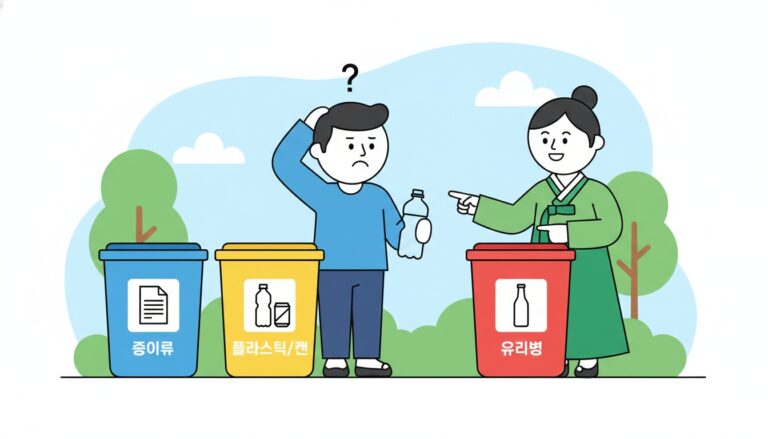
Have you ever stood in front of a row of colorful bins in Korea, holding an empty coffee cup, sweating because you didn’t know which hole to put it in?
“Is the lid plastic? Is the cup paper? What about the straw?!”
I’ve seen so many of my students freeze in this exact moment. Recycling, or 분리수거 (Bunlisugeo), is taken very seriously in Korea. Do it wrong, and you might get a stern look from the building security guard (or even a fine!).
But don’t worry. Today, I’m going to teach you the survival phrases to navigate the Korean trash system like a pro. This guide is built from real questions asked by students just like you.
Phase 2: Deep Dive into Key Expressions
Here are the top 3 phrases you need to survive trash day.
1. 이거 어디에 버려요? (Where do I throw this away?)
This is your magic key. When in doubt, just hold up the item and ask this.
- Pronunciation: [Igeo eodie beoryeoyo?]
- Ee-guh (This)
- Uh-dee-eh (Where)
- Buh-ryuh-yo? (Sounds like “Burrow” like a rabbit + “yo”)
- Meaning: Where do I throw this?
- Editor’s Insight: You don’t need to know the name of every material (plastic, vinyl, styrofoam). Just ask this, and a Korean will point to the right bin.
- Situation Check: Casual (O) / Formal (O) – Adding ‘yo’ makes it polite enough for neighbors or guards.
2. 이거 일반 쓰레기예요? (Is this general trash?)
In Korea, anything that isn’t recyclable goes into a specific paid trash bag (usually white or pink). This is called 일반 쓰레기 (General Waste).
- Pronunciation: [Igeo ilban sseuregi-yeyo?]
- Il-ban (General)
- Sseu-reh-gi (Trash – sounds like “Sue” + “Reggie”)
- Meaning: Is this general garbage?
- Editor’s Insight: This is crucial. If you put general trash in the recycling bin, it’s a big no-no.
- Situation Check: Use this when you are confused if something (like a dirty tissue) is recyclable.
3. 라벨 떼고 버려요. (Remove the label and throw it.)
You will hear this a lot. In Korea, clear PET bottles must have their plastic labels removed before recycling.
- Pronunciation: [Label ttego beoryeoyo]
- Label (Label)
- Tte-go (Remove/Peel off – distinct ‘Tt’ sound)
- Meaning: Peel off the label, then throw it away.
- Editor’s Insight: Many bottles now have an “Eco-tap” to make peeling easy. Doing this shows you really understand Korean culture!
Phase 3: Textbook vs. Real Life
Textbooks teach you to be robotic. Real life is about efficiency. Here is how we really talk.
| Textbook Korean (Too Formal) | Real Life Korean (Natural) |
|---|---|
| 쓰레기를 분리수거해 주세요. (Please separate the recyclables.) |
이거 다 씻어서 버려야 돼요? (Do I have to wash all of this before throwing it?) |
| 플라스틱은 어디에 있습니까? (Where is the plastic bin?) |
이거 플라스틱 맞아요? (Is this plastic? / Is this right for plastic?) |
| Editor’s Note: | A1 Level Tip: Using “맞아요?” (Is it correct/right?) is a hack! Just say “Plastic majayo?” |
Phase 4: Cultural Context (Nunchi & Manners)
The “Jongnyangje” (Volume-Rate System)
You cannot just use any black plastic bag from the convenience store for your house trash.
* The Rule: You must buy specific standardized garbage bags (종량제 봉투) from a convenience store or supermarket near your house. They are usually white, pink, or green depending on the district.
* The Nunchi: If you throw your trash in a random black bag, the cameras might catch you, or neighbors will complain. It’s considered very rude and rule-breaking.
The “Clean” Rule
Recyclables must be clean. If a delivery food container has red chili paste stains that won’t come off even after washing, it is not recycling. It becomes General Trash (일반 쓰레기). Don’t be the person who makes the whole recycling bin smell!
Phase 5: Real-Life Scenario (Roleplay)
Setting: In the apartment complex recycling area. You are holding a dirty pizza box.
Characters:
* You (Alex): A beginner in Korean.
* Guard (Ajeossi): The apartment security guard.
Alex: (Holding the pizza box confusedly)
아저씨, 이거 종이예요?
(Ajeossi, igeo jongiyeyo?)
[Sir, is this paper?]
Guard: (Frowning and waving hand)
아니요! 더러워요. 일반 쓰레기예요.
(Aniyo! Deoreowoyo. Ilban sseuregi-yeyo.)
[No! It’s dirty. It’s general trash.]
Alex: 아… 그럼 종량제 봉투에 버려요?
(Ah… geureom jongnyangje bongtue beoryeoyo?)
[Ah… then do I throw it in the standard garbage bag?]
Guard: 네, 맞아요. 접어서 버리세요.
(Ne, majayo. Jeobeoseo beoriseyo.)
[Yes, that’s right. Fold it and throw it away.]
Phase 6: 10-Second Shadowing Drill
Let’s practice the most useful phrase. Read this out loud, pausing at the slash /.
“Please throw it away / after washing it.”
씻어서 / 버려주세요.
[Ssi-seo-seo / buh-ryuh-ju-seh-yo]
- Intonation Tip: Raise your tone slightly on “Seo” (씻어서), and drop it calmly at “Yo” (주세요).
Phase 7: FAQ & Troubleshooting
Q: Can I throw chicken bones in Food Waste (음식물 쓰레기)?
A: NO! This is the biggest mistake foreigners make.
* The Rule: If an animal cannot eat it, it is General Trash.
* Hard things: Bones (chicken, beef), eggshells, clam shells, tea bags = General Trash.
* Soft things: Leftover rice, fruit peels, kimchi = Food Waste.
Q: Can I use the trash bag from one district in another district?
A: Generally, no. If you move from Gangnam-gu to Mapo-gu, you usually cannot use Gangnam bags in Mapo. You have to buy new stickers or new bags.
Phase 8: Wrap-up & Action Mission
Today’s Summary:
Recycling is about sorting (bunlisugeo) and using the right bag. When in doubt, ask “Igeo eodie beoryeoyo?”
🔥 Your Mission:
Go to your local convenience store (GS25, CU, 7-Eleven) today and buy a 10-Liter Standard Garbage Bag.
* Say this: “일반 쓰레기 봉투 10리터 주세요.” (Ilban sseuregi bongtu 10-liter juseyo.)
Did you successfully buy it? Let me know in the comments!
Phase 9: Quick Quiz
1. Which item is considered “General Trash” (일반 쓰레기)?
A) Clean plastic bottle
B) Chicken bones
C) Newspaper
2. What do you say when you don’t know where to throw something?
A) 이거 얼마예요? (How much is this?)
B) 이거 어디에 버려요? (Where do I throw this?)
C) 이거 맛있어요? (Is this delicious?)
3. True or False: You should remove the label from a PET bottle before recycling.
A) True
B) False
(Scroll down for answers)
Answers: 1. (B), 2. (B), 3. (A)
Frequently Asked Questions (FAQ)
Q: What does "분리수거" mean in Korean and how do you pronounce it?
A: In Korean, "분리수거" is pronounced [Bunlisugeo] and means: , is taken very seriously in Korea. Do it wrong, and you might get a stern look from the building security guard (or even a fine!).
Q: What does ""맞아요?"" mean in Korean and how do you pronounce it?
A: In Korean, ""맞아요?"" is pronounced [Is it correct/right?] and means: is a hack! Just say "Plastic majayo?"







