

Phase 1: Introduction
Hello! This is your Editor at Daily Hangul.
Have you ever walked up to a teacher’s desk in Korea, placed your homework down, and walked away, only to feel a strange silence in the room?
I’ve seen this happen dozens of times in my years of teaching. One of my students, Sarah, once told me, “I just put the paper on the desk. Why did the teacher look disappointed?”
In many Western cultures, efficiency is key. You drop it off, you leave. But in Korea, the interaction is just as important as the homework itself. If you just silently drop a paper, it can feel dismissive—almost like throwing the paper at someone.
Today, we are going to fix that. We will cover how to submit your homework with the right words and the right vibe (or as we say, the right manner). This guide is based on real questions from students just like you.
Phase 2: Deep Dive (Core Expressions)
Here are the top 3 phrases you need for this specific moment. We are keeping it at an A2 (High Beginner) level—simple, polite, and natural.
1. 숙제 여기 있어요. (Here is my homework.)
- Pronunciation: Suk-je yeo-gi i-sseo-yo [Sounds like: Sook-jeh yuh-ghee e-sso-yo]
- Meaning: “Homework is here.”
- Editor’s Insight: This is the safest, most standard phrase. It’s polite enough for a teacher but not overly stiff. It announces “I am doing my job as a student.”
- Situation Check: ✅ Teacher (Polite) | ❌ Close Friend (Too stiff)
2. 저 숙제 가져왔어요. (I brought my homework.)
- Pronunciation: Jeo suk-je ga-jyeo-wa-sseo-yo [Sounds like: Juh sook-jeh ga-juh-wah-ssuh-yo]
- Meaning: “I brought the homework.”
- Editor’s Insight: Use this when the teacher asks who has submitted it, or if you are handing it in a bit proudly. The verb 가져오다 (to bring) is essential for A2 learners.
- Situation Check: ✅ Teacher (Polite) | ✅ Friend (If you drop the ‘yo’ -> na suk-je ga-jyeo-wa-sseo)
3. 죄송해요, 숙제 깜빡했어요. (I’m sorry, I forgot my homework.)
- Pronunciation: Joe-song-hae-yo, suk-je kkam-ppak-hae-sseo-yo [Sounds like: Jay-song-hay-yo, sook-jeh kkam-ppak-hay-ssuh-yo]
- Meaning: “Sorry, I blinked/forgot the homework.”
- Editor’s Insight: This is a life-saver phrase. 깜빡하다 (to blink/forget momentarily) is much more natural and “cuter” than saying “I did not do it.” It implies it was a mistake, not laziness. It softens the blow!
- Situation Check: ✅ Teacher (Must look sorry!) | ✅ Friend
Phase 3: Textbook vs. Real Life
How does a robot speak vs. how a Seoul university student speaks?
| Textbook (Correct but stiff) | Real Life (Natural & Smart) |
|---|---|
| 숙제를 제출하겠습니다. (I will submit the homework.) Feels like you are in the military. |
선생님, 저 숙제 냈어요? (Teacher, did I submit the homework?) Checking if your name is on the list. |
| 숙제가 없습니다. (There is no homework.) Too direct. |
아, 맞다! 숙제! (Ah, right! Homework!) The universal sound of realizing you forgot. |
| 여기 있습니다. (Here it is.) |
숙제 여기요! (Homework, here!) A bit casual, but okay if you are close with the teacher. |
- Editor’s Note: Since you are A2 level, stick to “숙제 여기 있어요” for now. It’s the perfect balance.
Phase 4: Cultural Context & Manners
In Korea, Non-verbal communication (Body Language) is 50% of the conversation.
1. The “Two-Hand” Rule
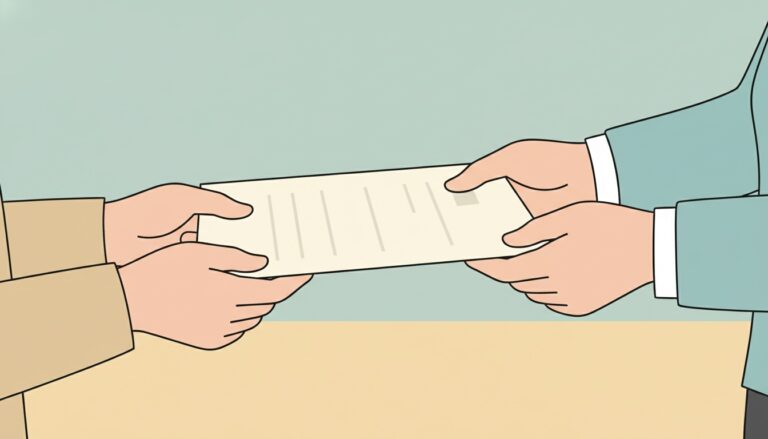
Never, ever hand a piece of paper to a teacher (or anyone older) with one hand.
* Best: Hold the paper with two hands.
* Okay: Hand it with your right hand, while your left hand lightly touches your right elbow or forearm. This shows great respect.
2. The Slight Bow
Don’t just walk up, drop it, and turn around.
* Approach -> Bow slightly (head nod) -> Hand the paper with two hands -> Say the phrase -> Bow slightly again -> Leave.
3. Nunchi (Eye-measure)
Is the teacher on the phone? Is the teacher scolding another student? Do not approach. Wait until they are free. Interrupting is considered having “no Nunchi.”
Phase 5: Real Life Scenario (Roleplay)
Setting: A Korean language classroom. Class has just finished.
Characters:
* Minsu (Student): A foreigner learning Korean.
* Teacher (native Korean): Kind but busy.
(Minsu walks up to the desk holding his worksheet with two hands.)
Minsu: 선생님, 저 숙제 여기 있어요.
(Seonsaengnim, jeo suk-je yeo-gi i-sseo-yo.)
Teacher, here is my homework.
Teacher: 어, 민수 씨. 벌써 다 했어요?
(Oh, Minsu-ssi. Beolsseo da hae-sseo-yo?)
Oh, Minsu. You finished it already?
Minsu: 네, 조금 어려웠어요.
(Ne, jogeum eo-ryeo-wo-sseo-yo.)
Yes, it was a little difficult.
(Teacher takes the paper.)
Teacher: 고생했어요. 가 보세요.
(Go-saeng-hae-sseo-yo. Ga bo-se-yo.)
Good job (You suffered well). You can go.
Minsu: 네, 안녕히 계세요. (Bows)
(Ne, an-nyeong-hi gye-se-yo.)
Yes, goodbye (stay in peace).
Phase 6: 10-Second Shadowing
Let’s practice the rhythm. Read this out loud. Pause where you see the /.
“Teacher / I brought / the homework.”
선생님, / 저 / 숙제 가져왔어요.
(Seonsaengnim, / jeo / suk-je ga-jyeo-wa-sseo-yo.)
💡 Acting Tip: Make the “Seonsaengnim” sound bright and energetic to get their attention!
Phase 7: FAQ & Troubleshooting
- Q: Can I just say “Here” (여기요)?
- A: To a convenience store clerk? Yes. To a teacher? Maybe not. It sounds a bit too short. Adding “-isseoyo” (있어요) makes it polite and complete.
- Q: What if I didn’t finish the homework?
- A: Be honest but polite. Say “아직 못 했어요” (A-jik mot hae-sseo-yo – I couldn’t do it yet). Don’t say “안 했어요” (An hae-sseo-yo – I didn’t do it) because that sounds like you chose not to do it!
Phase 8: Wrap-up
One-Liner Summary:
When submitting homework, always use two hands and say “숙제 여기 있어요” to show respect and polish.
Action Mission:
Next time you hand anything (a pen, a paper, a credit card) to someone older than you, try using the two-hand method. Watch their reaction—they will likely smile or treat you more kindly!
Your Turn:
Have you ever forgotten your homework in a language class? What did you say? Tell me in the comments!
Phase 9: Quick Quiz
1. Which gesture is correct when handing homework to a teacher?
a) Throwing it like a frisbee.
b) Using one hand while checking your phone.
c) Using two hands with a slight bow.
2. How do you say “I brought my homework”?
a) 숙제 깜빡했어요. (Suk-je kkam-ppak-hae-sseo-yo)
b) 숙제 가져왔어요. (Suk-je ga-jyeo-wa-sseo-yo)
c) 숙제 없어요. (Suk-je eop-seo-yo)
3. Why is “숙제 깜빡했어요” better than just saying “No”?
a) It sounds cuter and implies it was a mistake.
b) It is extremely formal.
c) It means you did the homework perfectly.
(Answers: 1-c, 2-b, 3-a)
Frequently Asked Questions (FAQ)
Q: What does "숙제 여기 있어요. (Here is my homework.)" mean in Korean and how do you pronounce it?
A: In Korean, "숙제 여기 있어요. (Here is my homework.)" is pronounced [Suk-je yeo-gi i-sseo-yo [Sounds like: Sook-jeh yuh-ghee e-sso-yo] and means: "Homework is here."
Q: What does "저 숙제 가져왔어요. (I brought my homework.)" mean in Korean and how do you pronounce it?
A: In Korean, "저 숙제 가져왔어요. (I brought my homework.)" is pronounced [Jeo suk-je ga-jyeo-wa-sseo-yo [Sounds like: Juh sook-jeh ga-juh-wah-ssuh-yo] and means: "I brought the homework."
Q: What does "죄송해요, 숙제 깜빡했어요. (I'm sorry, I forgot my homework.)" mean in Korean and how do you pronounce it?
A: In Korean, "죄송해요, 숙제 깜빡했어요. (I'm sorry, I forgot my homework.)" is pronounced [Joe-song-hae-yo, suk-je kkam-ppak-hae-sseo-yo [Sounds like: Jay-song-hay-yo, sook-jeh kkam-ppak-hay-ssuh-yo] and means: "Sorry, I blinked/forgot the homework."






