

Phase 1: Introduction
Hello! This is your Head Editor at Daily Hangul.
If you’ve ever walked through Sinsa station or Gangnam in Seoul, you’ve probably seen them: endless advertisements for plastic surgery clinics. It can be a culture shock! In Korea, striving to become a better version of yourself—often through cosmetic procedures—is a common topic of conversation among friends.
But as a learner, how do you talk about your insecurities or ask for advice without sounding rude or overly medical? Today, we are diving into the nuanced world of Overcoming Complexes (콤플렉스 극복).
Full Disclosure: This lesson is built from real questions my intermediate (B1) students have asked after being invited to go along for a friend’s “consultation.” Let’s learn to speak with the sensitivity and sophistication of a local.
Phase 2: Deep Dive into Key Expressions
Here are the top 3 expressions you need to discuss beauty and insecurities naturally.
1. 콤플렉스 (Complex / Insecurity)
- Pronunciation: Kom-peul-lek-seu [Sounds like “Com” + “Pull” + “Wreck” + “Sue”]
- Meaning: While “complex” in English can sound like a severe psychological term, in Korea, it simply means “a feature I am insecure about.”
- Editor’s Insight: You use this when you want to explain why you want to change something. It turns vanity into vulnerability.
- Situation Check: ✅ Friends / ✅ Consultation / ⚠️ Boss (Too personal)
2. 상담을 받다 (To get a consultation)
- Pronunciation: Sang-dam-eul bat-da [“Sang-dam” sounds like “Song-dam”]
- Meaning: To receive counseling/consultation.
- Editor’s Insight: You don’t usually say “I’m going to the hospital” (which sounds like you are sick). You say, “I’m going to get a consultation.” It implies you are in the planning stage.
- Situation Check: ✅ Friends / ✅ Co-workers (If close)
3. 티(가) 안 나다 (To not be obvious / To look natural)
- Pronunciation: Ti-ga an na-da [“Ti” as in “Tea”]
- Meaning: Literal: The ‘flaw/mark’ doesn’t show. Real Nuance: “It looks so natural, like you were born with it.”
- Editor’s Insight: This is the Holy Grail of K-beauty. If someone gets a procedure, the best compliment isn’t “Your nose looks new,” it’s “Wow, it doesn’t look obvious at all!” (티 안 나게 잘 됐다!).
- Situation Check: ✅ Everywhere
Phase 3: Textbook vs. Real Life
Stop sounding like a medical journal. Speak like a Seoulite.
| Textbook Korean (Too Formal/Dry) | Real Life Korean (Natural/Trending) |
|---|---|
| 성형수술을 하고 싶어요. (I want to do plastic surgery.) | 저 코가 좀 콤플렉스라서 고민이에요. (My nose is a bit of a complex, so I’m worrying about it.) |
| 어느 병원이 좋아요? (Which hospital is good?) | 어디가 잘해요? (Where do they do it well?) |
| 수술이 성공적이었어요. (The surgery was successful.) | 대박! 진짜 자연스럽게 됐어요! (Daebak! It turned out so naturally!) |
Editor’s Note: In casual speech, we often drop the word ‘hospital’ (병원) and just ask “Where do they do it well?” (어디가 잘해요?).
Phase 4: Cultural Context & Manners (Nunchi 101)
The Art of “Not Noticing”
In Korea, even if it’s obvious a friend had a procedure, Nunchi (eye-measure/social sense) is key.
- Don’t ask directly: “Did you get your eyes done?” (쌍수 했어?) is rude unless you are best friends.
- The “Diet” Excuse: If someone looks different, the polite prompt is: “Did you lose weight? You became so pretty!” (살 빠졌어? 예뻐졌다!). This gives them the choice to reveal the surgery or just accept the compliment.
- Gaze Etiquette: If someone mentions a specific complex (e.g., a scar or nose shape), do not stare at that spot while they talk. Look into their eyes to show you care about them, not the flaw.
Phase 5: Roleplay Scenario
Setting: A cafe in Gangnam. Ji-min is confessing an insecurity to her Korean friend, Su-jin.
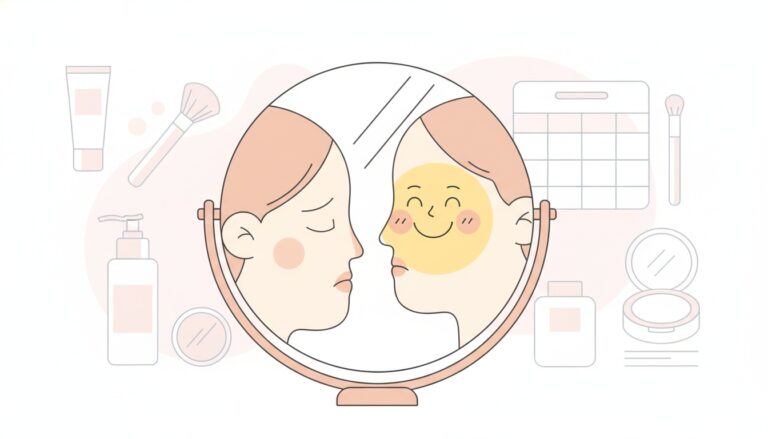
Ji-min: (Sighing while looking at a mirror)
사실… 나 코가 좀 콤플렉스야. 너무 낮은 것 같아.
(Sa-sil… na ko-ga jom kom-peul-lek-seu-ya. Neo-mu na-jeun geot ga-ta.)
Honestly… my nose is a bit of a complex. I think it’s too flat.
Su-jin: (Waving hand dismissively)
에이, 아니야! 너 지금도 충분히 예뻐.
(Ei, a-ni-ya! Neo ji-geum-do chung-bun-hi ye-ppeo.)
Hey, no way! You are pretty enough right now.
Ji-min:
그래도… 상담이라도 한번 받아볼까 고민 중이야.
(Geu-rae-do… sang-dam-i-ra-do han-beon ba-da-bol-kka go-min jung-i-ya.)
Still… I’m contemplating if I should at least get a consultation.
Su-jin:
음, 그러면 티 안 나게 잘하는 곳으로 같이 알아봐 줄게!
(Eum, geu-reo-myeon ti an na-ge jal-ha-neun go-seu-ro ga-chi a-ra-bwa jul-ge!)
Hmm, then I’ll help you look for a place that does it naturally (without it being obvious)!
Phase 6: 10-Second Shadowing
Repeat this sentence to master the rhythm. Focus on the pause to emphasize your desire.
“I want to do it naturally so it’s not obvious.”
티 안 나게 / 자연스럽게 / 하고 싶어요.
(Ti an na-ge / ja-yeon-seu-reop-ge / ha-go si-peo-yo)
- Intonation Tip: Raise your pitch slightly on ‘게’ (ge) in both phrases to sound softer and more hopeful.
Phase 7: FAQ & Troubleshooting
- Q: Can I use the word ‘성형’ (Plastic Surgery) openly?
- A: Yes, but it sounds a bit technical. Young people often use 시술 (procedure/treatment) for minor things (Botox, fillers) and 수술 (surgery) for major things. Using ‘시술’ makes it sound lighter and less scary.
- Q: Is it rude to say I have a complex?
- A: Not at all! It’s considered humble and relatable. It often bonds people closer together in Korea.
Phase 8: Wrap-up
One-Liner Summary:
When discussing plastic surgery, focus on “overcoming a complex” (콤플렉스) rather than “changing your face,” and always aim for “natural results” (티 안 나게).
Your Mission:
Next time you see a Korean celebrity who looks great, practice saying to yourself: “와, 진짜 자연스럽게 예쁘다!” (Wow, she/he is so naturally pretty!).
Let’s Chat:
Does your country talk openly about cosmetic procedures, or is it a secret? Tell me in the comments!
Phase 9: Quiz
- Which word means “insecurity” or “personal flaw” in this context?
a) 스트레스 (Stress)
b) 콤플렉스 (Complex)
c) 스타일 (Style) -
How do you describe a surgery result that looks very subtle and real?
a) 티가 많이 나요 (It’s very obvious)
b) 티가 안 나요 (It’s not obvious)
c) 티를 냈어요 (I showed it off) -
Instead of saying “I’m going to the hospital,” how do you say you are going to talk to a doctor about a procedure?
a) 상담 받으러 가요 (I’m going to get a consultation)
b) 약 사러 가요 (I’m going to buy medicine)
c) 입원하러 가요 (I’m going to be hospitalized)
(Answers: 1. b, 2. b, 3. a)
Frequently Asked Questions (FAQ)
Q: What does "콤플렉스 (Complex / Insecurity)" mean in Korean and how do you pronounce it?
A: In Korean, "콤플렉스 (Complex / Insecurity)" is pronounced [Kom-peul-lek-seu [Sounds like "Com" + "Pull" + "Wreck" + "Sue"] and means: While "complex" in English can sound like a severe psychological term, in Korea, it simply means "a feature I am insecure about."
Q: What does "상담을 받다 (To get a consultation)" mean in Korean and how do you pronounce it?
A: In Korean, "상담을 받다 (To get a consultation)" is pronounced [Sang-dam-eul bat-da ["Sang-dam" sounds like "Song-dam"] and means: To receive counseling/consultation.
Q: What does "티(가) 안 나다 (To not be obvious / To look natural)" mean in Korean and how do you pronounce it?
A: In Korean, "티(가) 안 나다 (To not be obvious / To look natural)" is pronounced [Ti-ga an na-da ["Ti" as in "Tea"] and means: Literal: The 'flaw/mark' doesn't show. Real Nuance: "It looks so natural, like you were born with it."







