

Introduction: The “Sticky” Charm of the West Coast
Hello! This is your Head Editor at Daily Hangul. 👋
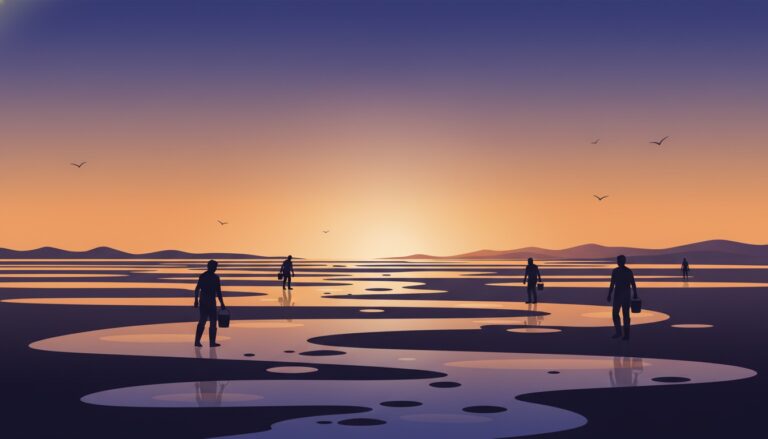
If you’ve mostly traveled to Seoul or the sandy beaches of Busan (the East or South Coast), the West Coast (서해안, Seohaean) might feel like a completely different planet. At low tide, the ocean disappears, leaving behind a massive, muddy playground called 갯벌 (Getbol – Mudflat).
Many advanced learners freeze here. Why? because standard textbooks teach you phrases like “The sea is blue” (바다가 파래요). But the West Sea isn’t just blue; it’s muddy, vast, and turns into a golden mirror at sunset.
Today, we are skipping the beginner stuff. We are going to look at C1-level expressions that capture the physical sensation of walking in mud and the emotional depth of watching a West Coast sunset.
Let’s learn how to speak not just like a tourist, but like a local photographer chasing the perfect shot.
Phase 2: Deep Dive (Core Expressions)
Here are three expressions that will add “texture” to your Korean.
1. 물때를 맞추다 (To time the tide)
- Pronunciation: [Mul-ttae-reul mat-chu-da] Sounds like ‘Mool-tte’ (rhymes with latte) + ‘match-who-da’.
- Meaning: Literally “to match the water time.” It means checking the tide table to know when the tide is low (for clam digging) or high (for swimming).
- Editor’s Insight: In the West Sea, the tides (조수 간만의 차) are extreme. If you don’t know this phrase, you might arrive at the beach and see only mud for miles! Using this shows you are a pro traveler who plans ahead.
- Situation Check: Used in both Casual and Formal settings.
2. 발이 푹푹 빠지다 (Feet sinking deep)
- Pronunciation: [Ba-ri puk-puk bba-ji-da] The ‘puk’ sound is explosive, like the sound of stepping into deep snow or thick dough.
- Meaning: To have one’s feet sink deep (into the mud).
- Editor’s Insight: Korean is famous for mimetic words (의태어). “푹푹” describes the feeling of sinking heavily and deeply. Don’t just say “걷기 힘들어요” (It’s hard to walk). Say “발이 푹푹 빠져서 걷기 힘들어요!” It paints a vivid picture.
- Situation Check: Mostly casual or descriptive storytelling.
3. 낙조가 장관이다 (The sunset is spectacular)
- Pronunciation: [Nak-jo-ga jang-gwan-i-da]
- Meaning: “The setting sun is a magnificent spectacle.”
- Editor’s Insight: You know “해” (sun) and “노을” (sunset glow), but 낙조 (낙조 – falling shine) is a more literary, advanced Hanja word often used for famous sunset spots. 장관 (Spectacle) implies a view so grand it feels overwhelming.
- Situation Check: Perfect for writing captions on Instagram or expressing awe to older Koreans.
Phase 3: Textbook vs. Real Life (Nuance Check)
Let’s upgrade your vocabulary from “Classroom Clean” to “Mudflat Realness.”
| Textbook Korean (Standard) | Real Korean (Native Vibe) |
|---|---|
| 바다에 물이 없어요. (There is no water in the sea.) |
지금 썰물 때라 물이 다 빠졌네. (It’s ebb tide now, so the water has drained out.) |
| 신발이 더러워졌어요. (My shoes got dirty.) |
갯벌이라 신발 엉망진창 됐어. (It’s a mudflat, so my shoes are a total mess.) |
| 경치가 아주 아름다워요. (The scenery is very beautiful.) |
와, 여기 완전 노을 맛집이네! (Wow, this place is a total ‘sunset gourmet’ spot!) |
Editor’s Note: “~맛집” (Restaurant/Gourmet) is slang used for any place that is exceptionally good at something (e.g., Selfie Matjib, View Matjib).
Phase 4: Cultural Context & Manners
1. The “Ppalli-Ppalli” of the Tides
Unlike the East Sea, the West Sea is dangerous if you ignore the tide. The water comes in faster than an adult can run. If you hear a broadcast or see locals leaving the mudflat (Getbol), do not rely on your eyes. Move immediately. Using the phrase “물 들어온다!” (The water is coming in!) is an urgent signal to pack up.
2. The “Mompe” Fashion
If you do a mudflat experience properly, you might be offered colorful, baggy floral pants called 몸빼 바지 (Mompe Baji). Do not be shy! Putting these on over your clothes is the ultimate “I accept your culture” move. It’s practical and hilarious for photos.
Phase 5: Real-Life Roleplay
Setting: Late afternoon at Anmyeondo (a famous West Coast island). Two friends are finishing a clam-digging session.
Characters:
* Min-jun (Native): Knows the area well.
* Alex (Learner): First time at a mudflat.
Min-jun: (Looking at his watch) 알렉스, 슬슬 나가자. 이제 곧 밀물 때야.
(Alex, let’s head out slowly. It’s almost high tide.)
Alex: (Struggling to walk) 잠깐만! 발이 푹푹 빠져서 빨리 못 가겠어.
(Wait! My feet keep sinking deep, I can’t move fast!)
Min-jun: (Laughs and offers a hand) 몸에 힘을 빼야지. 그나저나 저기 봐. 해 지는 거 보여?
(You need to relax your body. Anyway, look over there. See the sun setting?)
Alex: (Stopping to look) 와… 진짜 낙조가 장관이다. 서해안 오길 잘했네.
(Wow… the sunset is truly spectacular. I’m glad we came to the West Coast.)
Min-jun: 그치? 물 들어오면 저 갯벌이 다 금빛으로 변해.
(Right? When the water comes in, that whole mudflat turns golden.)
Phase 6: 10-Second Shadowing Drill
Let’s practice describing the scenery with emotion. Focus on the pause to emphasize the word “Golden.”
“해 질 녘에는 / 갯벌이 온통 / 황금빛으로 물들어요.”
(At dusk, the entire mudflat is dyed in golden light.)
- Key Point: Slightly elongate the sound on “온통” (on-tong) to emphasize “completely/everywhere.”
Phase 7: FAQ & Troubleshooting
- Q: Can I use “낙조” (Nakjo) for a sunrise?
- No! “Nak” (낙) means “fall/drop.” Sunrise is 일출 (Ilchul). Mixing these up will confuse Koreans. Nakjo is strictly for the sunset, especially over the ocean.
- Q: Is “물때” (Mul-ttae) a scientific term?
- It’s a common term used by fishermen and locals. In a scientific context, you might hear 조석 (Tide), but in daily conversation, stick to 물때.
Phase 8: Wrap-up
Today’s Summary:
To enjoy the West Coast, you need to respect the Time (물때), feel the Texture (푹푹 빠지다), and appreciate the View (낙조가 장관).
🚀 Your Mission:
Next time you see a beautiful sunset photo on Instagram, comment: “와, 낙조가 정말 장관이네요!” instead of just “예뻐요.”
Phase 9: Pop Quiz
1. Which word best describes the sound/feeling of stepping into deep mud?
a) 반짝반짝 (Twinkle twinkle)
b) 푹푹 (Deep sinking)
c) 살금살금 (Stealthily)
2. What should you check before going to a mudflat experience?
a) 물때 (The tide time)
b) 메뉴판 (The menu)
c) 환율 (Exchange rate)
3. Which phrase is appropriate when seeing a magnificent sunset?
a) 일출이 멋지네요.
b) 물이 맑네요.
c) 낙조가 장관이네요.
(Answers: 1. b, 2. a, 3. c)
Frequently Asked Questions (FAQ)
Q: What does "물때를 맞추다 (To time the tide)" mean in Korean and how do you pronounce it?
A: In Korean, "물때를 맞추다 (To time the tide)" is pronounced [Mul-ttae-reul mat-chu-da] and means: Literally "to match the water time." It means checking the tide table to know when the tide is low (for clam digging) or high (for swimming).
Q: What does "발이 푹푹 빠지다 (Feet sinking deep)" mean in Korean and how do you pronounce it?
A: In Korean, "발이 푹푹 빠지다 (Feet sinking deep)" is pronounced [Ba-ri puk-puk bba-ji-da] and means: To have one's feet sink deep (into the mud).
Q: What does "낙조가 장관이다 (The sunset is spectacular)" mean in Korean and how do you pronounce it?
A: In Korean, "낙조가 장관이다 (The sunset is spectacular)" is pronounced [Nak-jo-ga jang-gwan-i-da] and means: "The setting sun is a magnificent spectacle."







