

Phase 1: Introduction
Greeting: 안녕하세요! This is your Head Editor at Daily Hangul.
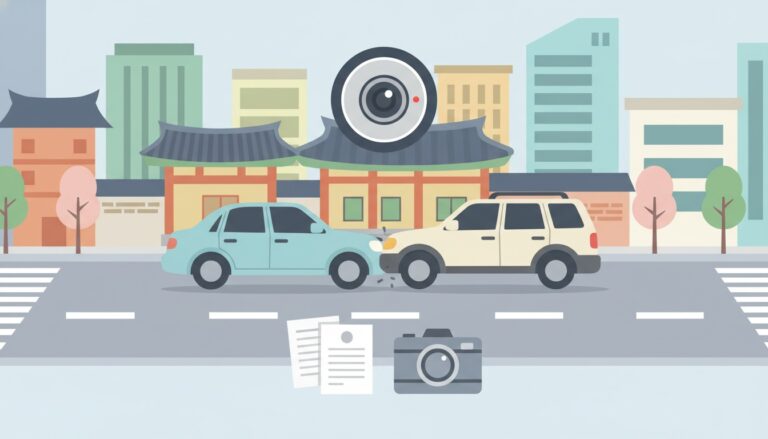
Scenario Setup: Imagine you are driving through the busy streets of Gangnam or taking a road trip to Jeju Island. Suddenly—Bang! Someone rear-ends your rental car. Your heart starts pounding. It’s stressful enough getting into a car accident in your home country, but in a foreign land? It’s terrifying.
The ‘Why’: Many foreigners panic here and either overpay for a settlement or fail to claim medical insurance because they don’t know the specific terms. Knowing the right words like “Black Box” (Dashcam) or “Insurance processing” transforms you from a confused tourist into a savvy local who can protect their rights.
Transparency: This guide is built from real distress calls we’ve received from our B2 level students living in Seoul. I’ve structured this so you can handle the situation calmly and professionally.
Phase 2: Deep Dive into Core Expressions
Here are the three heavy-hitting expressions you need when the adrenaline is pumping.
1. 대인 접수해주세요. (Please file for personal injury coverage.)
- Pronunciation: Dae-in jeop-su hae-ju-se-yo [Sounds like: Day-in + jup-soo]
- Meaning: “Please process the personal injury claim.”
- Dae-in (대인): Person/Body
- Jeop-su (접수): Filing/Registration
- Editor’s Insight: This is crucial. In Korea, insurance is split into Daemul (대물 – Car damage) and Daein (대인 – Body injury). If your neck hurts even a little, you must say this sentence to the other driver or their insurance agent to get medical treatment covered.
- Situation Check: Formal & Essential. Use this immediately if you feel pain.
2. 우리 보험사 불렀어요? (Did you call our insurance company?)
- Pronunciation: Uri bo-heom-sa bul-leoss-eo-yo? [Sounds like: Bo-hum-sa]
- Meaning: “Did you call the insurance company?”
- Editor’s Insight: In Korea, we rarely call the police for minor fender benders. We call the Boheom-sa (Insurance Company). They arrive on motorbikes faster than pizza delivery. The agents fight for you, so you don’t have to scream at the other driver.
- Situation Check: Use this to confirm the next step with the other party.
3. 블랙박스 확인해 봅시다. (Let’s check the dashcam.)
- Pronunciation: Beul-laek-bak-seu hwa-gin-hae bop-si-da [Sounds like: Black-Box]
- Meaning: “Let’s check the dashcam footage.”
- Editor’s Insight: 99% of cars in Korea have a “Black Box” (Dashcam). It is the ultimate judge. If the other driver claims it’s your fault, calmly suggest checking the footage. It shuts down arguments instantly.
- Situation Check: Logical & Assertive. Use this when there is a dispute about who is at fault.
Phase 3: Textbook vs. Real Life
How does a B2 student sound versus a Seoul local?
| Textbook (Correct but stiff) | Real Life (Natural & Smart) |
|---|---|
| 경찰서에 전화합시다. (Let’s call the police station.) | 일단 보험사부터 부르죠. (Let’s call the insurance first.) Note: Unless someone is seriously hurt, police are secondary. |
| 당신의 잘못입니다. (It is your fault.) | 이건 그쪽 과실인 것 같은데요. (I think this looks like your negligence.) Note: ‘과실’ (Gwasil) is the B2+ term for ‘fault/negligence’ in accidents. |
| 돈으로 주시겠어요? (Will you give me money?) | 현금 합의 하시겠어요? (Do you want to settle with cash?) Note: ‘합의’ (Hap-ui) is the legal term for settlement. |
Phase 4: Cultural Context & Manners
1. The “Neck Grab” Stereotype
You’ve seen it in K-Dramas: a car bumps someone, and they immediately grab the back of their neck (뒷목) and stumble out. While funny on TV, doing this excessively in real life can look like you are faking it to get settlement money (known as Na-i-long Hwan-ja). Be honest about your pain.
2. Don’t Fight in the Street
In many Western countries, you might argue about who is right on the spot. In Korea, it’s considered better “Nunchi” to stay calm, exchange numbers, take photos, and let the insurance agents discuss the “Gwasil Biyul” (Fault Ratio). Raising your voice makes you look like the aggressor.
Phase 5: Roleplay Script
Setting: A narrow alleyway in Hongdae. A delivery motorbike slightly scratches the side of Jason’s rental car.
Characters:
* Jason: Foreign learner (B2 Level)
* Driver: Korean delivery driver
(Crash sound! Jason gets out and looks at the scratch.)
Jason: (Calmly taking a photo of the license plate)
저기요, 방금 제 차 긁으셨죠?
(Excuse me, you just scratched my car, right?)
Driver: (Looking flustered)
아, 죄송합니다. 살짝 닿은 것 같은데요.
(Ah, I’m sorry. I think it just barely touched.)
Jason: (Pointing to the scratch)
아니요, 기스가 꽤 났어요. 보험 처리 해주세요.
(No, the scratch is quite deep. Please handle it through insurance.)
Driver: 그냥 현금으로 합의하면 안 될까요? 급해서요.
(Can’t we just settle with cash? I’m in a rush.)
Jason: (Firmly but politely)
죄송하지만 렌터카라서요. 블랙박스 영상 있으니까 보험사 부르겠습니다.
(Sorry, but it’s a rental car. We have dashcam footage, so I will call the insurance company.)
Phase 6: 10-Second Shadowing
Read this aloud to practice your intonation and pausing. This sentence asserts your rights without being rude.
“제 과실이 / 아니에요. // 지금 바로 / 블랙박스 / 확인해 보시죠.”
(It’s not my fault. Let’s check the dashcam right now.)
- Focus: Put stress on ‘아니에요’ (not) and ‘블랙박스’ (black box).
Phase 7: FAQ & Troubleshooting
Q: If the accident is small, should I move the car?
A: Yes, but WAIT! In the past, people left cars in the middle of the road to preserve the scene. Nowadays, because of traffic jams, the rule is: Take detailed photos first (close-up of damage + wide shot showing road lanes/wheel position), mark the tire position with spray if you have it (rare), and then move to the shoulder. If you move it without photos, you might lose evidence for the fault ratio.
Q: Can I use informal language (Banmal) if the other driver is younger?
A: Absolutely NOT. In an accident, emotions run high. Using Banmal can turn a simple insurance claim into a fistfight or a defamation lawsuit. Always maintain polite ‘Yo’ (요) endings.
Phase 8: Wrap-up
One-Liner Summary:
In a Korean car accident, don’t fight with your mouth; fight with photos, the Black Box, and the Insurance Agent.
Action Mission:
Next time you take a taxi or ride a friend’s car in Korea, look for the Black Box on the windshield. Point to it and ask: “블랙박스 잘 작동해요?” (Is the dashcam working well?)
Your Turn:
Have you ever seen a car accident in a K-Drama? Did they grab their neck? Tell me in the comments!
Phase 9: Quiz
Check if you are ready for the road!
1. What do you say if you have neck pain and need medical insurance coverage?
(a) 대물 접수 해주세요.
(b) 대인 접수 해주세요.
(c) 배달 해주세요.
2. What is the Korean word for “Dashcam”?
(a) 화이트박스
(b) 블랙박스
(c) 도시락
3. Which is the most natural way to suggest calling the insurance company?
(a) 경찰을 체포하세요.
(b) 119를 부르세요.
(c) 보험사 부르죠.
(Answers: 1-b, 2-b, 3-c)
Frequently Asked Questions (FAQ)
Q: What does "대인 접수해주세요. (Please file for personal injury coverage.)" mean in Korean and how do you pronounce it?
A: In Korean, "대인 접수해주세요. (Please file for personal injury coverage.)" is pronounced [Dae-in jeop-su hae-ju-se-yo [Sounds like: Day-in + jup-soo] and means: "Please process the personal injury claim."
Q: What does "우리 보험사 불렀어요? (Did you call our insurance company?)" mean in Korean and how do you pronounce it?
A: In Korean, "우리 보험사 불렀어요? (Did you call our insurance company?)" is pronounced [Uri bo-heom-sa bul-leoss-eo-yo? [Sounds like: Bo-hum-sa] and means: "Did you call the insurance company?"
Q: What does "블랙박스 확인해 봅시다. (Let's check the dashcam.)" mean in Korean and how do you pronounce it?
A: In Korean, "블랙박스 확인해 봅시다. (Let's check the dashcam.)" is pronounced [Beul-laek-bak-seu hwa-gin-hae bop-si-da [Sounds like: Black-Box] and means: "Let's check the dashcam footage."







