

Phase 1: Introduction
Hello! This is your Daily Hangul Senior Editor. 👋
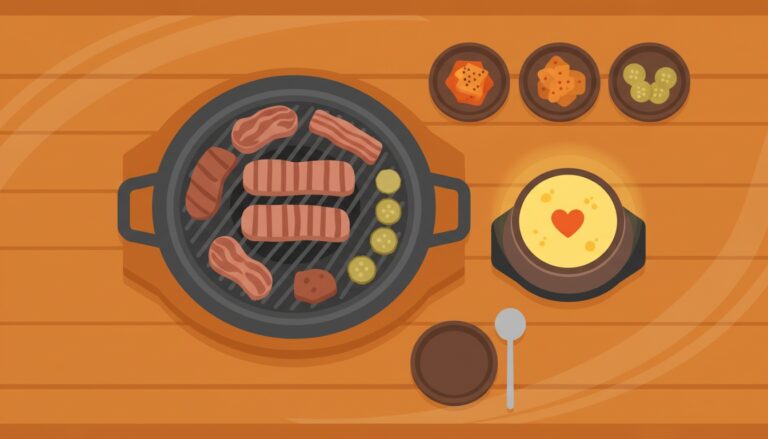
Imagine this: You are at a bustling Korean BBQ restaurant. You ordered Samgyeopsal (pork belly) and Soju. Suddenly, the Imo (the friendly auntie/server) places a steaming hot pot of Gyeran-jjim (steamed egg) on your table.
Your heart races. 😨
“Wait, I didn’t order this! Is she going to charge me extra? Do I have to pay for this mistake?”
Stop! Don’t panic. This isn’t a billing error. This is the heart of Korean culture: Jeong (정, 情). specifically manifesting as “Service” (서비스).
Today, we are going to learn how to handle this lovely surprise like a true local, not like a confused tourist reaching for their wallet. As a tutor, I’ve seen students try to return free food because they were scared of the bill. Let’s fix that today!
Phase 2: Deep Dive (Key Phrases)
Here are the three phrases you need to survive (and enjoy) this situation.
1. 이거 안 시켰는데요? (I didn’t order this)
- Pronunciation: [I-geo an si-kyeot-neun-de-yo]
- Sounds like: “Ee-go an she-kyot (rhymes with ‘caught’) neun-day-yo?”
- Meaning:
- Literal: I didn’t order this.
- Real Nuance: “Excuse me, there might be a mistake on the table.”
- Editor’s Insight: Even if you suspect it’s free, it’s polite to check first. It shows you are honest. At a B1 level, using the ending -는데요 softens the sentence, making it sound less like a complaint and more like a gentle observation.
- Situation Check: ✅ Casual (remove ‘yo’) | ✅ Polite/Formal
2. 아, 서비스예요? (Ah, is this ‘service’? / Is this on the house?)
- Pronunciation: [Ah, seo-bi-seu-ye-yo?]
- Sounds like: “Ah, saw-be-sue (like suing someone) yeh-yo?”
- Meaning:
- Literal: Is this service?
- Real Nuance: “Oh, is this a free gift?”
- Editor’s Insight: In Korea, the English word “Service” has a completely different meaning. It implies “Free of charge.” If you hear this word, put your wallet away!
- Situation Check: ✅ Casual | ✅ Polite
3. 우와, 잘 먹겠습니다! (Wow, I will eat well! / Thank you!)
- Pronunciation: [U-wa, jal meok-get-seum-ni-da]
- Sounds like: “Ooh-wah, jal (rhymes with ‘pal’) muck-get-sum-knee-da.”
- Meaning:
- Literal: I will eat well.
- Real Nuance: “Thank you for the food, I appreciate your kindness!”
- Editor’s Insight: Simply saying “Thank you” (감사합니다) is fine, but 잘 먹겠습니다 is the magic phrase that makes the restaurant owner feel proud of their food. It acknowledges the effort of cooking.
Phase 3: Textbook vs. Real Life
Let’s upgrade your Korean from “robot” to “Seoulite.”
| Textbook Korean 🤖 | Real Life Korean 🔥 |
|---|---|
| 이것은 무료입니까? (Is this free?) → Sounds like you are asking a legal question. |
사장님, 이거 서비스예요? (Boss, is this on the house?) → Friendly and natural. |
| 감사합니다. (Thank you.) → Standard, but a bit dry. |
와, 대박! 잘 먹을게요! (Wow, daebak! I’ll enjoy it!) → Shows genuine excitement. |
Note: As a B1 learner, try using “사장님” (Boss) instead of “저기요” (Excuse me) when addressing the staff. It builds instant rapport!
Phase 4: Cultural Context & Manners
The “Imo” (이모) Factor
In many local restaurants, middle-aged female servers are affectionately called Imo (Aunt). This isn’t biological; it’s social. It signifies that we are all family here.
Nunchi (눈치) Rule
If they give you a soda or a side dish and say “Service,” do not try to tip. Tipping is not a custom in Korea and can sometimes be seen as rude or awkward (like treating them as a servant rather than a host). The “Service” is their gift to you; accepting it happily is the best payment.
Phase 5: Real-Life Scenario (Roleplay)
Setting: A local Gopchang (grilled intestines) restaurant in Mapo-gu.
Characters:
* Tom: Foreign exchange student (B1 Level).
* Imo: Restaurant owner.
(Imo puts a bottle of Cola on the table unexpectedly)
Tom: 어? 이모님, 저희 콜라 안 시켰는데요? (looking confused)
(Huh? Auntie, we didn’t order Cola?)
Imo: 아유~ 학생들이 너무 맛있게 먹어서 주는 거야. 서비스!
(Oh~ You students are eating so well, so I’m giving it to you. Service!)
Tom: (Smiling brightly) 우와, 진짜요? 잘 마시겠습니다! 여기 진짜 최고예요.
(Wow, really? I will drink it well! This place is the best.)
Imo: (Laughing) 그래, 많이 먹고 또 와~
(Okay, eat a lot and come back again~)
Phase 6: 10-Second Shadowing
Read this aloud to practice your intonation. Pause where you see the /.
“사장님! / 이거 서비스예요? / 우와, / 진짜 잘 먹겠습니다!”
- Phonetics: Sa-jang-nim! / I-geo seo-bi-seu-ye-yo? / U-wa, / Jin-jja jal meok-get-seum-ni-da!
- Intonation Tip: Raise your pitch on “예요?” (question) and stretch out “우와~” to sound genuinely surprised.
Phase 7: FAQ & Troubleshooting
- Q: Can I ASK for service? (e.g., “Give me service!”)
- A: ⚠️ Caution! While joking regulars might say “사장님, 서비스 안 줘요?” (Boss, no service today?), as a learner, it can sound rude or demanding. It’s better to wait for it to be given. It’s a gift, not a right!
- Q: Can I use these phrases with a younger part-time worker?
- A: Yes! But usually, the “Service” decision comes from the owner (사장님) or the head server (이모님). A part-timer might not have the power to give freebies.
Phase 8: Wrap-up
One-Liner Summary: In Korea, “Service” (서비스) means free food given out of affection (Jeong), so accept it with a big “Jal meok-get-seum-ni-da!”
🔥 Your Mission: Next time you go to a Korean restaurant or even a cosmetic store (they give samples!), if they give you something extra, smile and say “우와, 서비스예요? 감사합니다!”
Have you ever received a surprising ‘Service’ in Korea? Tell me in the comments! 👇
Phase 9: Quiz
1. What does “Service” (서비스) mean in a Korean restaurant?
a) You need to serve yourself.
b) A service charge added to the bill.
c) Free food or drink given by the house.
2. You didn’t order a steamed egg, but it arrived. What is the most natural thing to say first?
a) 이거 싫어요. (I hate this.)
b) 이거 안 시켰는데요? (I didn’t order this.)
c) 돈 없어요. (I have no money.)
3. How should you respond when receiving ‘Service’?
a) Give them a cash tip.
b) Say “Jal meok-get-seum-ni-da” (I will eat well).
c) Ask for something more expensive.
(Answers: 1. c, 2. b, 3. b)







