

Phase 1: Introduction
Greeting:
Hello! I’m your Head Editor at Daily Hangul.
Scenario Setup:
Imagine this: You are on a road trip in Jeju Island with a rental car. The music is great, the ocean view is stunning, but suddenly, the empty fuel light turns on. You pull into a gas station, and an attendant walks up to your window. Suddenly, you freeze. “Wait, does this car take Gasoline or Diesel? And how do I say that in Korean?”
The ‘Why’:
In many countries, you just grab the pump and go. But in Korea, many stations are still full-service. If you accidentally put Diesel (Gyeongyu) into a Gasoline (Hwibalyu) car, you could ruin the engine and face a repair bill worth thousands of dollars. It’s a nightmare scenario.
Transparency:
I’m writing this guide because one of my actual students, Alex, panicked at a gas station and almost filled his sedan with diesel because he thought the blue nozzle looked “cool.” Let’s make sure you never have that moment!
Phase 2: Deep Dive (Key Phrases)
Here are the three life-saving words you need to know.
1. 휘발유 (Hwibalyu)
- Pronunciation:
Hwi-bal-yoo[Sounds like “Wheel” + “Ball” + “You”]- Meaning: Gasoline (Unleaded / Petrol)
- Editor’s Insight: This is the standard gas for most sedans in Korea. If you drive a small or standard car, 90% of the time, you need this. Think of the “Hwi” as the sound of something evaporating quickly—like gas fumes!
- Situation Check: Essential for all drivers.
2. 경유 (Gyeongyu)
- Pronunciation:
Gyeong-yoo[The “Gyeong” sounds like the ending of “Ping-pong” but with a soft G at the start]- Meaning: Diesel
- Editor’s Insight: This is tricky. In English, “Gas” and “Diesel” sound totally different. In Korean, they both end in “Yu” (oil). Be very careful to articulate the first syllable clearly. SUVs and trucks in Korea often use this.
- Situation Check: Essential if you rent an SUV or Van.
3. 가득 (Gadeuk)
- Pronunciation:
Ga-deuk[Sounds like “God” + “Duck” (but softer k)]- Meaning: Full / Fill it up
- Editor’s Insight: You don’t need to say “30 liters please.” Just say “Gadeuk”. It’s the magic word that makes everything easy.
- Situation Check: Casual to Formal (add ‘yo’ at the end for polite).
Phase 3: Textbook vs. Real Life
In a busy gas station, speed is key. Here is how to sound like a local.
| Textbook Korean (Polite but long) | Real Life Korean (Natural & Efficient) |
|---|---|
| 휘발유를 가득 채워 주세요. (Please fill it up fully with gasoline.) |
휘발유 가득이요. (Gas, full please.) |
| 이 차는 경유차입니다. (This car is a diesel car.) |
경유죠? (It’s diesel, right?) |
| 얼마나 넣어 드릴까요? (How much should I put in for you?) |
얼마치요? / 가득이요? (How much worth? / Full?) |
Bottom Note: For A2 learners, simply saying “[Fuel Type] + Gadeuk-iyo” is the perfect balance of polite and natural.
Phase 4: Cultural Context & Manners
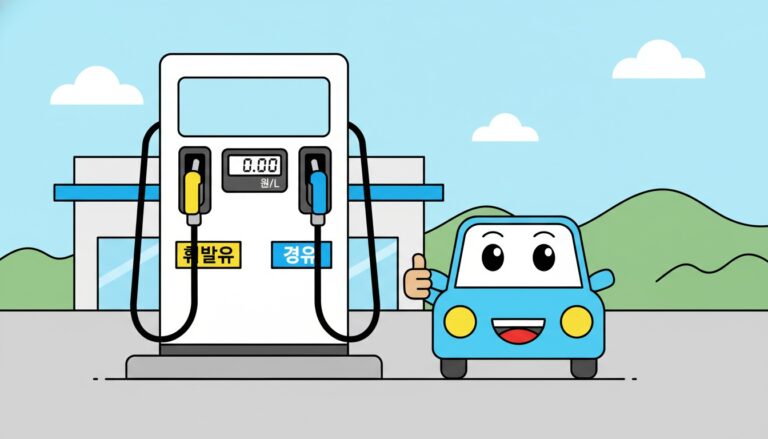
1. The Color Code Rule (Visual Nunchi)
Before you even speak, look at the nozzles.
* Yellow Nozzle: Usually 휘발유 (Gasoline).
* Blue/Green Nozzle: Usually 경유 (Diesel).
* Warning: Always double-check the text written on the pump, but the colors are a huge hint!
2. Full-Service Etiquette
When you enter a full-service station (where staff pump gas for you):
* Turn off your engine. It’s required by law in many cases and is a safety manner.
* Roll down your window as they approach.
* Hand over your credit card right after you say your order. It saves time.
Phase 5: Real-Life Scenario (Roleplay)
Setting: A full-service gas station in Seoul. You are driving a rental sedan.
Characters:
* You (Driver)
* Attendant (Gas Station Staff)
Attendant: (Approaching window) 어서 오세요.
(Welcome.)
You: (Stopping the car and rolling down window) 안녕하세요. 휘발유 가득이요.
(Hello. Gasoline, full please.)
Attendant: 네, 시동 좀 꺼 주세요.
(Okay, please turn off the engine.)
You: (Handing over card) 아, 네. 여기요.
(Ah, yes. Here you go.)
Attendant: 보너스 카드 있으세요?
(Do you have a bonus/points card?)
You: (Shaking head) 아뇨, 없어요.
(No, I don’t.)
Phase 6: 10-Second Shadowing
Let’s practice the most important sentence. Read this aloud three times. Focus on the pause.
“휘발유로 / 가득 / 넣어 주세요.”
- Pronunciation: Hwibalyu-ro / ga-deuk / neo-eo ju-se-yo.
- Meaning: Please fill it up / full / with gasoline.
- Check Point: Emphasize “Hwibalyu” clearly so they don’t grab the diesel hose!
Phase 7: FAQ & Troubleshooting
Q: What if I forget the word for Gasoline or Diesel?
A: Don’t guess! Open your fuel door (cap). In Korea, there is usually a sticker inside the fuel door that says 휘발유 (Yellow) or 경유 (Blue/Green). Just point to that sticker and say “Igeoyo” (This one).
Q: Can I say this to an older attendant?
A: Yes! As long as you end your sentence with “-yo” (e.g., Gadeuk-i-yo), it is polite enough for anyone.
Phase 8: Wrap-up
One-Liner Summary:
To save your rental car’s life, remember: Yellow is Hwibalyu (Gas), Blue is Gyeongyu (Diesel), and Gadeuk (Full) is the magic amount.
Action Mission:
Next time you are in a taxi or a friend’s car in Korea, look at the gas stations you pass. Try to spot the Yellow and Blue nozzles and whisper “Hwibalyu” and “Gyeongyu” to yourself!
Let’s Chat:
Have you ever had a confusing moment at a gas station abroad? Tell me in the comments!
Phase 9: Pop Quiz
1. Which word means “Diesel”?
a) 휘발유 (Hwibalyu)
b) 경유 (Gyeongyu)
c) 우유 (Uyu)
2. What does “Gadeuk” mean?
a) $10 worth
b) Half tank
c) Full tank
3. Usually, what color is the nozzle for Gasoline (Hwibalyu)?
a) Yellow
b) Black
c) Green
(Answers: 1-b, 2-c, 3-a)
Frequently Asked Questions (FAQ)
Q: What does "휘발유 (Hwibalyu)" mean in Korean and how do you pronounce it?
A: In Korean, "휘발유 (Hwibalyu)" is pronounced [Hwi-bal-yoo [Sounds like "Wheel" + "Ball" + "You"] and means: Gasoline (Unleaded / Petrol)
Q: What does "경유 (Gyeongyu)" mean in Korean and how do you pronounce it?
A: In Korean, "경유 (Gyeongyu)" is pronounced [Gyeong-yoo [The "Gyeong" sounds like the ending of "Ping-pong" but with a soft G at the start] and means: Diesel
Q: What does "가득 (Gadeuk)" mean in Korean and how do you pronounce it?
A: In Korean, "가득 (Gadeuk)" is pronounced [Ga-deuk [Sounds like "God" + "Duck" (but softer k] and means: Full / Fill it up







