

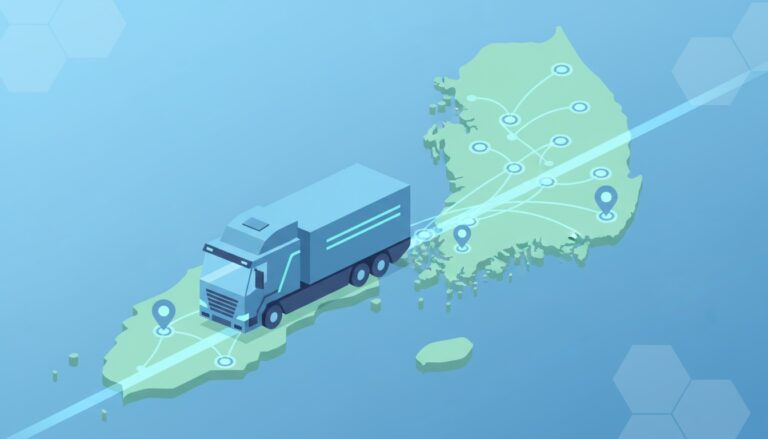
Phase 1: Introduction
Hello! This is your Senior Editor at Daily Hangul.
So, you’ve mastered ordering food and chatting about the weather. But imagine this: You are at a tech conference in Pangyo (Korea’s Silicon Valley) or a business meeting in Yeouido. The topic isn’t K-Pop—it’s Mobility Innovation.
The room is buzzing about Autonomous Trucks and the Unmanned Logistics revolution. Someone turns to you and asks for your opinion on the “regulatory sandbox” regarding truck platooning.
Panic? Not on my watch.
Many advanced learners freeze here. They know the grammar, but they lack the ‘Industry Domain Knowledge’ in Korean. Knowing how to discuss technology and logistics isn’t just about vocabulary; it’s about signaling that you are an intellectual insider.
Today, we are skipping the basics. We are diving into C2-level Business Korean that will make Korean executives nod in respect.
Phase 2: Deep Dive into Core Expressions
Here are the three heavy-hitters you need to survive a discussion on mobility innovation.
1. 상용화 (Commercialization)
- Pronunciation: [Sang-yong-hwa]
- Sound tip: ‘Sang’ sounds like the start of ‘Song’, ‘Yong’ is like ‘Young’ but shorter, ‘Hwa’ is a soft breathy ‘Hwa’.
- Meaning: Putting a technology into actual commercial use.
- Editor’s Insight: This is the golden word in the Korean tech industry. Every startup pitches a prototype, but investors only care about this word. It implies stability, profit, and mass adoption.
- Situation Check: Formal/Business. (You wouldn’t use this when buying groceries.)
2. 군집 주행 (Platooning)
- Pronunciation: [Gun-jip Ju-haeng]
- Sound tip: ‘Gun’ like the weapon, ‘Jip’ like ‘Jeep’, ‘Ju’ like ‘Jewel’, ‘Haeng’ like ‘Hang’.
- Meaning: Literally “Cluster Driving.” It refers to autonomous trucks driving in a tight formation to reduce air resistance and save fuel.
- Editor’s Insight: If you use this word instead of explaining “trucks driving together,” your listener’s eyes will light up. It shows you know the specific technical jargon.
- Situation Check: Technical/Professional.
3. 사각지대 (Blind Spot / Gray Area)
- Pronunciation: [Sa-gak-ji-dae]
- Meaning:
- Literal: The blind spot of a vehicle.
- Metaphorical (C2 Level): A gap in policy, law, or social welfare.
- Editor’s Insight: In the context of autonomous driving, we use this in two ways: the actual sensors’ blind spots, OR the “regulatory blind spots” (laws that haven’t caught up with tech). Using this metaphorically is pure C2 class.
- Situation Check: All situations.
Phase 3: Textbook vs. Real Life Business
In a C2 context, “Real Life” means “Boardroom Realism.” We move away from descriptive sentences to analytical statements.
| Textbook / Standard (A2-B1) | Real Business Korean (C2) |
|---|---|
| 자율주행 트럭이 곧 나올 거예요. (Autonomous trucks will come out soon.) |
본격적인 상용화 단계에 진입했다고 봅니다. (I see it as having entered the full-scale commercialization phase.) |
| 법이 아직 준비 안 됐어요. (The laws aren’t ready yet.) |
현행법상 규제 사각지대가 존재합니다. (There are regulatory blind spots under current laws.) |
| 운전자가 없어서 돈을 아낄 수 있어요. (We can save money because there are no drivers.) |
물류 비용 절감과 운송 효율성이 획기적으로 개선될 것입니다. (Logistics cost reduction and transport efficiency will be drastically improved.) |
Editor’s Note: Notice the use of Hanja (Sino-Korean) words like ‘절감’ (reduction) and ‘효율성’ (efficiency). At the C2 level, these add weight to your arguments.
Phase 4: Cultural Context & Manners
The “Palli-Palli” vs. “Safety” Paradox
In the Korean logistics sector (Saebyeok Baesong – Dawn Delivery), speed is religion. However, when discussing autonomous vehicles, the cultural sentiment shifts to extreme caution regarding safety.
The “Nunchi” (Reading the Room) Tip:
If you are talking to a Tech Developer, emphasize 혁신 (Innovation) and 효율 (Efficiency).
However, if you are talking to a Government Official or General Public, emphasize 안전성 검증 (Safety Verification).
Also, be aware that Unmanned Logistics (무인화) is a sensitive topic regarding jobs (truck drivers’ unions). When discussing this, use the phrase: “일자리 문제와의 사회적 합의가 필요하죠.” (We need social consensus regarding job issues.) This sentence alone makes you sound like a diplomat.
Phase 5: Roleplay Scenario
Setting: A break time at a ‘Smart Logistics Expo’ in Seoul.
Characters:
* Julian (You): A foreign logistics consultant.
* Mr. Kim: A director at a Korean logistics firm.
(Julian nods while looking at a prototype truck)
Julian: 이 모델, 드디어 군집 주행 테스트를 통과했다고 들었습니다.
(I heard this model finally passed the platooning test.)
Mr. Kim: 네, 기술적으로는 완성단계죠. 하지만 상용화까지는 아직 산 넘어 산입니다.
(Yes, technically it’s complete. But commercialization is still a long way off [mountain after mountain].)
Julian: 아무래도 규제 사각지대 때문이겠죠? 사고 책임 소재도 불분명하고요.
(Is it because of the regulatory blind spots? The liability for accidents is also unclear.)
Mr. Kim: (Surprised) 와, 쥴리안 씨. 한국 물류 시장의 핵심 쟁점을 정확히 꿰뚫고 계시네요.
(Wow, Julian. You pierce right through the core issues of the Korean logistics market.)
Julian: (Smiling modestly) 한국 뉴스를 매일 챙겨보니까요. 결국은 안전성 입증이 관건 아니겠습니까?
(I watch Korean news everyday. Ultimately, isn’t proving safety the key factor?)
Phase 6: 10-Second Shadowing
Let’s practice a sentence you can use in a presentation or debate. Pay attention to the pauses / to sound authoritative.
“단순한 기술 도입을 넘어, / 물류 시스템 전반의 / 무인화 혁신이 / 필요한 시점입니다.”
(Beyond simple technology adoption, / it is the time when / unmanned innovation of the entire logistics system / is needed.)
- Focus: Put a strong stress on ‘무인화’ (Unmanned/Automation) to highlight the keyword.
Phase 7: FAQ & Troubleshooting
Q: Can I use English loan words like “Last Mile”?
A: Yes! In the Korean tech and logistics industry, words like 라스트 마일 (Last Mile), 풀필먼트 (Fulfillment), and 인프라 (Infrastructure) are used more often than their pure Korean counterparts. Using them makes you sound like an industry peer.
Q: Is ‘군집 주행’ too difficult for casual conversation?
A: Yes. If you are just talking to a taxi driver, say “자율 주행 (Autonomous driving)”. Keep ‘군집 주행’ for professional contexts or when you want to show off specific knowledge about trucks.
Phase 8: Wrap-up
- One-Liner Summary: To discuss future logistics in Korea, master the trio: 상용화 (Commercialization), 군집 주행 (Platooning), and 규제 사각지대 (Regulatory Blind Spots).
- Action Mission: Next time you see a delivery truck in Korea, imagine explaining its future to a friend using the word ‘무인화’ (Automation/Unmanned). “나중에는 저거 다 무인화될걸?” (Later, that will likely all be automated, right?)
Phase 9: Quiz
1. Which word best describes the “gap” where laws haven’t caught up with technology?
a) 주차장 (Parking Lot)
b) 사각지대 (Blind Spot)
c) 고속도로 (Highway)
2. How do you say “Commercialization” in Korean?
a) 상용화 (Sang-yong-hwa)
b) 일반화 (Il-ban-hwa)
c) 자동화 (Ja-dong-hwa)
3. In a professional setting, instead of saying “trucks driving together,” you should say:
a) 친구 주행 (Friend Driving)
b) 함께 주행 (Together Driving)
c) 군집 주행 (Platooning)
(Answers: 1-b, 2-a, 3-c)
Frequently Asked Questions (FAQ)
Q: What does "'무인화'" mean in Korean and how do you pronounce it?
A: In Korean, "'무인화'" is pronounced [Unmanned/Automation] and means: to highlight the keyword.
Q: What does "풀필먼트" mean in Korean and how do you pronounce it?
A: In Korean, "풀필먼트" is pronounced [Fulfillment] and means: , and
Q: What does "인프라" mean in Korean and how do you pronounce it?
A: In Korean, "인프라" is pronounced [Infrastructure] and means: are used more often than their pure Korean counterparts. Using them makes you sound like an industry peer.
Q: What does "군집 주행" mean in Korean and how do you pronounce it?
A: In Korean, "군집 주행" is pronounced [Platooning] and means: , and







