

Phase 1: Hook & Empathy (Introduction)
Hello! This is your Senior Editor from Daily Hangul.
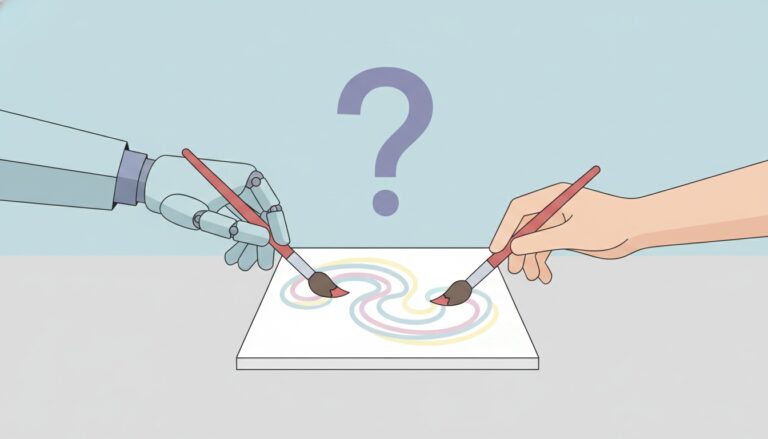
Imagine this: You are at a networking event in Gangnam or a university seminar in Seoul. The topic turns to the hottest tech trend—Generative AI. Everyone is heating up, debating whether an image created by Midjourney belongs to the user or the algorithm. You want to jump in and say, “Well, technically, without human creative intent, copyright can’t be established!”
But instead, you just nod and say, “Ah… yes… AI is smart.” (아… 네… AI 똑똑해요.)
Frustrating, right? As a C1 learner, you have the thoughts, but you might lack the specific legal and ethical vocabulary to hold your ground in an intellectual debate. Today, we are moving beyond survival Korean to “Intellectual Korean.” Let’s learn how to discuss the gray areas of AI copyright like a true modern Seoulite.
Phase 2: Deep Dive (Core Expressions)
Here are the top 3 expressions you need to sound authoritative on this topic.
1. 저작권이 귀속되다 [jeojakgwoni gwisokdoeda]
- Pronunciation: Juh-jak-gwon-ee Gwi-sok-dwe-da
- Meaning: Copyright is attributed to / belongs to (someone).
- Editor’s Insight: You know “It’s mine” (내 거야), but in a legal or formal debate, that sounds childish. 귀속되다 (to be attributed/vested) is the power verb here. It implies a legal shifting of ownership.
- Situation Check: 👔 Formal/Professional. Do not use this when fighting over the last slice of pizza.
2. 법적 회색지대 [beopjeok hoesaekjidae]
- Pronunciation: Bup-juk Hweh-sek-ji-deh
- Meaning: Legal gray area.
- Editor’s Insight: This is a “magic shield” phrase. When you aren’t sure of the answer (because nobody is!), you can drop this phrase to sound insightful. It shows you understand the nuance.
- Situation Check: 👔 Formal & Casual. You can use this with friends when discussing rules that aren’t clear.
3. 창작적 개입 [changjakjeok gaeip]
- Pronunciation: Chang-jak-juk Geh-ip
- Meaning: Creative intervention / Creative input.
- Editor’s Insight: This is the core argument in Korean law right now. Did the human just press a button, or did they intervene creatively? Use this to argue that human effort is necessary.
- Situation Check: 👔 Formal/Academic.
Phase 3: Textbook vs. Real Life
Textbooks teach you to be correct. We teach you to be convincing.
| Textbook (Correct but dry) | Real Korean (Natural & Smart) |
|---|---|
| 이 그림의 주인은 누구입니까? (Who is the owner of this picture?) |
이거 저작권 소유가 애매하지 않나요? (Isn’t the copyright ownership regarding this a bit ambiguous?) |
| 법이 아직 없습니다. (There is no law yet.) |
아직 법적 가이드라인이 마련되지 않았어요. (Legal guidelines haven’t been established yet.) |
| 사람이 만들지 않았습니다. (A person did not make it.) |
인간의 창작적 기여가 결여되어 있죠. (It lacks human creative contribution.) |
Bottom Note: Notice the use of words like 애매하다 (ambiguous) and 결여되다 (to lack/be absent). These are hallmarks of C1 proficiency.
Phase 4: Cultural Context (The “Jeong” of Art)
In Korea, there is a strong cultural attachment to 손맛 (Son-mat)—literally “hand taste,” meaning the unique flavor or quality that comes from human hands/effort. While Korea is a tech giant, there is a deep philosophical resistance to “soulless” automated creations.
When debating AI ethics in Korea, acknowledging 성의 (Seong-ui – sincerity/effort) is crucial. If you argue that AI art is equal to human art without mentioning the lack of effort (effortless production), you might be seen as ignoring the human spirit (혼). A great phrase to acknowledge this sentiment is:
- “기술은 놀랍지만, 역시 사람의 온기가 없네요.”
(The technology is amazing, but as expected, it lacks human warmth.)
Phase 5: Roleplay Script (The Office Debate)
Setting: A marketing team meeting discussing a new logo generated by AI.
Characters:
* Min-ji (You): Foreign marketing manager (C1 level).
* Team Leader Kim: Korean boss, pragmatic but cautious.
Team Leader Kim: 이번 로고 시안, AI로 10분 만에 뽑았다면서요? 퀄리티는 좋네요.
(I heard this logo draft was pulled from AI in 10 minutes? The quality is good, though.)
Min-ji (You): 네, 하지만 상업적으로 쓰려면 조심해야 합니다. 저작권이 누구에게 귀속되는지 명확하지 않거든요.
(Yes, but we must be careful using it commercially. It’s unclear to whom the copyright is attributed.)
Team Leader Kim: 에이, 우리가 프롬프트 입력했으니까 우리 거 아니에요?
(Ey, we entered the prompt, so isn’t it ours?)
Min-ji (You): (Shaking head slightly) 현행법상 인간의 창작적 개입이 없으면 보호받기 어려워요. 나중에 표절 시비 걸릴 수도 있고요.
(Under current laws, it’s hard to get protection without human creative intervention. We could get caught in a plagiarism dispute later.)
Team Leader Kim: 흠… 듣고 보니 법적 회색지대가 너무 많네요. 디자이너랑 다시 상의합시다.
(Hmm… hearing that, there are too many legal gray areas. Let’s consult the designer again.)
Phase 6: 10-Second Shadowing
Read this aloud to practice your professional intonation. Focus on the pauses / to sound authoritative.
“단순한 명령어 입력만으로는 / 저작권을 인정받기 어려운 게 / 현재의 법적 현실입니다.”
- Pronunciation: Dan-sun-han myeong-ryeong-eo im-nyeok-ma-neu-ro-neun / juh-jak-gwon-eul in-jeong-bat-gi eo-ryeo-un ge / hyeon-jae-ui beop-jeok hyeon-sil-im-ni-da.
- Translation: “The current legal reality is that / it is difficult to have copyright recognized / merely through simple command input.”
Phase 7: FAQ & Troubleshooting
Q: Can I use the word “베끼다 (to copy/cheat)” in a meeting?
A: I wouldn’t recommend it for C1 level in a formal setting. “베끼다” sounds like you cheated on homework. Instead, use 모방하다 (to imitate) or 표절하다 (to plagiarize). It sounds much more objective and professional.
Q: Is it rude to debate the boss about this?
A: Not if you frame it as “protecting the company.” If you say “You are wrong,” it’s rude. If you say “There is a legal risk regarding copyright attribution (저작권 귀속),” you are a capable employee.
Phase 8: Wrap-up
- One-Liner: When discussing AI, move beyond “good/bad” and use specific terms like 귀속 (attribution) and 개입 (intervention).
- Action Mission: Next time you see an AI image on Instagram, comment in Korean: “이건 저작권 문제가 좀 복잡하겠네요.” (The copyright issue on this looks a bit complicated.)
Phase 9: Quiz
1. Which word best fills the blank? “AI 창작물은 현행법상 ______에 놓여 있다.” (AI creations are currently placed in a ______.)
a) 안전지대 (Safety zone)
b) 회색지대 (Gray area)
c) 어린이 보호구역 (School zone)
2. How do you say “Copyright belongs to the creator” formally?
a) 저작권은 만든 사람 거야. (Copyright is the maker’s.)
b) 저작권은 창작자에게 귀속됩니다. (Copyright is attributed to the creator.)
c) 저작권을 창작자에게 줍니다. (Give copyright to the creator.)
3. Which word means “Creative Intervention”?
a) 창작적 개입
b) 기술적 문제
c) 법적 책임
(Answers: 1-b, 2-b, 3-a)
Frequently Asked Questions (FAQ)
Q: What does "저작권이 귀속되다 [jeojakgwoni gwisokdoeda]" mean in Korean and how do you pronounce it?
A: In Korean, "저작권이 귀속되다 [jeojakgwoni gwisokdoeda]" is pronounced [Juh-jak-gwon-ee Gwi-sok-dwe-da] and means: Copyright is attributed to / belongs to (someone).
Q: What does "법적 회색지대 [beopjeok hoesaekjidae]" mean in Korean and how do you pronounce it?
A: In Korean, "법적 회색지대 [beopjeok hoesaekjidae]" is pronounced [Bup-juk Hweh-sek-ji-deh] and means: Legal gray area.
Q: What does "창작적 개입 [changjakjeok gaeip]" mean in Korean and how do you pronounce it?
A: In Korean, "창작적 개입 [changjakjeok gaeip]" is pronounced [Chang-jak-juk Geh-ip] and means: Creative intervention / Creative input.







