

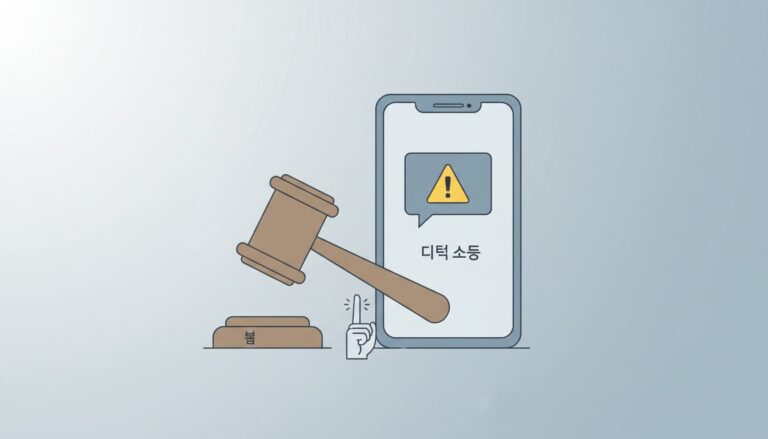
Phase 1: Hook & Empathy (Introduction)
Hello! This is your Senior Editor from Daily Hangul.
Imagine this: You had a terrible experience at a restaurant in Seoul. Out of frustration, you post a review on a popular community app saying, “The owner, Mr. Kim, recycles leftover side dishes! He is a scammer!” You feel righteous because, well, you actually saw him do it.
A week later, you receive a police notification. You’re being sued for Defamation (명예훼손).
“Wait, but it’s true!” you scream. In many Western countries, truth is an absolute defense. In Korea? Not always.
Welcome to the deep end of the pool, Level C2 learners. Today, we aren’t just learning words; we are navigating the legal minefield of Insult (모욕) versus Defamation (명예훼손). Understanding this distinction isn’t just about fluency—it’s about survival in Korea’s highly connected, reputation-sensitive society. This lesson comes straight from frantic questions I’ve received from advanced learners who almost got into legal trouble.
Let’s keep your record clean and your Korean sharp.
Phase 2: Deep Dive into Core Expressions
These are legal terms, but you will hear them on the news, in dramas, and even in serious arguments.
1. 모욕죄 [Moyok-jjoe]
- Pronunciation: Mo-yok-jjoe (The ‘jjoe’ sounds sharp and tight, like the ‘zz’ in pizza but with a ‘j’ sound.)
- Meaning: Crime of Insult / Contempt
- Editor’s Insight: This applies when you express an abstract negative judgment or emotion without stating specific facts. Calling someone “stupid,” “a dog,” or “trash” in public falls here. It attacks a person’s social standing through abstraction.
- Situation Check: Used in legal contexts, news, or when threatening legal action. (Formal)
2. 명예훼손죄 [Myeong-ye-hweson-jjoe]
- Pronunciation: Myeong-ye-hwe-son-jjoe (‘Myeong-ye’ implies honor/reputation. ‘Hweson’ means damage.)
- Meaning: Crime of Defamation
- Editor’s Insight: This is the big gun. It requires Specific Fact Revelation (사실 적시). Even if the fact is true, if your intent is solely to damage someone’s reputation publicly (and not for the public good), you can be punished. There is Truth Defamation (사실 적시 명예훼손) and False Fact Defamation (허위 사실 적시 명예훼손).
- Situation Check: Highly formal and serious.
3. 공연성 [Gong-yeon-seong]
- Pronunciation: Gong-yeon-seong (‘Gong’ sounds like ‘gong’, ‘yeon’ like ‘yawn’ with a smile.)
- Meaning: Publicity / Public Nature
- Editor’s Insight: This is the critical condition for both crimes above. Does the situation allow the insult/defamation to spread to unspecified people? If you curse at someone in a 1:1 DM, there is no Gong-yeon-seong. If you do it in a group chat with 3 people? That counts.
- Situation Check: Legal analysis and arguments.
Phase 3: Textbook vs. Real Life (Textbook vs. Real Life)
At the C2 level, you need to know how lawyers speak versus how angry netizens speak.
| Textbook / Legal Term (Formal) | Real Life / Netizen Slang (Natural) |
|---|---|
| 고소장을 접수하다 (To file a complaint) | 고소미 먹이다 (Slang: To feed someone a ‘Gosomi’ cracker = To sue them) |
| 명예훼손으로 처벌받을 수 있습니다. (You can be punished for defamation.) | 그러다 인실좆 된다. (Vulgar slang: You’ll learn ‘Real Life is F***ed’ = You’ll face harsh reality/consequences.) |
| 합의를 요청하다 (To request a settlement) | 합의금 뜯어내다 (To rip off/extract settlement money – cynical nuance) |
- Editor’s Note: Use the Right Column very carefully. “고소미” is witty, but “인실좆” is internet slang that is quite aggressive. Know it to understand comments, but stick to the Left Column in speech.
Phase 4: Cultural Context (Manners & Nunchi)
The “Fact” Trap
In many cultures, “I just told the truth” is a shield. In Korea, the concept of Chemyon (체면 – Face/Reputation) is protected by law. The law prioritizes protecting an individual’s social evaluation over the freedom of speech in private matters.
Nunchi Tip:
If you have a grievance with a business or a person:
1. Do not name them specifically in a public post if you want to be 100% safe.
2. Use expressions like “A certain person (모 씨)” or “A specific company (모 업체)” to avoid Specific Identity (특정성), though netizens are good at digging this up.
3. Never insult someone in a group chat (KakaoTalk). The screenshot is the evidence of Publicity (공연성).
Phase 5: Real Scenario Roleplay
Setting: A cafe. Min-ji is warning her foreign friend, Mark, who is angrily typing a comment on Instagram.
(Mark is typing furiously on his phone)
- Mark: 이 식당 주인이 나한테 욕했어. 내 인스타에 다 올릴 거야. 이 사람은 쓰레기라고!
(The owner swore at me. I’m posting this on Insta. This guy is trash!) -
Min-ji: (Grabing his phone) 야, 잠깐만! 그러다 모욕죄로 고소당해. 진정해.
(Hey, wait! You’ll get sued for Insult. Calm down.) -
Mark: 사실인데 왜? 그리고 내가 욕한 것도 아니고, 그 사람이 나쁜 사람이라고 하는 건데.
(It’s the truth, so why? I’m not cursing, I’m just saying he’s a bad person.) -
Min-ji: ‘쓰레기’라는 표현은 추상적이라서 모욕죄 성립이 돼. 게다가 인스타는 공연성이 너무 확실하잖아.
(The word ‘trash’ is abstract, so it constitutes Insult. Plus, Instagram has undeniable ‘publicity’.) -
Mark: 와… 한국 법 진짜 까다롭네. 그럼 구체적으로 무슨 짓을 했는지 쓰면?
(Wow… Korean law is really tricky. Then what if I write exactly what he did?) -
Min-ji: 그럼 사실 적시 명예훼손이 될 수도 있어. 그냥 리뷰는 비공개로 하거나, 감정 빼고 서비스 내용만 써.
(Then it could become ‘Defamation by Stating Facts.’ Just make the review private, or write only about the service without emotion.)
Phase 6: 10-Second Shadowing Drill
Let’s practice a sophisticated sentence you can use to warn a friend. Focus on the pauses / to sound authoritative.
“공공의 이익을 위한 게 아니라면, / 사실을 말해도 / 명예훼손으로 처벌받을 수 있어요.”
[Gong-gong-ui i-ig-eul wi-han ge a-ni-ra-myeon, / sa-sil-eul mal-hae-do / myeong-ye-hwe-son-eu-ro cheo-beol-ba-deul su i-sseo-yo.]
(If it’s not for the public good, / even if you state facts, / you can be punished for defamation.)
Phase 7: FAQ & Troubleshooting
Q: Can I shout at someone in a private room with no one else around?
A: Legally? Likely No Insult (모욕죄 성립 안 함) because there is no Publicity (공연성). No one else heard it to spread the rumor. However, recording it might be evidence for other civil issues, so just don’t do it!
Q: What if I write a review for the “Public Good”?
A: This is the main defense against Defamation. If you write a review purely to prevent others from suffering the same harm (public interest), illegality can be exempted (위법성 조각). But proving your sole intent was public good, not revenge, is difficult. Keep wording neutral.
Phase 8: Wrap-up & Action Item
- One-Liner: In Korea, “Truth” is not a free pass to ruin a reputation; mind the Publicity (공연성) and avoid personal attacks.
- Mission: Next time you see a controversial celebrity news article, look at the comments. Can you spot which ones are risking a Moyok-jjoe lawsuit? (Don’t leave a comment, just observe!)
- Engagement: Have you ever felt frustrated because you couldn’t complain publicly in Korea? Tell me your story in the comments (safely)!
Phase 9: Pop Quiz
1. Which element is NOT required for Defamation (명예훼손)?
A) Publicity (공연성)
B) Specific Identification (특정성)
C) Falsehood (Only lies constitute defamation)
D) Fact Revelation (사실 적시)
2. Which phrase is an example of Insult (모욕) rather than Defamation?
A) “He stole 1 million won from the company funds.”
B) “He is a pathetic loser.”
C) “He had an affair with Ms. Kim.”
D) “He falsified his academic records.”
3. What is the slang term for “getting sued”?
A) 김치 먹다 (Eating Kimchi)
B) 고소미 먹다 (Eating Gosomi)
C) 물 먹다 (Eating Water)
D) 엿 먹다 (Eating Taffy)
(Answers: 1. C | 2. B | 3. B)
Frequently Asked Questions (FAQ)
Q: What does "모욕죄 [Moyok-jjoe]" mean in Korean and how do you pronounce it?
A: In Korean, "모욕죄 [Moyok-jjoe]" is pronounced [Mo-yok-jjoe (The 'jjoe' sounds sharp and tight, like the 'zz' in pizza but with a 'j' sound.] and means: Crime of Insult / Contempt
Q: What does "명예훼손죄 [Myeong-ye-hweson-jjoe]" mean in Korean and how do you pronounce it?
A: In Korean, "명예훼손죄 [Myeong-ye-hweson-jjoe]" is pronounced [Myeong-ye-hwe-son-jjoe ('Myeong-ye' implies honor/reputation. 'Hweson' means damage.] and means: Crime of Defamation
Q: What does "공연성 [Gong-yeon-seong]" mean in Korean and how do you pronounce it?
A: In Korean, "공연성 [Gong-yeon-seong]" is pronounced [Gong-yeon-seong ('Gong' sounds like 'gong', 'yeon' like 'yawn' with a smile.] and means: Publicity / Public Nature







