

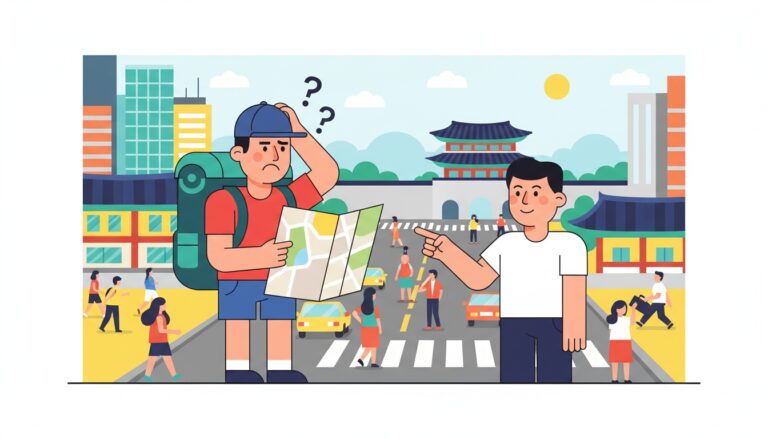
✨ Hello! I’m Your Daily Hangul Editor.
Have you ever stood in the middle of a busy street in Hongdae or Gangnam, staring at your phone, spinning in circles because the map app says you’ve arrived, but you see absolutely nothing? ᄀ_ᄀ
It happens to the best of us! In Korea, buildings are often hidden behind other buildings, or entrances are tucked away in alleys. Relying solely on maps can be tricky.
Today, we are going to fix that. As your veteran tutor, I’m not just teaching you textbook grammar. I’m giving you the confidence to stop a stranger and ask, “Where on earth is this place?” without sounding rude or like a robot.
(Note: This guide is crafted based on real questions from our A2 level students who got tired of being lost!)
⚓ Phase 1: The Essentials (Deep Dive)
Here are the top 3 phrases you need. Forget complex grammar for a second; just master the rhythm of these sentences.
1. [Place] is where? (Most Basic)
[Place] 거디뼤요?
([Place] eodi-yeyo?)
- Pronunciation: Uh-dee-yeah-yo? (Think of ‘Uh’ as in the sound you make when thinking, and ‘dee’ like the letter ‘D’.)
- Meaning: Where is [Place]?
- Editor’s Insight: This is your bread and butter. It’s polite enough for strangers but simple enough to not mess up. Make sure to raise your tone at the end!
- Situation: ✅ Casual / ✅ Polite to strangers
2. Is [Place] near here? (Contextual)
이 근처에 [Place] 이써요?
(I geun-cheo-e [Place] isseo-yo?)
- Pronunciation: Ee geun-chuh-eh [Place] is-saw-yo?
- Meaning: Is there a [Place] around here?
- Editor’s Insight: Use this when you aren’t looking for a specific branch, but just any convenience store or subway station nearby.
- Situation: ✅ Asking for general amenities (ATM, Toilet, Cafe)
3. Asking specifically using “Hoksi” (The Magic Word)
혹시… [Place] 아세요?
(Hok-si… [Place] a-se-yo?)
- Pronunciation: Hoke-shi… [Place] ah-say-yo?
- Meaning: By any chance… do you know [Place]?
- Editor’s Insight: ‘Hoksi’ is the magic word in Korean. It means “by chance” or “perhaps.” It instantly lowers your aggressiveness and makes you sound incredibly polite and local.
- Situation: ✅ When asking someone who looks busy.
페 Textbook vs. Real Life 실전
Textbooks often teach you formal, rigid sentences. Let’s see how real Koreans actually speak on the street.
| Textbook Style (A bit robotic) 로보ᅣ | Real Life (Natural & Friendly) 자연스러왜 | Notes |
|---|---|---|
| [Place]이 거디에 이ᄄ습니가? (Where does the place exist?) |
저기요, [Place] 거디예요? (Excuse me, where’s [Place]?) |
Nobody uses ‘iss-seub-ni-kka’ on the street unless you are in the army! |
| [Place]로 가고 시ᄑ습니다. (I want to go to [Place].) |
[Place] 가는 길 아세요? (Do you know the way to [Place]?) |
Using “I want to go” sounds like a wish, not a question. |
예 Cultural Tip: The Art of “Jeogiyo”
In Western cultures, you might say “Excuse me” while tapping someone on the shoulder. ⚠️ Do not do this in Korea!
Touching a stranger is considered rude or startling. Instead:
1. Approach them slightly from the side (not directly in their face).
2. Bow your head slightly.
3. Say “저기요” (Jeogiyo) clearly but softly.
This simple word alerts them that you have a question. Wait for eye contact before asking your question!
시ᄄ나리오 Real-Life Scenario
Setting: You are looking for the “Daily Hangul” office, but you are lost.
Characters: Alex (You), Local (Korean passerby)
Alex: (Approaches hesitatingly) 저기요… 혹시 길 좁 무러봐도 ᄃᄐ가요?
(Jeogiyo… hoksi gil jom mureobwado doelkkayo?)
[Excuse me… may I ask for directions by any chance?]
Local: (Stops walking) 네, 어디 가세요?
(Ne, eodi gaseyo?)
[Yes, where are you going?]
Alex: ‘Daily Hangul’ 저기 거디예요?
(Daily Hangul office eodi-yeyo?)
[Where is the ‘Daily Hangul’ office?]
Local: (Points finger) 저기 흰단보도 거너서 오른로가세요.
(Jeogi hoengdanbodo geonneoseo oreunjjogeuro gaseyo.)
[Cross that crosswalk over there and go right.]
Alex: 감사하ᄅ니다!
(Gamsahamnida!)
[Thank you!]
타라하기 10-Second Shadowing
Don’t just read it, say it! Focus on the pause / and the rising intonation ⤴.
“Excuse me, where is the subway station?”
저기요 / 지하철역 / 어디예요⤴?
(Jeogiyo / Jihacheol-yeok / eodi-yeyo?)
Tip: Say “Jeogiyo” softly, and punch the “Eodi” slightly stronger. ᄑ
❓ FAQ: Troubleshooting
- Q: Can I just point at a map and say “Eodi?” (Where?)
- A: No! 메. Just saying “Eodi?” is casual speech (Banmal) and sounds very rude to strangers. Always add “예요” (yeyo) at the end.
- Q: People ignore me when I ask. Why?
- A: You might be too quiet, or you look like a salesperson. Try making eye contact first and start with a confident “Jeogiyo!” or “Sillye-hamnida” (Excuse me).
마무리 Wrap-up
One-Liner Summary: To ask for a location, remember the formula: “Excuse me (Jeogiyo) + [Place] + Where is it? (Eodi-yeyo?)”
미션 Your Mission: Next time you are out, ask a store clerk where the restroom is using: “화잔실(Restroom) 어디예요?” even if you already know! Practice makes perfect.
Have you ever gotten lost in Korea? Tell me your story in the comments below! ᄇ
튀즈 Pop Quiz!
1. Which is the most polite “magic word” to start your question with?
a) Ya! (야!)
b) Hoksi… (혹시…)
c) Eodi… (어디…)
2. How do you say “Where is the Starbucks?”
a) Starbucks eodi-yeyo?
b) Starbucks isseo-yo?
c) Starbucks eodi-ga?
3. True or False: You should tap someone on the shoulder to get their attention.
(True / False)
(Scroll down for answers)
⬇️ Click for Answers
- b) Hoksi…
- a) Starbucks eodi-yeyo?
- False (Use your words, not your hands!)






