

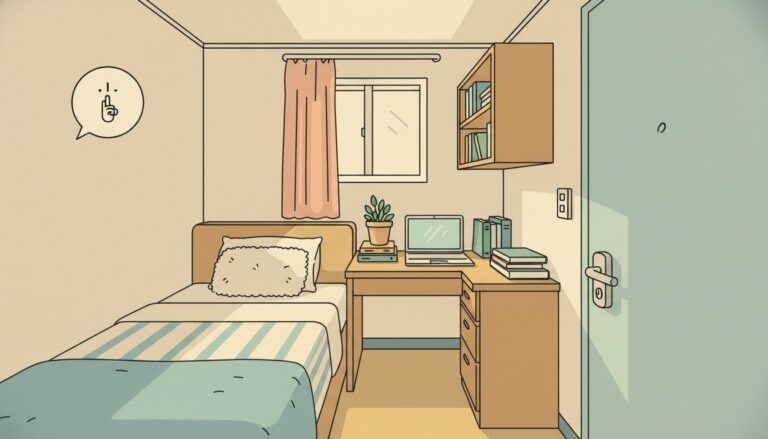
Welcome to the “Shoebox” Life! 🏠
Hello! This is your Senior Editor at Daily Hangul. 👋
So, you’ve decided to experience the quintessential Korean rite of passage: living in a Goshiwon (고시원). It’s affordable, convenient, and yes… incredibly small. Imagine a room just big enough for a bed and a desk, where you can touch both walls if you stretch your arms.
Here is the scenario: You are lying in your bed, and you can hear your neighbor slurping noodles. Or maybe you want to find the free rice that was promised in the brochure, but the kitchen is empty.
If you don’t know the right phrases, you might suffer in silence (literally) or miss out on free meals. But knowing how to communicate here will not only make your life comfortable, it will earn you the respect of the Chongmu-nim (Manager).
Let’s dive into the real Korean used in these tiny living spaces. This guide is based on stories from students who actually survived (and enjoyed!) their Goshiwon days.
Phase 2: Deep Dive (Core Expressions)
Here are the top 3 phrases you need to survive the shared life.
1. 방음이 잘 안 돼요.
- Pronunciation: [Bang-eum-i jal an-dwae-yo]
- Sound Analogy: Bang (like a gun) + eum (like ‘um’ in umbrella).
- Meaning: “The soundproofing isn’t good.”
- Editor’s Insight: This is B1 level gold. Instead of angrily saying “You are noisy!” (too direct), we blame the building. It’s a polite, indirect way to complain or explain why you are whispering.
- Situation Check: Use this with the manager to complain, or with neighbors to apologize.
2. 밥/라면 제공되나요?
- Pronunciation: [Bap / Ra-myeon je-gong-doe-na-yo?]
- Meaning: “Is rice/ramyeon provided?”
- Editor’s Insight: The verb 제공하다 (to provide) sounds a bit formal, but it is standard when asking about services included in your rent. Many Goshiwons offer free rice, kimchi, and instant noodles. Don’t be shy—this is your right!
- Situation Check: Use this when asking the manager or reading the rules.
3. 총무님
- Pronunciation: [Chong-mu-nim]
- Meaning: Manager / Admin Staff
- Editor’s Insight: In a Goshiwon, the person at the front desk is rarely the “owner” (Sajangnim). They are usually a Chongmu, often a student working part-time for free rent. Calling them “Chongmu-nim” instead of “Jeogiyo” (Excuse me) makes you sound like a true insider.
Phase 3: Textbook vs. Real Life
Textbooks teach you to be robotic. Real life requires sense.
| Textbook Korean 📘 | Real “Goshiwon” Korean 🗣️ | Note |
|---|---|---|
| 옆 방 사람이 시끄러워요. (The person next door is noisy.) | 옆 방 소리가 너무 크게 들려요. (I can hear the next room too loudly.) | Blaming the sound is softer than blaming the person. |
| 규칙이 무엇입니까? (What are the rules?) | 여기 지켜야 할 거 있나요? (Is there anything I need to follow here?) | Much more natural for casual inquiries. |
| 밥이 없습니다. (There is no rice.) | 밥이 다 떨어졌어요. (The rice has all run out/fallen out.) | 떨어지다 is the perfect B1 verb for “out of stock.” |
Phase 4: Cultural Context (Nunchi & Manners)
Living in 3 square meters requires high-level Nunchi (Eye-measure/Sense).
- The “Slipper” Rule: Never walk around the hallway with bare feet making “thud thud” sounds. Wear soft slippers. If you stomp, you become the enemy of the floor.
- The Kitchen Whisperer: The kitchen is a shared zone. If you encounter someone eating alone, a slight bow (nod) is enough. Do not try to start a loud conversation; most people in Goshiwons value privacy and quiet.
- Phone Calls: Never take calls in the hallway. The walls are paper. Go to the rooftop (옥상) or outside.
Phase 5: Real-Life Roleplay
Setting: The communal kitchen. The rice cooker is empty. Alex asks the Manager for help.
Characters:
* Alex: B1 Level Student.
* Chongmu-nim: Tired but helpful manager.
Alex: (Opening the rice cooker cautiously)
저기요, 총무님! 여기 밥이 다 떨어졌는데요…
(Jeogiyo, Chongmu-nim! Yeogi babi da tteoreojyeonneundeyo…)
Excuse me, Manager! The rice has run out here…
Manager: (Looking up from phone)
아, 그래요? 제가 금방 해 놓을게요. 30분 뒤에 오세요.
(Ah, geuraeyo? Jega geumbang hae noeulgeyo. 30-bun dwi-e oseyo.)
Ah, really? I’ll make some right away. Come back in 30 minutes.
Alex: (Feeling relieved)
감사합니다. 아, 그리고 제 방 방음이 잘 안 돼서요… 옆 방 통화 소리가 다 들려요.
(Gamsahamnida. Ah, geurigo je bang bang-eumi jal an-dwaeseoyo… yeop bang tonghwa soriga da deullyeoyo.)
Thank you. Ah, and the soundproofing in my room isn’t great… I can hear the phone call from the next room.
Manager:
주의하라고 문자 보낼게요.
(Ju-ui-ha-rago munja bonaelgeyo.)
I will send a text telling them to be careful.
Phase 6: 10-Second Shadowing Drill
Practice this sentence to complain politely without fighting. Focus on the pause!
“죄송한데 / 방음이 잘 안 돼서 / 조금만 조용히 해 주시겠어요?”
(Joe-song-han-de / bang-eum-i jal an-dwae-seo / jo-geum-man jo-yong-hi hae ju-si-ge-sseo-yo?)
“I’m sorry, but since the soundproofing isn’t good, could you please be a little quieter?”
Phase 7: FAQ & Troubleshooting
Q: Can I invite my friend to sleep over in my Goshiwon room?
A: No. 99% of Goshiwons strictly forbid overnight guests due to the noise and cramped space. If you do this, you might get kicked out (퇴실). Always ask the Chongmu-nim first if a brief visit is okay.
Q: Is it rude to complain about noise?
A: Not if you use the “Soundproofing” excuse we learned! If you say “You are loud,” it’s aggressive. If you say “The walls are thin,” it’s a shared problem.
Phase 8: Wrap-up
Summary: Use “총무님” to address the staff, blame the “방음” (soundproofing) when complaining about noise, and use “떨어졌다” when the free rice is gone.
Action Mission: Next time you pass the Goshiwon office, try greeting the manager with a cheerful “안녕하세요, 총무님!” instead of just nodding.
Question: Have you ever lived in a room smaller than a car? Tell me your story in the comments!
Phase 9: Pop Quiz 📝
1. Who is the best person to talk to for daily issues in a Goshiwon?
A) Sajangnim (Owner)
B) Chongmu-nim (Manager)
C) Ajumma (Auntie)
2. How do you politely say “The rice is gone”?
A) 밥이 죽었어요. (The rice is dead.)
B) 밥이 없어요. (There is no rice – a bit direct.)
C) 밥이 다 떨어졌어요. (The rice has run out.)
3. Which excuse is best for a noise complaint?
A) Your voice is ugly.
B) I hate K-Pop.
C) The soundproofing (방음) isn’t good.
(Answers: 1. B, 2. C, 3. C)
Frequently Asked Questions (FAQ)
Q: What does "제공하다" mean in Korean and how do you pronounce it?
A: In Korean, "제공하다" is pronounced [to provide] and means: sounds a bit formal, but it is standard when asking about services included in your rent. Many Goshiwons offer free rice, kimchi, and instant noodles. Don't be shy—this is your right!
Q: What does ""방음"" mean in Korean and how do you pronounce it?
A: In Korean, ""방음"" is pronounced [soundproofing] and means: when complaining about noise, and use







