

Phase 1: Hook & Empathy (Introduction)
Hello! This is your Senior Editor at Daily Hangul.
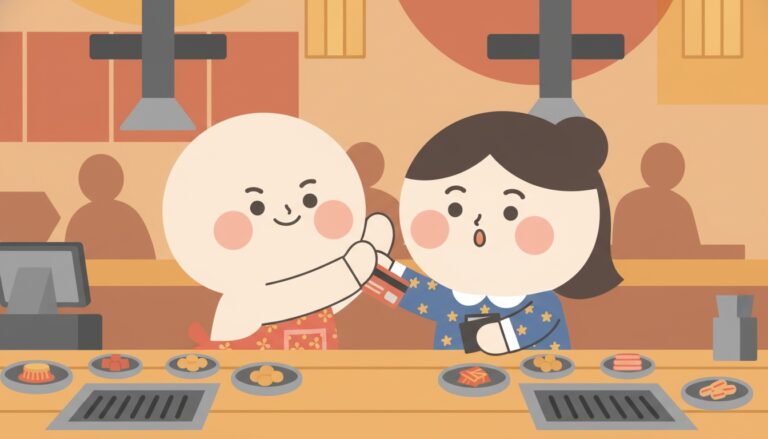
Picture this: You’ve just finished a delicious meal of Samgyeopsal (pork belly) with your new Korean friend. You wipe your mouth, happy and full. Then, the bill arrives. Suddenly, the atmosphere changes. Your friend dives for the bill like a goalkeeper saving a penalty kick.
“No, no! I pay!” they shout.
You freeze. Should you let them? Should you fight back? In Korea, paying the bill is often a sport—a way to show affection. If you just sit there and say “Okay, thanks,” you might accidentally look a bit cold.
Today, I’m going to arm you with the ultimate weapon to win this battle: How to say “I’ll pay” naturally. Whether you want to treat a friend or impress a colleague, these phrases will make you look like a total insider.
(Note: This guide is based on real questions from students who felt awkward standing by the register while their Korean friends paid for everything!)
Phase 2: Deep Dive (Core Expressions)
Here are the three most important ways to take the lead at the register.
1. 제가 낼게요 (Jega nael-ge-yo)
- Pronunciation: [Je-ga nael-ge-yo]
- Je sounds like the ‘Je’ in Jelly.
- ga sounds like ‘ga’ in Garden.
- nael sounds like Nail.
- Meaning: “I will pay.” (Polite/Formal)
- Editor’s Insight: This is your safety net. It uses polite language (Honorifics). You can use this with coworkers, older friends, or people you aren’t super close with yet. It sounds responsible and classy.
- Situation Check: ✅ Older people ✅ Coworkers ✅ Strangers
2. 내가 낼게 (Naega nael-ge)
- Pronunciation: [Nae-ga nael-ge]
- Nae sounds like the start of Never.
- Meaning: “I’ll pay.” (Casual)
- Editor’s Insight: Drop the ‘yo’ and change ‘Je’ to ‘Nae’, and you’re in the Casual Zone. Use this only with close friends or people younger than you. It sounds cool and confident.
- Situation Check: ✅ Close Friends ❌ Boss ❌ Elders
3. 내가 살게 (Naega sal-ge)
- Pronunciation: [Nae-ga sal-ge]
- Meaning: “I’ll buy.” (Casual)
- Editor’s Insight: “Nael-ge” focuses on the act of paying the money. “Sal-ge” focuses on the act of buying the meal for you. It sounds slightly more generous, like “It’s my treat!”
- Situation Check: ✅ Close Friends ❌ Boss
Phase 3: Textbook vs. Real Life
Textbooks often teach you to be robotic. Real life is different. Let’s compare.
| Textbook Korean (Robot Mode 🤖) | Real Korean (Insider Mode 😎) |
|---|---|
| 계산서를 주시겠습니까? (May I have the bill?) |
사장님, 계산이요! (Boss, check please!) |
| 제가 돈을 지불하겠습니다. (I will effectuate the payment.) |
오늘은 내가 쏜다! (Today, I shoot! = It’s on me!) |
| 더치페이 합시다. (Let’s do Dutch pay.) |
반반? (Half-half?) |
- Note: “쏜다 (Ssonda)” literally means “to shoot (a gun/arrow).” In slang, it means you are shooting (paying for) the bill. It’s a fun A1+ expression to know!
Phase 4: Cultural Context (The Art of Nunchi)
In Korea, paying is rarely a simple transaction. It involves Nunchi (eye-measure/sense).
1. The “Bill War” is Fake Wrestling:
If a Korean friend fights to pay, they aren’t actually mad if you pay. They are showing politeness. If you insist 2-3 times and then finally “win” and pay, they will feel cared for.
2. Don’t block the register:
When you say “Jega nael-ge-yo,” try to physically position your body near the cashier or hand your card over quickly. Words are good, but speed is better!
3. The “Next Round” Rule:
If your friend absolutely refuses to let you pay, don’t fight forever. Accept it gracefully and say: “그럼 2차는 내가 낼게!” (Then I’ll pay for the 2nd round/coffee!). This is the perfect compromise.
Phase 5: Roleplay Script
Setting: A BBQ restaurant in Seoul. You and your Korean friend (Min-su) are walking to the counter.
Min-su: (Reaching for his wallet) 아, 잘 먹었다. 내가 낼게.
(Ah, jal meogeot-da. Naega nael-ge.)
“Ah, that was good. I’ll pay.”
You: (Blocking his hand gently) 아니야, 오늘은 내가 낼게.
(Aniya, oneul-eun naega nael-ge.)
“No, today I’ll pay.”
Min-su: 에이, 괜찮아. 내가 사주고 싶어서 그래.
(Ei, gwaenchana. Naega sa-jugo sipeoseo geurae.)
“Hey, it’s okay. I want to buy this for you.”
You: (Smiling and handing card to owner) 그럼 커피는 네가 사.
(Geureom keopi-neun nega sa.)
“Then you buy the coffee.”
Phase 6: 10-Second Shadowing
Let’s practice the polite version. Read this aloud three times. Imagine you are holding your credit card.
“Deliciously / I ate. / I will pay.”
잘 먹었습니다. / 제가 / 낼게요!
[Jal meo-geot-sseum-ni-da. / Je-ga / nael-ge-yo!]
- Intonation Tip: Put a slight stress on Je (I) to emphasize that you are the one doing it.
Phase 7: FAQ (Troubleshooting)
- Q: Can I just ask to split the bill?
- A: Yes! The word is “N-bbang (N-빵)” (Slang) or “Douch-pay (더치페이)”. However, among close friends, it’s more common for one person to pay for dinner and the other to pay for coffee/dessert.
- Q: Is it rude to pay for someone much older than me?
- A: Not rude, but it can be awkward. In Korea, the older person (or the boss) usually pays. If you want to pay, say: “제가 대접하고 싶어요” (I want to treat/serve you). It sounds very respectful.
Phase 8: Wrap-up & Action Item
Summary:
* Polite: 제가 낼게요 (Jega nael-ge-yo)
* Casual: 내가 낼게 (Naega nael-ge)
🔥 Today’s Mission:
Next time you go to a convenience store or a cafe, try saying “영수증은 괜찮아요 (Yeong-su-jeung-eun gwaen-cha-na-yo)” (It’s okay without the receipt) after you pay. It’s a bonus phrase that makes you sound super local!
Tell me in the comments: Have you ever fought over a bill with a Korean friend? Who won?
Phase 9: Quiz
- You are eating with your strict boss. The bill arrives. What should you NOT say?
A) 제가 낼게요. (Jega nael-ge-yo)
B) 잘 먹었습니다. (Jal meogeot-seumnida)
C) 내가 낼게! (Naega nael-ge!) -
How do you say “I’ll buy” (Treating someone) in a casual way?
A) 내가 살게 (Naega sal-ge)
B) 더치페이 하자 (Dutch pay haja)
C) 안녕히 가세요 (An-nyeong-hi ga-se-yo) -
If your friend pays for dinner, what is a polite way to suggest paying next?
A) I will go home now.
B) 2차는 내가 낼게! (I’ll pay for the 2nd round!)
C) Why did you pay?
(Answers: 1. C, 2. A, 3. B)
Frequently Asked Questions (FAQ)
Q: What does "제가 낼게요 (Jega nael-ge-yo)" mean in Korean and how do you pronounce it?
A: In Korean, "제가 낼게요 (Jega nael-ge-yo)" is pronounced [Je-ga nael-ge-yo] and means: a key conversational Korean expression covered in this lesson.
Q: What does "내가 낼게 (Naega nael-ge)" mean in Korean and how do you pronounce it?
A: In Korean, "내가 낼게 (Naega nael-ge)" is pronounced [Nae-ga nael-ge] and means: a key conversational Korean expression covered in this lesson.
Q: What does "내가 살게 (Naega sal-ge)" mean in Korean and how do you pronounce it?
A: In Korean, "내가 살게 (Naega sal-ge)" is pronounced [Nae-ga sal-ge] and means: "I'll buy." (Casual)







