

Phase 1: The Hook & Introduction
안녕하세요! This is your Head Editor at Daily Hangul.
So, you’ve mastered ordering food and chatting about K-dramas. But imagine this: You are at a networking dinner in Yeouido (Korea’s Wall Street/Political Hub), and the topic shifts to the “Sunshine Policy” or the “Unification Tax.” suddenly, everyone turns to you.
Are you going to freeze? Or are you going to drop a nuanced opinion on the opportunity costs of division?
Today, we are tackling the heavy hitters: Inter-Korean Relations and Unification Costs. This isn’t just about vocabulary; it’s about understanding the psyche of modern Korea. At the C2 level, you aren’t just translating words; you are interpreting the socio-political pulse of the nation.
Let’s turn you into the person who makes Koreans say, “Wow, you understand our situation better than we do.”
Phase 2: Deep Dive into Core Expressions
Here are three high-level concepts essential for discussing Korean politics.
1. 남북 관계의 특수성 (The distinct nature of Inter-Korean relations)
- Pronunciation: Nam-buk gwan-gye-ui teuk-su-seong [Sounds like: Nam-book gwan-gye-eh teuk-soo-sung]
- Meaning: The unique/special nature of North-South relations.
- Editor’s Insight: This is the magic card in political debates. Why doesn’t Korea treat the North exactly like a foreign enemy? Because of this 특수성. Legally, it’s defined as a “provisional special relationship” oriented towards unification, not just a relationship between two separate states. Using this term shows you understand the constitutional dilemma.
- Situation Check: Formal/Academic. Use this in debates, essays, or serious discussions with intellectuals.
2. 천문학적인 통일 비용 (Astronomical unification costs)
- Pronunciation: Cheon-mun-hak-jeok-in tong-il bi-yong [Sounds like: Chun-moon-hak-jug-in tong-il bee-yong]
- Meaning: Astronomical (enormous) costs of unification.
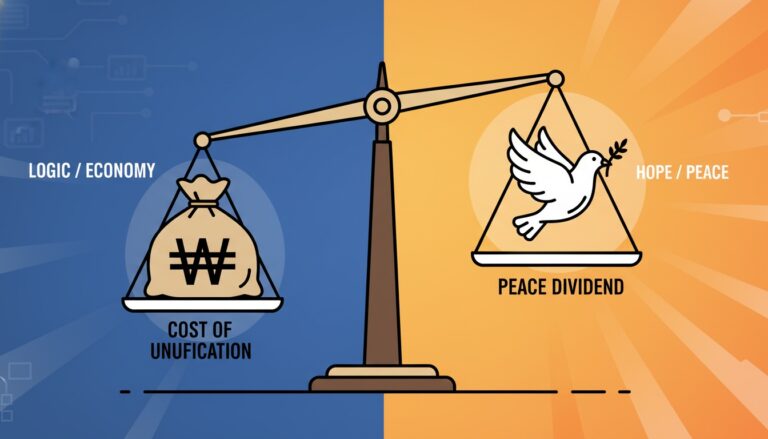
- Editor’s Insight: Koreans rarely say “very expensive” (비싸다) when talking about unification infrastructure. We say 천문학적 (astronomical). It conveys the overwhelming scale of economic burden (taxes, infrastructure integration) that scares the younger generation.
- Situation Check: News/Debate. Widely used when discussing the downside of unification.
3. 평화 배당금 (Peace Dividend)
- Pronunciation: Pyeong-hwa bae-dang-geum [Sounds like: Pyung-hwa be-dang-geum]
- Meaning: Economic benefits resulting from a decrease in defense spending.
- Editor’s Insight: This is the counter-argument to #2. If you want to argue for unification, you mention this. It implies that the money saved from reduced military tension can be reinvested into the economy. Dropping this term proves you are C2 level.
- Situation Check: Economic/Political Analysis.
Phase 3: Textbook vs. Real Life (The C2 Nuance)
At this level, it’s about shifting from “Textbook Correct” to “News Anchor/Analyst Natural.”
| Textbook / Standard (B1-B2) | Real Life / Advanced Analyst (C2) |
|---|---|
| 통일하면 돈이 많이 들어요. (Unification costs a lot of money.) |
막대한 초기 투자 비용이 불가피하죠. (Massive initial investment costs are inevitable.) |
| 남한과 북한은 사이가 복잡해요. (South and North have a complicated relationship.) |
남북은 이중적인 성격을 띠고 있습니다. (The two Koreas possess a dual nature [enemy & partner].) |
| 통일은 경제에 도움이 될 거예요. (Unification will help the economy.) |
장기적으로 코리아 디스카운트 해소에 기여하겠죠. (Long-term, it will contribute to resolving the ‘Korea Discount’.) |
Editor’s Note: “Korea Discount” (코리아 디스카운트) is a real economic term used in Korea referring to the undervaluation of Korean stocks due to the geopolitical risk of the North.
Phase 4: Cultural Context & Manners
The Generational Divide (세대 갈등)
When discussing this topic, “Read the Room” (눈치) is vital.
- With the Older Generation (60s+): Many view unification as a 당위 (moral imperative). They might have roots in the North or lived through the war. Focusing too much on the “cost” can seem cold-hearted. Acknowledge the emotional aspect first.
- With the Younger Generation (20s-30s): They are pragmatists. To them, the 세금 폭탄 (tax bomb) is a real fear. It is acceptable and common to discuss the economic downsides openly. Approaching it purely emotionally might make you seem out of touch with reality.
Non-verbal Tip: When making a strong political point, use the “Open Hand Chop”. Gently chopping your hand on the table (palm open, not a fist) emphasizes logic and determination without being aggressive.
Phase 5: Real-Life Scenario (Roleplay)
Setting: A casual discussion at a university cafe between a foreign PhD student and a Korean Political Science major.
Characters:
* Mark (Foreigner): C2 level, researching East Asian politics.
* Minji (Korean): Skeptical about immediate unification.
Dialogue:
Mark: (taking a sip of coffee)
최근 여론조사를 보면, 젊은 층일수록 통일 비용에 대한 부담감이 큰 것 같아.
(Choe-geun yeo-ron-jo-sa-reul bo-myeon, jeol-meun cheung-il-su-rok tong-il bi-yong-e dae-han bu-dam-gam-i keun geot ga-ta.)
Looking at recent polls, it seems the younger generation feels a greater burden regarding unification costs.
Minji: (nodding seriously)
맞아. 솔직히 말해서 천문학적인 세금을 우리가 다 감당해야 하잖아. ‘평화 배당금’은 너무 먼 미래 얘기 같고.
(Ma-ja. Sol-jik-hi mal-hae-seo cheon-mun-hak-jeok-in se-geum-eul u-ri-ga da gam-dang-hae-ya ha-ja-na. ‘Pyeong-hwa bae-dang-geum’-eun neo-mu meon mi-rae yae-gi gat-go.)
Right. Honestly speaking, we have to shoulder astronomical taxes. The ‘Peace Dividend’ feels like a story in the distant future.
Mark: (leaning in)
하지만 분단 비용도 무시할 순 없지. 지정학적 리스크 때문에 한국 경제가 저평가되는 것도 사실이니까.
(Ha-ji-man bun-dan bi-yong-do mu-si-hal sun eop-ji. Ji-jeong-hak-jeok ri-seu-keu ttae-mun-e Han-guk gyeong-je-ga jeo-pyeong-ga-doe-neun geot-do sa-sil-i-ni-kka.)
But you can’t ignore the cost of division. It is true that the Korean economy is undervalued due to geopolitical risks.
Minji:
와, 마크. 너 진짜 한국 뉴스 앵커처럼 말한다. 인정!
(Wa, Mark. Neo jin-jja Han-guk nyu-seu aeng-keo-cheo-reom mal-han-da. In-jeong!)
Wow, Mark. You really speak like a Korean news anchor. I admit it!
Phase 6: 10-Second Shadowing Drill
Read this aloud. Focus on the pauses / to sound like a professional analyst.
“통일 비용이 부담스러운 건 사실이지만, / 눈에 보이지 않는 분단 비용과 / 안보 리스크도 함께 고려해야 합니다.”
- Romanization: Tong-il bi-yong-i bu-dam-seu-reo-un geon sa-sil-i-ji-man, / nun-e bo-i-ji an-neun bun-dan bi-yong-gwa / an-bo ri-seu-keu-do ham-kke go-ryeo-hae-ya ham-ni-da.
- Meaning: It is true that unification costs are burdensome, but we must also consider the invisible costs of division and security risks.
Phase 7: FAQ & Troubleshooting
Q: Can I use the word “빨갱이 (Commie)” casually?
A: ABSOLUTELY NOT. This is a highly offensive, politically charged slur used to attack people’s ideologies. Using this can instantly ruin a relationship or cause a fight. Stick to neutral terms like 진보 (Progressive) or 보수 (Conservative).
Q: Is it okay to ask North Korean defectors about their escape?
A: Generally, no. Unless you are very close, it is considered trauma. If you meet a Saeteomin (새터민 – Defector/Refugee), simply treat them as a neighbor. If the topic of “unification” comes up, focus on the future, not their painful past.
Phase 8: Wrap-up
One-Liner Summary:
Don’t just say “It’s expensive”; talk about “Astronomical Costs (천문학적 비용)” vs. “Peace Dividend (평화 배당금)” to sound like a sophisticated intellectual.
Action Mission:
Read a Korean editorial (사설) headline regarding North Korea today. Find the word “리스크” (Risk) or “합의” (Consensus) and see how it’s used in a sentence.
Editor’s Question:
If you had to vote on Korean Unification today based on the “Cost vs. Benefit,” which side would you choose? Let me know in the comments!
Phase 9: Pop Quiz
1. Which term describes the benefit of reduced military spending after unification?
A) 통일세 (Unification Tax)
B) 평화 배당금 (Peace Dividend)
C) 분단 비용 (Division Cost)
2. How would a C2 speaker describe the “huge” cost of unification?
A) 아주 비싼 비용 (Very expensive cost)
B) 천문학적인 비용 (Astronomical cost)
C) 나쁜 비용 (Bad cost)
3. Which term best explains the legal and political duality of North-South relations?
A) 남북 관계의 특수성 (Uniqueness of Inter-Korean relations)
B) 남북 관계의 단순성 (Simplicity of Inter-Korean relations)
C) 남북 관계의 우정 (Friendship of Inter-Korean relations)
(Answers: 1-B, 2-B, 3-A)
Frequently Asked Questions (FAQ)
Q: What does "남북 관계의 특수성 (The distinct nature of Inter-Korean relations)" mean in Korean and how do you pronounce it?
A: In Korean, "남북 관계의 특수성 (The distinct nature of Inter-Korean relations)" is pronounced [Nam-buk gwan-gye-ui teuk-su-seong [Sounds like: Nam-book gwan-gye-eh teuk-soo-sung] and means: The unique/special nature of North-South relations.
Q: What does "천문학적인 통일 비용 (Astronomical unification costs)" mean in Korean and how do you pronounce it?
A: In Korean, "천문학적인 통일 비용 (Astronomical unification costs)" is pronounced [Cheon-mun-hak-jeok-in tong-il bi-yong [Sounds like: Chun-moon-hak-jug-in tong-il bee-yong] and means: Astronomical (enormous) costs of unification.
Q: What does "평화 배당금 (Peace Dividend)" mean in Korean and how do you pronounce it?
A: In Korean, "평화 배당금 (Peace Dividend)" is pronounced [Pyeong-hwa bae-dang-geum [Sounds like: Pyung-hwa be-dang-geum] and means: Economic benefits resulting from a decrease in defense spending.







